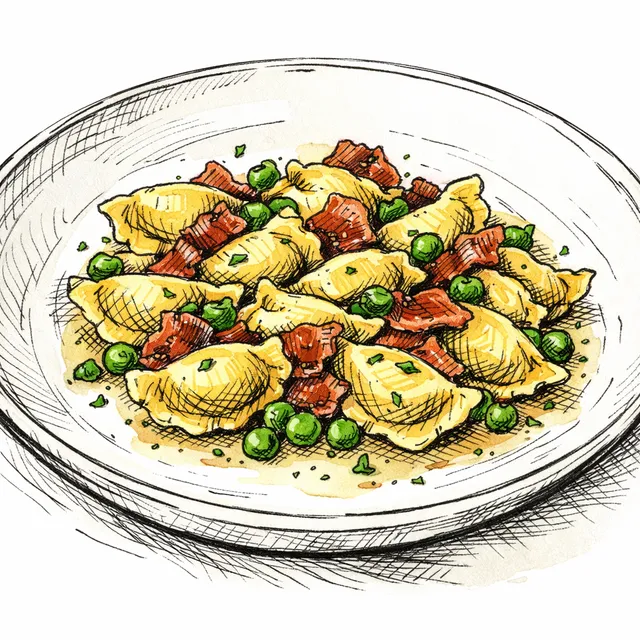
The Piedmontese Plin: Sweet Pea and Lemon Agnolotti with Crispy Prosciutto
While I usually champion effortless modern weeknights, a quiet spring weekend in Milan calls for returning to my foundation. This recipe is a structural homage to my grandmother. She would sit at her flour-dusted table in Piedmont, rhythmically pinching tiny pockets of dough. She called it 'making the plin.' To her, it was tradition; to my architect's eye, it is pure engineering. That tiny fold creates a load-bearing pocket designed specifically to cradle sauce. Today, I balance her old-world patience with my fast-paced metropolitan reality. These delicate hand-pinched agnolotti enclose a structurally sound filling of sweet spring peas, lemon, and bright ricotta. I bathe them in my signature dry vermouth and fresh sage brown butter, allowing the glossy sauce to pool in those clever architectural folds. The crispy prosciutto acts as the perfect decorative facade, offering a salty crunch against the delicate pasta. What makes this recipe so special to me is how it captures the essence of Northern Italian elegance from the ground up. Make it your own by swapping the prosciutto for crushed toasted hazelnuts for a warm, vegetarian crunch. Remember, build a solid foundation and let the ingredients do the heavy lifting.
Featured Recipe
The Piedmontese Plin: Sweet Pea and Lemon Agnolotti with Crispy Prosciutto
On busy weeknights, I rely on culinary shortcuts, but an elegant spring weekend dinner is the time to build a masterpiece from the ground up. These delicate, hand-pinched agnolotti enclose a structurally sound filling of sweet spring peas and bright ricotta, all bathed in my signature dry vermouth and sage brown butter. The 'plin' (the pinch) creates a clever architectural pocket that perfectly catches the glossy, slow-simmered sauce.
Save a copy to your collection for editing
Timeline
Ingredients
- 2 cups "00" flour(Plus extra for dusting)
- 3 large eggs(Room temperature)
- 1 tbsp olive oil(High quality extra virgin)
- 1.5 cups fresh spring peas(Shelled. High-quality frozen peas can substitute if out of season.)
- 1 cup whole milk ricotta(Well-drained; this is crucial for structural integrity)
- 1/2 cup Parmigiano-Reggiano(Freshly grated, plus more for serving)
- 1 tsp lemon zest(Freshly grated)
- 3 oz prosciutto(Thinly sliced)
- 4 tbsp unsalted butter
- 8 fresh sage leaves
- 1/4 cup dry vermouth(My signature deglazing agent)
- 1/4 cup premium chicken brodo(Store-bought is perfectly fine here)
- generous pinch salt(mentioned in step 4)
Instructions
- 1
On the counter, create a well with 2 cups "00" flour. Crack in 3 large eggs and add 1 tbsp olive oil. Using a fork, gradually incorporate the flour from the inner walls until a shaggy dough forms. Knead by hand for 10 minutes until you have a smooth, elastic foundation.
10 min
Tip: If the dough feels too dry, wet your hands slightly and continue kneading. Do not add water directly.
- 2
Wrap the dough tightly in plastic wrap and let it rest at room temperature. This relaxes the gluten network, ensuring our pasta sheets will be structurally sound and won't tear during the rolling phase.
30 min
Tip: Never skip the resting phase; the dough must hydrate fully to be pliable.
- 3
While the dough rests, drop 1.5 cups fresh spring peas into a pot of boiling salted water. Blanch for 2 minutes until just tender, then immediately drain and rinse under ice-cold water to lock in their vibrant, decorative green color.
5 min
Tip: The ice bath halts the cooking process, ensuring the filling doesn't turn mushy.
- 4
In a food processor, combine the blanched peas, 1 cup whole milk ricotta, 1/2 cup Parmigiano-Reggiano, 1 tsp lemon zest, and a generous pinch of salt. Pulse until combined but still retaining a bit of texture. The well-drained ricotta is our load-bearing ingredient here—if it's too wet, it will compromise the pasta's integrity.
5 min
Tip: Transfer the filling to a piping bag or a zip-top bag with the corner snipped off for precise assembly later.
- 5
Place 3 oz prosciutto in a large, cold skillet over medium heat. Cook until crispy and the fat has rendered. Remove the prosciutto to a paper towel, but leave the savory rendered fat in the pan—this acts as the flavor foundation for our pan sauce.
10 min
Tip: Starting the prosciutto in a cold pan allows the fat to render slowly and evenly without burning.
- 6
Cut the rested dough into four pieces. Keep three covered so they don't dry out. Run the first piece through your pasta machine, starting at the widest setting and working down to the second-thinnest setting to create a long, elegant facade of dough.
15 min
Tip: Lightly dust the dough with flour as needed to prevent sticking to the rollers.
- 7
Pipe small mounds of the pea filling (about a teaspoon each) along the bottom half of the pasta sheet, spacing them an inch apart. Fold the top half of the dough over the filling, pressing out all the air. Now for the 'plin'—pinch the dough firmly between each mound of filling, then run a fluted pastry wheel along the long edge and between the pinches to separate them into neat little parcels.
20 min
Tip: Pressing the air out is critical; air pockets will expand and burst the pasta in the boiling water.
- 8
Bring a large pot of generously salted water to a boil. Meanwhile, return the prosciutto skillet to medium heat and melt 4 tbsp unsalted butter along with 8 fresh sage leaves.
5 min
Tip: The water should taste pleasantly briny, like the sea.
- 9
Once the butter turns a nutty golden brown and the sage is fragrant, deglaze the pan with 1/4 cup dry vermouth and 1/4 cup premium chicken brodo. Let the ingredients do the heavy lifting as they bubble together into a glossy, unified emulsion.
3 min
Tip: Swirl the pan rather than stirring to help the fats and liquids emulsify naturally.
- 10
Drop the fresh agnolotti into the boiling water. Because their construction is delicate but sound, they will only take about 2 minutes to cook, floating to the surface when they are ready.
2 min
Tip: Don't overcrowd the pot; boil them in two batches if necessary.
- 11
Using a slotted spoon, transfer the agnolotti directly into the vermouth-sage butter. Toss gently to coat, allowing the sauce to pool into the little structural pockets created by the 'plin'. Serve immediately, crowned with the crumbled crispy prosciutto and an extra shower of Parmigiano-Reggiano.
2 min
Tip: A splash of pasta water can be added to the skillet if the sauce needs loosening.
Chef's Notes
The beauty of agnolotti dal plin lies entirely in its architecture. The 'plin'—the physical pinch between the pockets of filling—creates a built-in reservoir designed expressly to scoop up pan sauces. While weeknights are for high-quality dried pasta, dedicating a spring weekend afternoon to forming these parcels connects me deeply to my grandmother's Piedmontese roots. Remember, structural integrity begins with the ricotta: it must be thoroughly drained, or its moisture will collapse your pasta foundation.

Elena Rossi
Effortless Northern Italian elegance for busy modern weeknights.
Milan-born Elena Rossi, her true passion was always simmering on the stove. Raised on the rich, comforting flavors of her grandmother's Piedmontese kitchen, Elena found herself constantly reimagining those time-intensive classics for her own demanding, fast-paced lifestyle. Today, Elena is the voice behind a beloved culinary movement that proves authentic Italian food does not require spending eight hours stirring a pot. She beautifully merges the precision of her design background with the soul of Northern Italian cooking, offering busy home cooks a stylish, stress-free approach to dinner. Whether she is utilizing a pressure cooker for a Tuesday night osso buco or elevating a high-quality store-bought brodo with fresh herbs, Elena empowers her readers to cook with confidence. Her recipes are a testament to the idea that practicality and elegance can perfectly coexist on the modern dinner table.