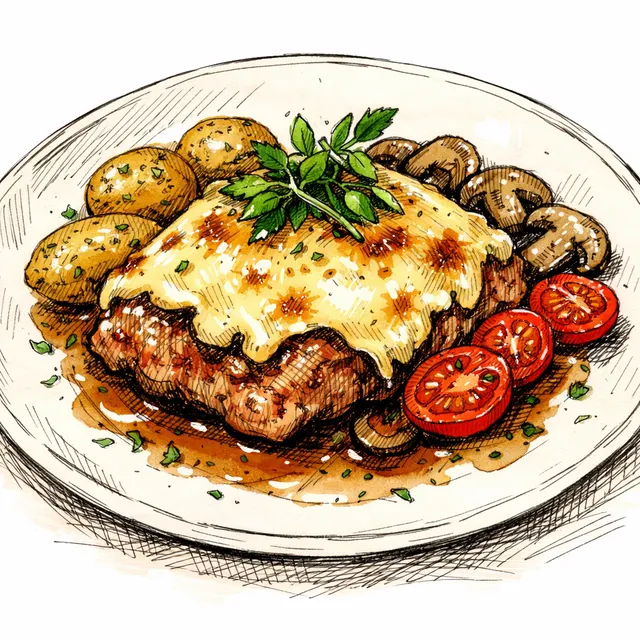
The Alpine Facade: Pan-Fried Veal with a Fontina Canopy
As an architect, I appreciate a building with a solid foundation and a striking roofline. My grandmother's Piedmontese kitchen taught me that cooking requires the exact same structural integrity. Today, I am sharing The Alpine Facade, a recipe born from my nostalgia for those crisp mountain evenings, beautifully retrofitted for our fast-paced Milanese weeknights. The foundation of this dish is a flawless, pan-fried veal cutlet, dredged lightly to ensure structural crispness. Upon this, we layer a load-bearing sheet of Prosciutto di San Daniele, topped with a gorgeous, melting canopy of Fontina cheese. I vividly remember my grandmother carefully tending to veal cutlets by the old stove, a process that took her all afternoon. For our modern reality, a quick high-heat sear and a brief finish under the broiler achieves that same profound flavor in minutes. What makes this recipe so special is its brilliant simplicity. To make it your own, add a decorative flourish of fried fresh sage or a splash of dry vermouth to the pan drippings. Remember, weeknight cooking should feel like an escape, not a chore. Let the ingredients do the heavy lifting while you pour yourself a glass of Barbaresco and admire your culinary architecture.
Featured Recipe
The Alpine Facade: Pan-Fried Veal with a Fontina Canopy
An elegant Northern Italian classic, engineered for the modern weekend. Crisp, pan-fried veal cutlets form a flawless structural foundation, topped with a load-bearing layer of Prosciutto di San Daniele and a melting canopy of Fontina. Let the ingredients do the heavy lifting while you enjoy a glass of Barbaresco.
Save a copy to your collection for editing
Timeline
Ingredients
- 4 pieces veal cutlets(About 1 lb total, pounded to 1/4-inch thickness)
- 1 tsp sea salt(For seasoning the veal)
- 1/2 tsp black pepper(Freshly ground)
- 1/2 cup all-purpose flour(For dredging)
- 2 large eggs(Lightly beaten)
- 1 cup coarse breadcrumbs(Panko works brilliantly for maximum structural crunch)
- 1/2 cup Parmigiano-Reggiano(Finely grated, to mix into the breading)
- 3 tbsp unsalted butter(Divided (2 tbsp for frying, 1 tbsp for the pan glaze))
- 2 tbsp extra virgin olive oil(For frying)
- 4 slices Prosciutto di San Daniele(Thinly sliced)
- 4 slices Fontina cheese(True Fontina Val d'Aosta if you can find it)
- 1/4 cup dry vermouth(For deglazing)
- 6 leaves fresh sage leaves(For the aromatic finish)
Instructions
- 1
Preheat your broiler to high. Establish your breading assembly line in three shallow dishes: place 1/2 cup all-purpose flour in the first, beat 2 large eggs in the second, and whisk together 1 cup coarse breadcrumbs and 1/2 cup grated Parmigiano-Reggiano in the third. This three-part system ensures the breading bonds permanently to the protein.
5 min
Tip: Adding Parmigiano directly to the breadcrumbs builds structural flavor right into the facade of the cutlet.
- 2
Season 4 veal cutlets evenly with 1 tsp sea salt and 1/2 tsp black pepper. Dredge each piece first in the flour (shaking off the excess), then submerge in the eggs, and finally press firmly into the breadcrumb mixture. The pressure you apply here is crucial; you want a completely solid, unbroken exterior.
5 min
Tip: Rest the breaded cutlets on a wire rack for a few minutes if you have time—it helps the crust set like curing concrete.
- 3
In a heavy skillet—preferably carbon steel or cast iron—heat 2 tbsp unsalted butter and 2 tbsp extra virgin olive oil over medium-high heat until the butter foams and begins to subside. The combination of oil and butter raises the smoke point while preserving that essential dairy richness.
3 min
Tip: Wait for the foam to subside before adding the meat; this is the visual cue that the water has evaporated and the temperature is right for searing.
- 4
Working in batches if necessary to avoid overcrowding, pan-fry the veal for about 3 to 4 minutes per side until the breading transforms into a deep, golden-brown crust. Transfer the finished cutlets to a foil-lined baking sheet.
8 min
Tip: Do not fiddle with the cutlets while they sear. A crisp, load-bearing crust requires uninterrupted contact with the heat.
- 5
Assemble the vault: Drape 4 slices Prosciutto di San Daniele neatly over the crispy cutlets, then top each with 4 slices Fontina cheese. Place the baking sheet under the preheated broiler.
2 min
Tip: Keep the prosciutto strictly within the perimeter of the cutlet to prevent the delicate edges from burning under the broiler.
- 6
Broil the cutlets for 2 to 3 minutes, watching them like a hawk. You want the Fontina to melt into a bubbling, golden canopy that binds the prosciutto to the crispy veal foundation.
3 min
Tip: Leave the oven door cracked slightly if your broiler is particularly aggressive.
- 7
While the cutlets broil, return your skillet to medium heat. Pour in 1/4 cup dry vermouth to deglaze, scraping up any browned architectural remnants from the frying process. Toss in 6 fresh sage leaves and the remaining 1 tbsp unsalted butter. Swirl until it reduces into a glossy, fragrant emulsion.
4 min
Tip: The vermouth's botanicals will cut right through the richness of the fried veal and melted cheese.
- 8
Transfer the bubbling, melted cutlets to warm plates. Spoon the quick vermouth and crisp sage glaze selectively around the base of the cutlets rather than over the top, preserving the integrity of that beautiful, crispy facade. Serve immediately.
2 min
Tip: A sharp knife and a glass of Nebbiolo are the only required accompaniments.
Chef's Notes
This dish takes its inspiration from the classic Cotoletta alla Valdostana, but deconstructs the traditional stuffing method. By treating the prosciutto and cheese as a structural roof rather than a hidden interior, we maintain the absolute crispness of the breaded veal. Remember my rule for weekend cooking: let the ingredients do the heavy lifting.

Elena Rossi
Effortless Northern Italian elegance for busy modern weeknights.
Milan-born Elena Rossi, her true passion was always simmering on the stove. Raised on the rich, comforting flavors of her grandmother's Piedmontese kitchen, Elena found herself constantly reimagining those time-intensive classics for her own demanding, fast-paced lifestyle. Today, Elena is the voice behind a beloved culinary movement that proves authentic Italian food does not require spending eight hours stirring a pot. She beautifully merges the precision of her design background with the soul of Northern Italian cooking, offering busy home cooks a stylish, stress-free approach to dinner. Whether she is utilizing a pressure cooker for a Tuesday night osso buco or elevating a high-quality store-bought brodo with fresh herbs, Elena empowers her readers to cook with confidence. Her recipes are a testament to the idea that practicality and elegance can perfectly coexist on the modern dinner table.