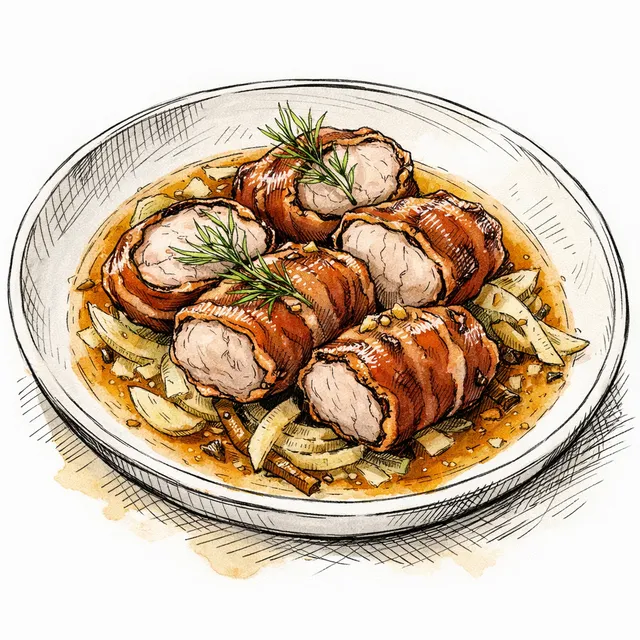
The Parmense Vault: Prosciutto-Wrapped Pork Tenderloin with Vermouth and Fennel
Think of this dish as the structural upgrade to a traditional Sunday roast, scaled down for effortless execution. Growing up, my grandmother would spend hours slow-braising pork in her Piedmontese kitchen, the rich aroma anchoring the entire house. But in my fast-paced metropolitan reality, time is a luxury. The inspiration for this Parmense Vault came from marrying her rustic, slow-simmered flavors with the sleek efficiency of modern Milanese design. We wrap tender pork in a load-bearing layer of Prosciutto di Parma, sear it to build an unbreakable foundation of flavor, and quick-braise it with dry vermouth and crisp spring fennel. The prosciutto seals in the juices, acting much like a protective vault. What makes this recipe so special to me is how a simple 30-minute weeknight meal can still evoke the warmth of my nonna's old-world kitchen. To make it your own, consider swapping the fennel for a visual handful of fresh sage, or finish the pan sauce with a knob of premium compound butter for decorative richness. Remember, weeknight cooking should feel like an escape, not a chore. Pour yourself a glass of wine and let the ingredients do the heavy lifting.
Featured Recipe
The Parmense Vault: Prosciutto-Wrapped Pork Tenderloin with Vermouth and Fennel
Think of this as the structural upgrade to a traditional Sunday roast, scaled down for effortless execution. We wrap tender pork in a load-bearing layer of Prosciutto di Parma, sear it to build an unbreakable foundation, and quick-braise it in dry vermouth and crisp spring fennel. Let the ingredients do the heavy lifting while you pour yourself a glass of wine.
Save a copy to your collection for editing
Timeline
Ingredients
- 6 slices Prosciutto di Parma(Thinly sliced, ensuring it can wrap tightly)
- 12 leaves Fresh sage leaves(Large, beautiful leaves for the foundation)
- 1 lb lb Pork tenderloin(Silver skin removed, patted thoroughly dry)
- 1/2 tsp tsp Cracked black pepper(Divided use; skip the salt as the prosciutto provides plenty)
- 1 medium Fennel bulb(Trimmed and cut into 1/2-inch structural wedges)
- 2 tbsp tbsp Extra virgin olive oil(High quality, for searing)
- 1/2 cup cup Dry vermouth(Crucial for deglazing and flavor building)
- 1/2 cup cup Premium vegetable brodo(Store-bought premium quality works brilliantly)
- 3 tbsp tbsp Unsalted butter(Very cold and cubed, for the final emulsion)
Instructions
- 1
On a clean work surface, lay out 6 slices Prosciutto di Parma slightly overlapping to form a continuous sheet. Place 12 leaves Fresh sage leaves evenly across the prosciutto. Lay 1 lb Pork tenderloin in the center, season the meat with 1/4 tsp Cracked black pepper, and roll the prosciutto tightly around the pork. This creates a load-bearing exterior that protects the meat and crisps beautifully.
5 min
Tip: Make sure the tenderloin is very dry before wrapping, otherwise the prosciutto won't adhere properly.
- 2
Prepare your mise en place by slicing 1 medium Fennel bulb into thick, structural wedges. Having this ready allows you to manage the searing process without distraction.
5 min
Tip: Keep the core intact when slicing the fennel so the wedges don't fall apart in the pan.
- 3
Heat 2 tbsp Extra virgin olive oil in a large, heavy-bottomed skillet over medium-high heat. Once shimmering, place the wrapped pork in the pan seam-side down to lock the foundation in place. Sear for about 8 minutes, turning occasionally, until the prosciutto is crispy, golden, and fully adhered all over.
8 min
Tip: Do not rush the sear; the crispy prosciutto is the architectural highlight of this dish.
- 4
Transfer the seared pork to a plate. In the same skillet, leaving the rendered fat, arrange the fennel wedges in a single layer and sprinkle with the remaining 1/4 tsp Cracked black pepper. Sear undisturbed for 5 minutes until beautifully caramelized edges form.
5 min
Tip: Let the fennel sit without moving it to develop a proper crust.
- 5
Pour in 1/2 cup Dry vermouth to deglaze the hot pan, using a wooden spoon to scrape up the savory fond. Add 1/2 cup Premium vegetable brodo. Return the pork to the skillet resting on the fennel, reduce the heat to a gentle simmer, cover, and quick-braise for 10 minutes. The steam and liquid will perfectly cook the tenderloin while softening the fennel.
10 min
Tip: Use a meat thermometer; you are looking for an internal temperature of 140°F for a perfect, juicy blush.
- 6
Remove the pork to a cutting board to rest, ensuring the juices redistribute. Leave the skillet uncovered over medium heat to let the liquid reduce for 4 minutes. Turn off the heat entirely and vigorously swirl in 3 tbsp Unsalted butter until the sauce becomes a glossy, emulsified glaze coating the fennel.
5 min
Tip: The butter must be very cold to properly emulsify into the sauce without breaking.
- 7
Slice the rested pork into thick medallions. Serve arranged elegantly over the braised fennel, and spoon the glossy vermouth-sage reduction generously over the entire plate.
2 min
Tip: Serve immediately while the prosciutto crust retains its texture.
Chef's Notes
Growing up, Sunday roasts in my grandmother's Piedmontese kitchen took hours, relying on slow, methodical heat. In my modern Milanese kitchen, we don't always have a whole Sunday to spare. By applying that same quick-braising architecture to a naturally tender cut like pork tenderloin, we achieve profound flavor and structural integrity in a fraction of the time. The dry vermouth and premium brodo act as our shortcut to an all-day slow-simmered taste.

Elena Rossi
Effortless Northern Italian elegance for busy modern weeknights.
Milan-born Elena Rossi, her true passion was always simmering on the stove. Raised on the rich, comforting flavors of her grandmother's Piedmontese kitchen, Elena found herself constantly reimagining those time-intensive classics for her own demanding, fast-paced lifestyle. Today, Elena is the voice behind a beloved culinary movement that proves authentic Italian food does not require spending eight hours stirring a pot. She beautifully merges the precision of her design background with the soul of Northern Italian cooking, offering busy home cooks a stylish, stress-free approach to dinner. Whether she is utilizing a pressure cooker for a Tuesday night osso buco or elevating a high-quality store-bought brodo with fresh herbs, Elena empowers her readers to cook with confidence. Her recipes are a testament to the idea that practicality and elegance can perfectly coexist on the modern dinner table.