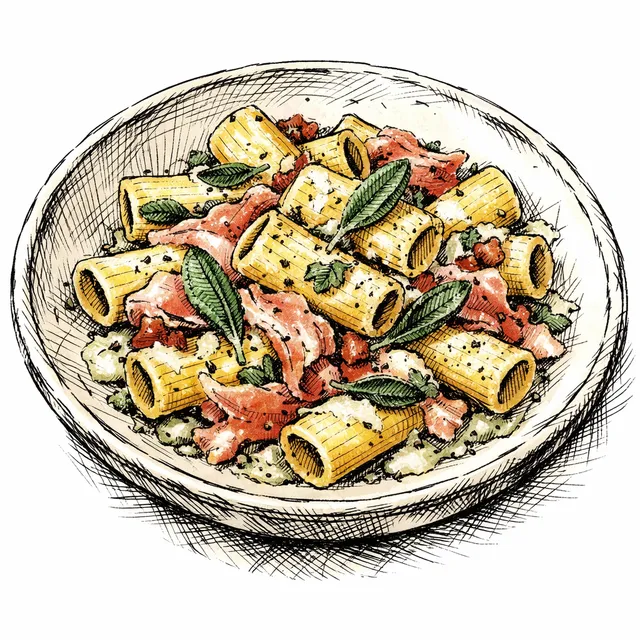
The Ricotta Mortar: Building Fast, Elegant Rigatoni
In architecture, the mortar is just as vital as the bricks it binds. Growing up, I watched my grandmother spend hours stirring rich ragùs in her Piedmontese kitchen, but my fast-paced Milanese reality requires a different blueprint. The inspiration for 'The Ricotta Mortar' struck while sketching a brutalist facade in the Navigli district. I realized that weeknight cooking, much like modern design, requires a solid foundation of a few high-quality components rather than unnecessary complexity. Tonight, we rely on a luxurious, load-bearing emulsion of fresh ricotta, starchy pasta water, and my signature splash of dry vermouth to seamlessly fuse hearty rigatoni 'columns' together. Prosciutto acts as our structural steel, crisp and savory, while fresh sage provides the perfect decorative flourish. This recipe is special to me because it bridges nostalgic flavors with our modern need for speed. Through a rapid boil and an aggressive pan-toss, this effortless masterpiece comes together in minutes. To make it your own, consider swapping prosciutto for speck, or melting in some sage compound butter for extra depth. Remember, my friends, keep your foundations strong, and let the ingredients do the heavy lifting. Weeknight cooking should feel like an escape, not a chore.
Featured Recipe
The Ricotta Mortar: Pan-Tossed Rigatoni with Prosciutto and Sage Emulsion
In architecture, the mortar is just as vital as the bricks it binds. Tonight, we rely on a luxurious, load-bearing emulsion of fresh ricotta, starchy pasta water, and my signature dry vermouth to seamlessly fuse hearty rigatoni 'columns' together. Through a rapid boil and an aggressive pan-toss, this effortless weeknight masterpiece comes together in minutes, proving once again that we must let the ingredients do the heavy lifting.
Save a copy to your collection for editing
Timeline
Ingredients
- 1 lb Rigatoni(Bronze-die extruded, for texture)
- 1.5 cups Whole Milk Ricotta(Fresh and high quality; this is our structural foundation)
- 4 oz Prosciutto di Parma(Torn into bite-sized ribbons)
- 2 tbsp Unsalted butter(For crisping the prosciutto)
- 12 Fresh Sage leaves(Left whole)
- 1/4 cup Dry Vermouth(A crucial acidic counterweight)
- 1/2 cup Parmigiano-Reggiano(Finely grated, plus more for the facade)
- 1 tsp Black Pepper(Freshly cracked)
- 2 tbsp Kosher Salt(For the pasta water)
- 1 cup Pasta water(Reserved from the boiling pot)
Instructions
- 1
Fill a large pot with water, add 2 tbsp Kosher Salt, and bring to a rapid boil over high heat. We need a rolling boil to properly agitate the pasta later.
10 min
Tip: Treat your pasta water like the sea; it provides the internal seasoning for the rigatoni.
- 2
While the water heats, combine 1.5 cups Whole Milk Ricotta, 1/2 cup Parmigiano-Reggiano, and 1 tsp Black Pepper in a bowl. Whip vigorously with a fork until airy. This is our mortar.
3 min
Tip: Whipping the ricotta breaks down its curds, creating a smoother emulsion later.
- 3
In a wide, deep skillet, melt 2 tbsp Unsalted butter over medium-high heat. Add 4 oz Prosciutto di Parma and 12 fresh Sage leaves. Sauté until the prosciutto renders and crisps, and the sage becomes fragrant and translucent.
5 min
Tip: Keep a close eye on the sage; it should crisp but retain its deep green hue.
- 4
Pour 1/4 cup Dry Vermouth into the skillet to deglaze, scraping up the caramelized pork foundation from the bottom. Let it reduce by half, then turn off the heat.
2 min
Tip: Vermouth provides a sophisticated botanical acidity that white wine simply cannot match.
- 5
Drop 1 lb Rigatoni into the boiling water. Cook for 2 minutes less than the package instructions dictate for al dente. We will finish the structural integrity of the pasta in the pan.
10 min
Tip: Stir immediately to prevent the 'columns' from sticking together.
- 6
Just before draining, carefully scoop out and reserve 1 cup Pasta water. Drain the pasta.
1 min
Tip: Never rinse your pasta! We need that exterior starch for the emulsion.
- 7
Return the skillet to medium heat. Add the drained pasta, the whipped ricotta mixture, and 1/2 cup Pasta water. Pan-toss aggressively, stirring constantly. The heat, starch, and fat will bind together. If it looks too thick, add the remaining 1/2 cup Pasta water until a glossy, clinging mortar forms.
3 min
Tip: The pan-toss is an active, dynamic process. Move the pan back and forth while stirring to force the emulsion.
Chef's Notes
My nonna in Piedmont would have happily spent an entire afternoon hand-rolling tajarin, but in my fast-paced Milanese reality, a high-quality bronze-die rigatoni serves as the perfect prefabricated conduit. By treating the ricotta not as a passive garnish, but as a load-bearing ingredient bound by starchy water, we achieve hours of slow-cooked creaminess in roughly twenty minutes. Weeknight cooking should feel like an escape, an exercise in elegance, rather than a chore.

Elena Rossi
Effortless Northern Italian elegance for busy modern weeknights.
Milan-born Elena Rossi, her true passion was always simmering on the stove. Raised on the rich, comforting flavors of her grandmother's Piedmontese kitchen, Elena found herself constantly reimagining those time-intensive classics for her own demanding, fast-paced lifestyle. Today, Elena is the voice behind a beloved culinary movement that proves authentic Italian food does not require spending eight hours stirring a pot. She beautifully merges the precision of her design background with the soul of Northern Italian cooking, offering busy home cooks a stylish, stress-free approach to dinner. Whether she is utilizing a pressure cooker for a Tuesday night osso buco or elevating a high-quality store-bought brodo with fresh herbs, Elena empowers her readers to cook with confidence. Her recipes are a testament to the idea that practicality and elegance can perfectly coexist on the modern dinner table.