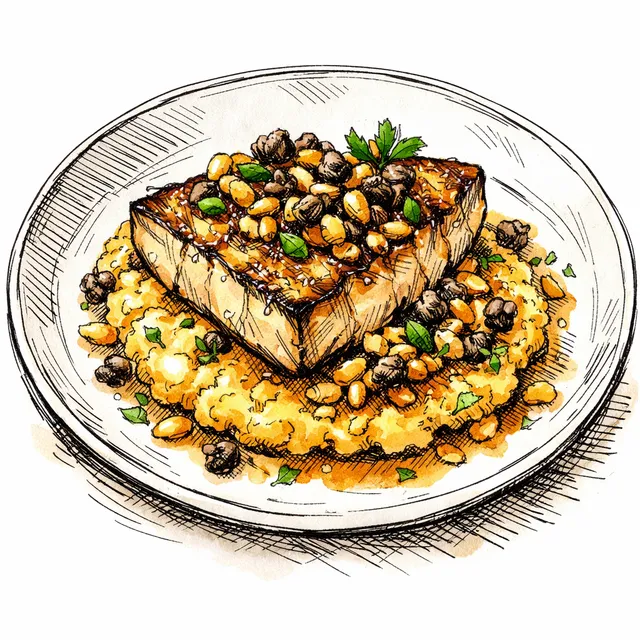
The Tortona Loggia: Gentle Pan-Seared Swordfish with Pine Nut Agrodolce
Walking through Milan's Tortona district during Design Week always leaves me craving clean lines and bold, yet effortless, structure. That aesthetic inspired this dish: The Tortona Loggia. Meaty center-cut swordfish steaks get a gentle, golden pan-sear, topped with a glossy white balsamic, toasted pine nut, and crispy caper agrodolce. It rests on a bed of quick-whisked Parmigiano polenta rustica, acting as the ultimate load-bearing base for these vibrant flavors. This recipe reminds me of late autumn evenings spent with my grandmother in Piedmont, where balancing sweet and sour was an art form. What makes this special to me is how it bridges fast-paced metropolitan life with deep culinary heritage. Let the ingredients do the heavy lifting here; use the highest quality pine nuts and crisp your capers until they practically melt on your tongue. For a personal twist, swap the polenta for a quick white bean puree if you are short on time. Weeknight cooking should feel like an escape, never a chore.
Featured Recipe
The Tortona Loggia: Gentle Pan-Seared Swordfish with Pine Nut Agrodolce, Crisped Capers, and Polenta Rustica
Meaty center-cut swordfish steaks are given a gentle, golden pan-sear before being spooned with a glossy white balsamic, toasted pine nut, and crispy caper agrodolce. Resting atop a bed of quick-whisked Parmigiano polenta rustica, this dish brings the poised architectural warmth of Milan's design district straight to the weeknight table in just thirty minutes.
Save a copy to your collection for editing
Timeline
Ingredients
- 2 steaks Center-cut swordfish steaks(About 7 to 8 ounces each, cut 1-inch thick; patted thoroughly dry)
- 1 cup Coarse-ground quick-cooking yellow polenta(Instant or quick-cooking variety for effortless texture)
- 3 cups High-quality vegetable brodo(Store-bought or homemade, unsalted or low-sodium)
- 1 cup Whole milk(Adds structural creaminess to the polenta base)
- 0.75 cup Parmigiano-Reggiano(Freshly and finely grated; aged 24 months preferred)
- 4 tbsp Unsalted European butter(Divided; high butterfat creates a velvety emulsion)
- 2.5 tbsp Extra virgin olive oil(Divided)
- 3 tbsp Pine nuts(Toasted gently until fragrant and golden)
- 2 tbsp Nonpareil capers(Drained and patted dry with paper towels)
- 1 small Shallot(Finely minced)
- 0.25 cup Dry white vermouth(Italian dry vermouth, such as Carpano or Martini Bianco)
- 2 tbsp White balsamic vinegar(Delicate sweetness without darkening the pan sauce)
- 1 tsp Acacia honey(Provides structural balance to the acidity)
- 2 tbsp Fresh flat-leaf parsley(Finely chopped, tender leaves and stems)
- 1 tsp Flaky sea salt(Maldon or Cervia salt, to taste)
- 0.5 tsp Freshly cracked white peppercorn(Milder, elegant heat that lets the fish sing)
Instructions
- 1
In a heavy-bottomed saucepan, bring 3 cups vegetable brodo and 1 cup whole milk to a gentle simmer over medium heat. Season with 0.5 tsp flaky sea salt.
4 min
Tip: Milk and brodo together create the perfect architectural scaffolding for a quick polenta that tastes slow-simmered.
- 2
Slowly stream 1 cup quick-cooking yellow polenta into the simmering liquid in a steady, thin ribbon while whisking vigorously to prevent clumps. Reduce heat to low and whisk continuously for 3 minutes until smooth and thickened.
3 min
Tip: Pouring like a fine sand glass ensures zero lumps form.
- 3
Cover the polenta saucepan tightly and let it sit over the lowest possible flame to gently steam, stirring once halfway through.
10 min
Tip: Even quick polenta benefits from this hands-off resting phase to fully hydrate the grain.
- 4
While the polenta rests, dry 2 center-cut swordfish steaks thoroughly with paper towels. Season both sides evenly with remaining 0.5 tsp flaky sea salt and 0.5 tsp freshly cracked white peppercorn.
2 min
Tip: Surface moisture is the enemy of a gentle, golden crust; make sure the steaks are bone dry.
- 5
Set a large stainless steel or enameled cast iron skillet over medium heat. Add 1.5 tbsp extra virgin olive oil and 1 tbsp unsalted European butter. Once the foam subsides, add 2 tbsp nonpareil capers and fry for 2 minutes until blistered and crisp. Remove capers with a slotted spoon to a small dish, leaving the fragrant oil in the skillet.
3 min
Tip: Crisping the capers first perfumes the cooking fat with a bright, saline depth.
- 6
Increase heat slightly to medium-high. Lay the seasoned 2 center-cut swordfish steaks gently into the hot oil. Sear undisturbed for 3 to 4 minutes until a delicate, golden crust forms. Carefully flip and sear the other side for another 3 minutes until just cooked through to a tender medium.
7 min
Tip: Do not rush or overheat; swordfish possesses dense muscular structure and should be seared with gentle authority so it remains juicy.
- 7
Transfer the seared swordfish to a warm plate and tent lightly with foil to rest.
1 min
Tip: Resting lets the juices redistribute evenly throughout the fish.
- 8
Return the skillet to medium heat and add the remaining 1 tbsp extra virgin olive oil and 1 small shallot. Sauté for 1 minute until translucent, then toss in 3 tbsp pine nuts for 1 minute to toast lightly in the shallot oil.
2 min
Tip: Keep the pine nuts moving constantly so they turn golden rather than scorched.
- 9
Deglaze the skillet with 0.25 cup dry white vermouth, scraping up any caramelized bits from the bottom. Simmer for 1 minute until reduced by half, then stir in 2 tbsp white balsamic vinegar and 1 tsp acacia honey. Simmer for 1 minute until syrupy.
2 min
Tip: Vermouth provides the botanical backbone, while white balsamic gives pure agrodolce brilliance without turning the sauce dark.
- 10
Remove skillet from heat. Swirl in 1 tbsp unsalted European butter until a glossy, emulsified pan sauce forms. Fold in the crisped capers from earlier and 2 tbsp fresh flat-leaf parsley.
2 min
Tip: Whisking cold butter off the flame creates a velvety, restaurant-grade emulsion in seconds.
- 11
Uncover the polenta and vigorously fold in remaining 2 tbsp unsalted European butter and 0.75 cup Parmigiano-Reggiano until completely melted, creamy, and spoonable.
2 min
Tip: A final vigorous beat incorporates air, giving Northern Italian polenta its signature pillow-soft drape.
- 12
Spoon a generous pool of creamy polenta onto two warmed shallow dinner plates. Place a rested swordfish steak atop each mound, then spoon the warm pine nut and caper agrodolce sauce generously over the fish and polenta.
2 min
Tip: Warmed plates are an essential, civilized detail—they preserve the luxurious texture of both polenta and fish right to the last bite.
Chef's Notes
When designing a dinner after a frantic day in the studio, I want components that carry their own weight. Swordfish is a wonderfully load-bearing protein—dense, clean, and regal when handled with care. The secret to gentle pan-searing here is resisting excessive heat; let the pan maintain a steady, confident sizzle that toasts the exterior while preserving the steak's interior silkiness. The sweet-sour interplay of white balsamic and vermouth cuts through the rich Parmigiano polenta seamlessly. As I always say, let the ingredients do the heavy lifting.

Elena Rossi
Effortless Northern Italian elegance for busy modern weeknights.
Milan-born Elena Rossi, her true passion was always simmering on the stove. Raised on the rich, comforting flavors of her grandmother's Piedmontese kitchen, Elena found herself constantly reimagining those time-intensive classics for her own demanding, fast-paced lifestyle. Today, Elena is the voice behind a beloved culinary movement that proves authentic Italian food does not require spending eight hours stirring a pot. She beautifully merges the precision of her design background with the soul of Northern Italian cooking, offering busy home cooks a stylish, stress-free approach to dinner. Whether she is utilizing a pressure cooker for a Tuesday night osso buco or elevating a high-quality store-bought brodo with fresh herbs, Elena empowers her readers to cook with confidence. Her recipes are a testament to the idea that practicality and elegance can perfectly coexist on the modern dinner table.