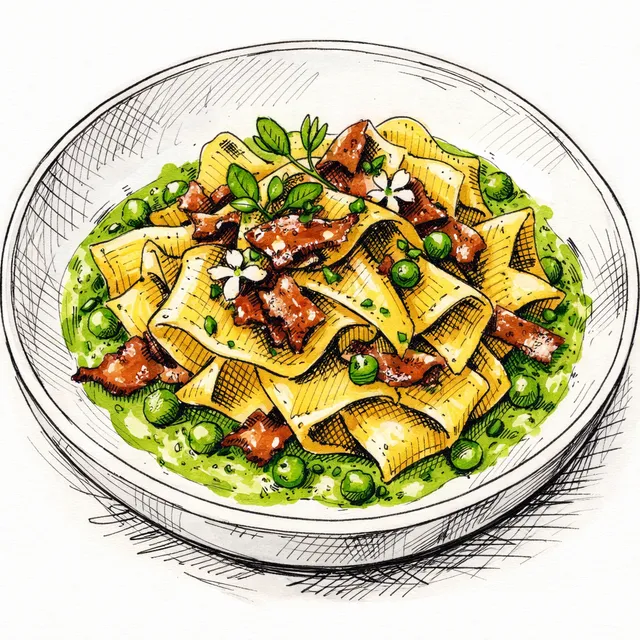
Architect's Spring Pappardelle with Crisp Speck and Sweet Pea Emulsion
In Milan, spring arrives not with a whisper, but with a vibrant flash of green at the markets. This dish is built on a solid foundation of wide pappardelle ribbons, designed specifically to carry a silky, load-bearing emulsion of starchy pasta water, dry vermouth, and robust Parmigiano-Reggiano. We let the sweet peas and crispy speck do the heavy lifting, proving that weeknight elegance requires structure, not hours at the stove.

Save a copy to your collection for editing
Timeline
Ingredients
- 12 ounces Dried pappardelle pasta(The wide architectural foundation of our dish; provides maximum surface area for the emulsion.)
- 4 ounces Speck or high-quality pancetta(Diced. Adds a deep, smoky structural support without the need for a long-simmered meat ragu.)
- 1.5 cups Fresh sweet peas(The hero of the dish. High-quality frozen peas are a perfectly acceptable modern shortcut.)
- 0.33 cup Dry vermouth(A splash of Milanese sophistication that provides crucial structural acidity.)
- 0.5 cup Premium store-bought chicken brodo(Our liquid foundation. Invest in the good stuff; it makes all the difference.)
- 1 cup Parmigiano-Reggiano(Freshly grated to a powdery finish. This is the primary binder for our emulsion.)
- 8 whole Fresh sage leaves(Torn if large. Serves as both an aromatic infuser and a decorative, textural garnish.)
- 1 tablespoon Unsalted butter(Just enough to initiate the fat rendering of the speck.)
- 1 teaspoon Black pepper(Freshly cracked, for the final decorative finish.)
- 2 tablespoons salt(for aggressively salting pasta water)
- 8 cups water(for boiling pappardelle in a large pot)
Instructions
- 1
Drop the 12 ounces Dried pappardelle pasta into a large pot of 2 tablespoons salt aggressively salted boiling 8 cups water. Stir once to prevent sticking, then let the structural foundation of our dish cook until just shy of al dente.
8 min
Tip: The water should taste like the Ligurian Sea. This seasons the pasta from the inside out.
- 2
While the pasta boils, place a large skillet over medium heat. Add the 1 tablespoon Unsalted butter, then the 4 ounces Speck or high-quality pancetta and 8 whole Fresh sage leaves. Cook until the speck renders its fat and the sage becomes crispy.
5 min
Tip: Keep a close eye on the sage; it transitions from perfectly crisp to bitter very quickly.
- 3
Remove the crispy sage leaves and set them aside. Pour the 0.33 cup Dry vermouth into the skillet to deglaze, scraping up any browned bits. Let the vermouth reduce by half, then pour in the 0.5 cup Premium store-bought chicken brodo.
3 min
Tip: The dry vermouth provides a crucial acidic lift that balances the richness of the cured pork fat.
- 4
Lower the heat and gently fold the 1.5 cups Fresh sweet peas into the reducing brodo. We only want to warm them through so they retain their vibrant pop of spring color and delicate texture.
2 min
Tip: If using frozen peas, run them under warm water briefly before adding them to the pan.
- 5
Before draining the pasta, carefully scoop out about a cup of the starchy pasta water. This cloudy liquid is the absolute key to our pan sauce. Drain the 12 ounces Dried pappardelle pasta.
1 min
Tip: Never pour all your pasta water down the drain! It is the load-bearing mortar of Italian cooking.
- 6
Transfer the cooked 12 ounces Dried pappardelle pasta directly into the skillet with the peas and speck. Add a generous splash of the reserved pasta water and begin sprinkling in the 1 cup Parmigiano-Reggiano while tossing vigorously. The mechanical action forces the fat, water, and cheese into a glossy, unified emulsion.
4 min
Tip: If the sauce looks too tight, add another splash of pasta water. Toss like you mean it.
- 7
Divide the pasta among warmed shallow bowls. Top with the reserved crispy sage leaves and a generous crack of 1 teaspoon Black pepper.
1 min
Tip: Serve immediately. Emulsions wait for no one.
Chef's Notes
Remember, a recipe is like a building. The starchy pasta water is your mortar. When you vigorously toss the pappardelle with the reduced vermouth, premium brodo, and Parmigiano, you are engineering a structural emulsion that coats every ribbon. Don't rush this final tossing stage; it is the absolute crux of the dish. My grandmother in Piedmont would have simmered a heavy meat sauce all day, but our modern lives demand clever shortcuts without sacrificing integrity. Let the ingredients do the heavy lifting, and enjoy your evening.
Frequently Asked Questions
How long does Architect's Spring Pappardelle with Crisp Speck and Sweet Pea Emulsion take to make?
Architect's Spring Pappardelle with Crisp Speck and Sweet Pea Emulsion takes about 24 minutes total. That includes 10 minutes of prep and 14 minutes of cooking.
How many servings does this recipe make?
This recipe makes 4 servings.
What skill level is needed for Architect's Spring Pappardelle with Crisp Speck and Sweet Pea Emulsion?
This recipe is rated medium — it's intermediate, requiring some cooking experience.
What ingredients do I need for Architect's Spring Pappardelle with Crisp Speck and Sweet Pea Emulsion?
The main ingredients are: Dried pappardelle pasta, Speck or high-quality pancetta, Fresh sweet peas, Dry vermouth, Premium store-bought chicken brodo, Parmigiano-Reggiano, Fresh sage leaves, Unsalted butter, Black pepper, salt, water.
What type of meal is Architect's Spring Pappardelle with Crisp Speck and Sweet Pea Emulsion?
Architect's Spring Pappardelle with Crisp Speck and Sweet Pea Emulsion is categorized as: dinner.
Ask Elena Rossi a question
Sign in to chat about this recipe, get cooking tips, and ask for substitutions.
Sign in to chat