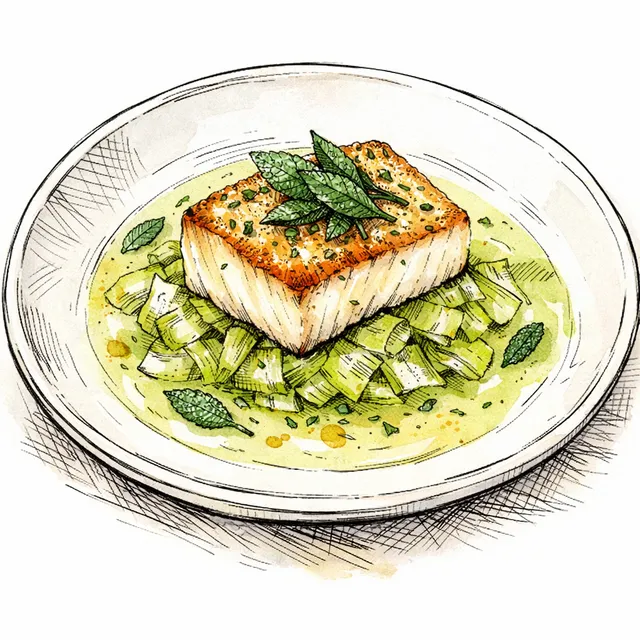
The Cernobbio Solarium: Gentle Pan-Seared Halibut with Melted Leeks and Gavi-Sage Emulsion
Thick, pristine fillets of wild halibut are gently pan-seared to pearlescent perfection and nestled into sweet, buttery melted leeks. Finished with a rapid reduction of crisp Gavi di Gavi and cold mountain butter infused with fresh sage, this dish translates Lake Como's quiet luxury into a streamlined, thirty-minute weeknight triumph.

Save a copy to your collection for editing
Timeline
Ingredients
- 4 fillets skinless halibut fillets(about 6 ounces each, cut uniformly thick)
- 1 tsp flaky sea salt(divided; such as Maldon)
- 0.5 tsp freshly cracked white pepper(divided)
- 2 tbsp extra-virgin olive oil(divided; cold-pressed Ligurian preferred)
- 5 tbsp unsalted European-style butter(cold and cubed, divided)
- 2 large leeks(white and pale green parts only, sliced into 1/4-inch rounds and well washed)
- 2 cloves garlic(lightly crushed but left intact)
- 10 fresh sage leaves(whole)
- 0.5 cup Gavi di Gavi or crisp dry Italian white wine(never cooking wine; choose a bright, mineral Piedmontese white)
- 0.33 cup rich vegetable or light chicken brodo(premium store-bought or homemade)
- 1 tsp fresh lemon zest(finely grated on a microplane)
Instructions
- 1
Using paper towels, pat dry 4 skinless halibut fillets thoroughly to remove all surface moisture, which allows for clean heat transfer. Season both sides evenly with 0.75 tsp flaky sea salt and 0.25 tsp freshly cracked white pepper. Let the fish rest on a plate at room temperature while you begin the leek foundation.
4 min
Tip: Surface dryness is structural when searing delicate white fish; moisture creates steam rather than a pristine, golden seal.
- 2
In a wide stainless steel or enameled skillet, heat 1 tbsp extra-virgin olive oil and 1 tbsp unsalted European-style butter over medium-low heat. Once foamy, add the sliced 2 large leeks, 2 cloves garlic, 0.25 tsp flaky sea salt, and 0.25 tsp freshly cracked white pepper. Sweat gently, stirring frequently, until the leeks are completely translucent, tender, and sweet, about 7 minutes. Transfer the melted leeks to a warmed serving platter, discard the garlic, and cover loosely with foil.
8 min
Tip: Keep the flame moderate—we want the leeks to melt into silky sweetness without taking on bitter browning.
- 3
Wipe out the skillet quickly with a paper towel and place it over medium heat. Add the remaining 1 tbsp extra-virgin olive oil and 1 tbsp unsalted European-style butter. When the foam subsides and begins to shimmer, lay the seasoned 4 skinless halibut fillets into the pan without crowding. Scatter 10 fresh sage leaves into the surrounding butter.
2 min
Tip: Lay the fish into the pan away from you so the hot fat doesn't splash toward your apron.
- 4
Cook the fish undisturbed for 4 minutes until the bottom edges turn opaque and an ivory-gold crust forms. Gently flip the fillets using a thin fish spatula. Continue cooking on the second side for another 3 minutes, tilting the skillet occasionally to spoon the fragrant, sage-infused pan butter directly over the tops of the fish. Transfer the fillets gently to rest atop the bed of warm melted leeks.
5 min
Tip: Halibut is lean; gentle pan-searing with constant butter-basting guarantees a succulent, flaky interior rather than dried flakes.
- 5
Return the skillet to medium-high heat with the crisp sage leaves still inside. Pour in 0.5 cup Gavi di Gavi or crisp dry Italian white wine, scraping up any caramelized fond from the pan with a wooden spoon, and boil rapidly until the wine reduces by half, about 2 minutes. Pour in 0.33 cup rich vegetable or light chicken brodo and simmer for 1 minute to unify the flavors.
3 min
Tip: Deglazing captures all the load-bearing flavor left behind on the pan floor and turns it into architectural liquid silk.
- 6
Remove the pan from the heat. Vigorously swirl in the remaining chilled 3 tbsp unsalted European-style butter, one cube at a time, until the sauce emulsifies into a glossy, velvety nappe. Stir in 1 tsp fresh lemon zest. Spoon the pan emulsion and crisp sage leaves generously over the halibut fillets and leeks, and serve immediately.
2 min
Tip: Cold butter is essential for a true mantecatura emulsion; warm butter will simply melt into an oily separation.
Chef's Notes
In Milanese culinary design, balance is paramount. Halibut provides a lean, pristine structure that needs generous, sweet fat to feel luxurious. By pairing it with slowly melted September leeks and a brisk Gavi reduction, we achieve that harmonious Piedmontese-Lombard equilibrium without spending an hour at the stove. Remember: let the ingredients do the heavy lifting, keep your butter ice-cold for the final sauce mount, and open a bottle of Gavi di Gavi to enjoy at the table.
Frequently Asked Questions
How long does The Cernobbio Solarium: Gentle Pan-Seared Halibut with Melted Leeks and Gavi-Sage Emulsion take to make?
The Cernobbio Solarium: Gentle Pan-Seared Halibut with Melted Leeks and Gavi-Sage Emulsion takes about 25 minutes total. That includes 10 minutes of prep and 15 minutes of cooking.
How many servings does this recipe make?
This recipe makes 4 servings.
What skill level is needed for The Cernobbio Solarium: Gentle Pan-Seared Halibut with Melted Leeks and Gavi-Sage Emulsion?
This recipe is rated medium — it's intermediate, requiring some cooking experience.
What ingredients do I need for The Cernobbio Solarium: Gentle Pan-Seared Halibut with Melted Leeks and Gavi-Sage Emulsion?
The main ingredients are: skinless halibut fillets, flaky sea salt, freshly cracked white pepper, extra-virgin olive oil, unsalted European-style butter, large leeks, garlic, fresh sage leaves, Gavi di Gavi or crisp dry Italian white wine, rich vegetable or light chicken brodo, fresh lemon zest.
What type of meal is The Cernobbio Solarium: Gentle Pan-Seared Halibut with Melted Leeks and Gavi-Sage Emulsion?
The Cernobbio Solarium: Gentle Pan-Seared Halibut with Melted Leeks and Gavi-Sage Emulsion is categorized as: dinner.
Ask Elena Rossi a question
Sign in to chat about this recipe, get cooking tips, and ask for substitutions.
Sign in to chat