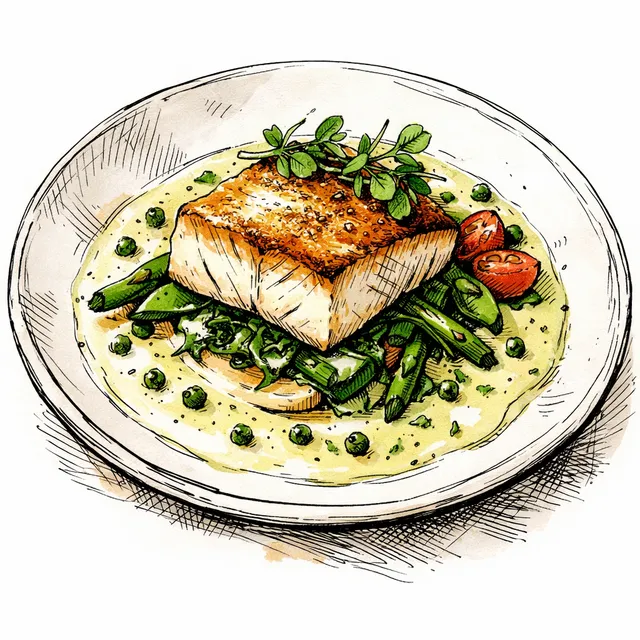
The Coastal Cantilever: Pan-Seared Halibut with Vermouth & Green Peppercorn Emulsion
As an architect, I know that a cantilevered structure—one that appears to float effortlessly—requires a robust, hidden anchor. In this refined weeknight dinner, thick, load-bearing halibut fillets take a hard, golden sear, while a glossy pan sauce of dry vermouth, fresh sage, and bracing green peppercorns acts as the structural foundation, binding everything together in minutes.

Save a copy to your collection for editing
Timeline
Ingredients
- 2 (6 oz) pieces halibut fillets(Skinless, ideally 1.5 inches thick for structural integrity)
- 1/2 tsp Kosher salt(For seasoning the fish)
- 1/4 tsp black pepper(Freshly cracked)
- 1 tbsp extra-virgin olive oil(For searing)
- 1 medium shallot(Finely minced)
- 1 tbsp green peppercorns in brine(Lightly crushed; a nod to my grandmother's Piedmontese pantry)
- 6 whole fresh sage leaves(Provide an earthy, Northern Italian aroma)
- 1/3 cup dry vermouth(An essential shortcut for deep, slow-simmered flavor)
- 1/4 cup premium vegetable brodo(Store-bought is perfectly fine; let the ingredients do the heavy lifting)
- 3 tbsp cold unsalted butter(Cubed, crucial for a stable emulsion)
- 1 tbsp fresh lemon juice(Adds necessary architectural tension to the rich sauce)
Instructions
- 1
Pat 2 (6 oz) pieces halibut fillets completely dry with paper towels. I cannot stress this enough: moisture is the enemy of a structural crust. Your fish should be as dry as architectural parchment. Season evenly with 1/2 tsp Kosher salt and 1/4 tsp black pepper.
2 min
Tip: Leave the fish at room temperature for 10 minutes before cooking to ensure even heat distribution.
- 2
Heat 1 tbsp extra-virgin olive oil in a stainless steel or cast-iron skillet over medium-high heat until shimmering. Carefully lay the halibut in the pan and press down gently with a spatula for 10 seconds to ensure full contact. Sear undisturbed until a golden crust forms.
5 min
Tip: If the fish resists when you try to lift it, the crust hasn't fully formed. Patience is key to masonry and searing alike.
- 3
While the fish sears, mince 1 medium shallot and gently crush 1 tbsp green peppercorns in brine with the side of your knife. Having your materials prepped before construction ensures a seamless workflow.
3 min
Tip: You can prep the aromatics right on your cutting board while keeping one eye on the skillet.
- 4
Flip the halibut and cook the other side until opaque throughout and beautifully firm.
4 min
Tip: A metal fish spatula is your best tool here.
- 5
Transfer the seared halibut to a warm plate to rest. Do not wipe out the skillet; the fond left behind is the foundational blueprint of our pan sauce.
5 min
Tip: Tent loosely with foil if your kitchen is chilly.
- 6
Reduce the heat to medium. Add the prepared 1 medium shallot, 1 tbsp green peppercorns in brine, and 6 whole fresh sage leaves directly into the residual fish oil. Sauté briefly until the shallots soften and the sage begins to crisp.
2 min
Tip: The kitchen should smell instantly of a Milanese autumn.
- 7
Deglaze the pan by pouring in 1/3 cup dry vermouth and 1/4 cup premium vegetable brodo. Scrape up any browned bits with a wooden spoon and let the liquid vigorously bubble and reduce by half.
3 min
Tip: The liquid should look noticeably thicker and slightly syrupy.
- 8
Remove the skillet entirely from the heat. Scatter in 3 tbsp cold unsalted butter and 1 tbsp fresh lemon juice. Swirl the pan continuously until the cold butter melts into a glossy, opaque emulsion that binds the liquid components together.
2 min
Tip: Taking the pan off the heat is critical; if it's too hot, the emulsion will break, compromising the structural integrity of your sauce.
- 9
Plate the rested halibut and spoon the glossy vermouth-peppercorn emulsion generously over the top, letting the crisp sage leaves rest decoratively on the fish.
1 min
Tip: Serve immediately alongside crusty bread or a quick bed of wilted spinach to catch any stray sauce.
Chef's Notes
Remember: let the ingredients do the heavy lifting! A weeknight dinner should feel like an escape to a chic metropolitan bistro, not a chore. The green peppercorns are a nod to my grandmother's Piedmontese pantry—they provide an architectural tension that cuts beautifully through the richness of the thick halibut and the butter emulsion.
Frequently Asked Questions
How long does The Coastal Cantilever: Pan-Seared Halibut with Vermouth & Green Peppercorn Emulsion take to make?
The Coastal Cantilever: Pan-Seared Halibut with Vermouth & Green Peppercorn Emulsion takes about 20 minutes total. That includes 5 minutes of prep and 15 minutes of cooking.
How many servings does this recipe make?
This recipe makes 2 servings.
What skill level is needed for The Coastal Cantilever: Pan-Seared Halibut with Vermouth & Green Peppercorn Emulsion?
This recipe is rated medium — it's intermediate, requiring some cooking experience.
What ingredients do I need for The Coastal Cantilever: Pan-Seared Halibut with Vermouth & Green Peppercorn Emulsion?
The main ingredients are: halibut fillets, Kosher salt, black pepper, extra-virgin olive oil, shallot, green peppercorns in brine, fresh sage leaves, dry vermouth, premium vegetable brodo, cold unsalted butter, fresh lemon juice.
What type of meal is The Coastal Cantilever: Pan-Seared Halibut with Vermouth & Green Peppercorn Emulsion?
The Coastal Cantilever: Pan-Seared Halibut with Vermouth & Green Peppercorn Emulsion is categorized as: dinner.
Ask Elena Rossi a question
Sign in to chat about this recipe, get cooking tips, and ask for substitutions.
Sign in to chat