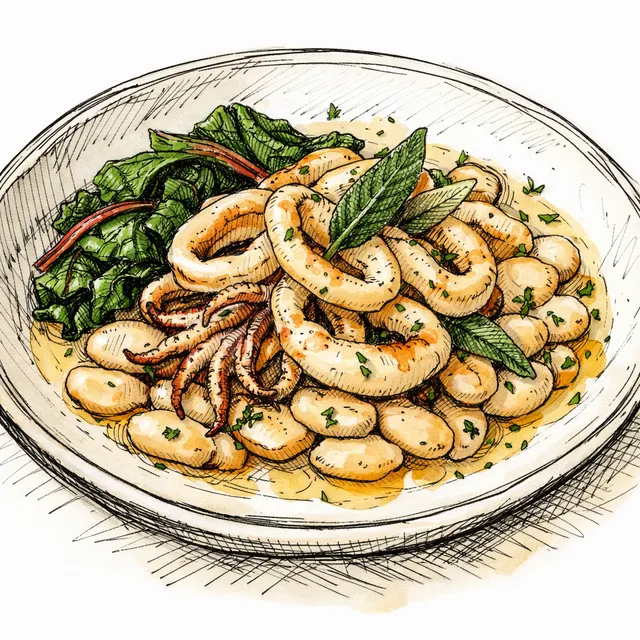
The Manzoni Atelier: Gentle Pan-Seared Calamari with Creamed Corona Beans, Wilted Swiss Chard, and Salvia Butter
Tender ribbons of calamari are gently pan-seared in golden olive oil and served over velvety, brodo-simmered white Corona beans and tender autumnal Swiss chard. Finished with a quick pan-emulsion of dry vermouth, fresh sage, and nutty Parmigiano-Reggiano, this dish brings effortless Milanese sophistication to a brisk midday pause.

Save a copy to your collection for editing
Timeline
Ingredients
- 2 cans large white beans (Corona or Gigante)(15-ounce cans, rinsed and drained (or cooked dried Corona beans))
- 1 lb fresh calamari tubes and tentacles(cleaned, tubes scored lightly in a diamond pattern and cut into wide ribbons)
- 1 bunch rainbow or Swiss chard(stems finely diced, leaves roughly chopped)
- 0.75 cup rich vegetable or chicken brodo(high-quality artisanal store-bought brodo)
- 0.33 cup dry vermouth(such as Martini & Rossi Bianco or Noilly Prat)
- 3 tbsp unsalted butter(cold and cubed)
- 8 fresh sage leaves(whole leaves)
- 3 tbsp extra-virgin olive oil(divided; robust Northern Italian preferred)
- 1 large shallot(finely minced)
- 2 cloves garlic clove(thinly sliced)
- 0.25 cup Parmigiano-Reggiano(finely grated, 24-month aged)
- 1 tbsp fresh lemon juice(for finishing brightness)
- 0.5 tsp flaky sea salt and freshly cracked black pepper(to taste)
Instructions
- 1
Warm 1 tbsp olive oil in a medium saucepan over medium-low heat. Add the minced 1 large shallot and diced stems from 1 bunch rainbow or Swiss chard with a pinch of 0.25 tsp flaky sea salt and freshly cracked black pepper. Sweat until translucent and softened, about 3 minutes.
3 min
Tip: The chard stems act as a textural anchor here; do not discard them.
- 2
Add the drained 2 cans large white beans (Corona or Gigante) and 0.75 cup rich vegetable or chicken brodo to the saucepan. Bring to a gentle simmer for 5 minutes, then crush roughly half the beans against the side of the pot with a wooden spoon to build a silky, creamy foundation.
5 min
Tip: Crushing the beans releases their natural starch, thickening the brodo into an elegant sauce without flour.
- 3
Fold the chopped greens from 1 bunch rainbow or Swiss chard and sliced 2 cloves garlic clove into the simmering beans. Cover and cook for 3 minutes until tender and wilted, then stir in 0.25 cup Parmigiano-Reggiano. Turn off the heat, cover, and keep warm.
3 min
Tip: The residual heat of the brodo will perfectly soften the delicate autumn chard.
- 4
Thoroughly pat 1 lb fresh calamari tubes and tentacles completely dry with paper towels and season with a pinch of 0.25 tsp flaky sea salt and freshly cracked black pepper.
2 min
Tip: Moisture is the enemy of a gentle pan-sear; bone-dry calamari guarantees tender edges instead of steamed rubber.
- 5
Heat the remaining 2 tbsp olive oil in a large wide stainless steel skillet over medium-high heat until shimmering. Add the scored 1 lb fresh calamari tubes and tentacles in an even single layer. Sear gently without disturbing for 90 seconds until opaque and lightly golden at the edges, then toss for 30 seconds more.
2 min
Tip: Calamari demands architectural precision—two minutes maximum in a hot pan preserves its buttery texture.
- 6
Transfer the calamari immediately to a plate to prevent overcooking. Pour 0.33 cup dry vermouth into the hot skillet, scraping up any caramelized bits, and simmer until reduced by half, about 1 minute.
1 min
Tip: The vermouth provides clean alpine acidity that cuts through the creaminess of the beans.
- 7
Reduce heat to low and swirl in 3 tbsp unsalted butter, 8 fresh sage leaves, and 1 tbsp fresh lemon juice, shaking the pan vigorously until a glossy, emulsified salvia sauce forms and the sage is fragrant.
2 min
Tip: Keep the butter cold so it emulsifies smoothly into the reduced vermouth rather than breaking into grease.
- 8
Spoon the warm, creamy white beans and chard across shallow warmed bowls. Crown each plate with the tender seared calamari and spoon the warm sage-vermouth pan butter generously over top. Serve immediately.
2 min
Tip: Warming the bowls keeps the rich bean starch and delicate seafood at the ideal serving temperature.
Chef's Notes
In Milan, lunch is treated as a moment of refined pause between morning rigor and afternoon appointments. White beans—particularly substantial Corona or Gigante varieties—are what I call load-bearing ingredients: they absorb brodo and aromatics greedily, creating an instant creamy pedestal for delicately seared seafood. Remember my core rule: let the ingredients do the heavy lifting, keep the pan-sear gentle and swift, and never skimp on the cold butter to finish the pan sauce.
Frequently Asked Questions
How long does The Manzoni Atelier: Gentle Pan-Seared Calamari with Creamed Corona Beans, Wilted Swiss Chard, and Salvia Butter take to make?
The Manzoni Atelier: Gentle Pan-Seared Calamari with Creamed Corona Beans, Wilted Swiss Chard, and Salvia Butter takes about 28 minutes total. That includes 10 minutes of prep and 18 minutes of cooking.
How many servings does this recipe make?
This recipe makes 2 servings.
What skill level is needed for The Manzoni Atelier: Gentle Pan-Seared Calamari with Creamed Corona Beans, Wilted Swiss Chard, and Salvia Butter?
This recipe is rated medium — it's intermediate, requiring some cooking experience.
What ingredients do I need for The Manzoni Atelier: Gentle Pan-Seared Calamari with Creamed Corona Beans, Wilted Swiss Chard, and Salvia Butter?
The main ingredients are: large white beans (Corona or Gigante), fresh calamari tubes and tentacles, rainbow or Swiss chard, rich vegetable or chicken brodo, dry vermouth, unsalted butter, fresh sage leaves, extra-virgin olive oil, shallot, garlic clove, Parmigiano-Reggiano, fresh lemon juice, flaky sea salt and freshly cracked black pepper.
What type of meal is The Manzoni Atelier: Gentle Pan-Seared Calamari with Creamed Corona Beans, Wilted Swiss Chard, and Salvia Butter?
The Manzoni Atelier: Gentle Pan-Seared Calamari with Creamed Corona Beans, Wilted Swiss Chard, and Salvia Butter is categorized as: lunch.
Ask Elena Rossi a question
Sign in to chat about this recipe, get cooking tips, and ask for substitutions.
Sign in to chat