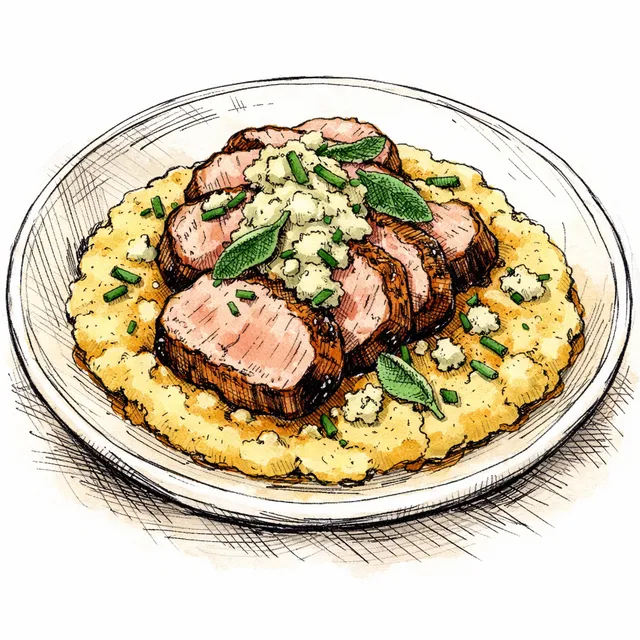
Pan-Roasted Pork Tenderloin with Gorgonzola-Sage Butter and Polenta Foundation
A modern Milanese take on a weekend classic. We build structural integrity with a hard pan-sear on the pork, resting it on a load-bearing foundation of pressure-cooked polenta, and let a melting Gorgonzola and fresh sage compound butter deliver rich, slow-simmered flavor in a fraction of the time.

Save a copy to your collection for editing
Timeline
Ingredients
- 1.5 lbs Pork tenderloin(About the span of two hands; trim the silver skin so it doesn't warp our structural crust)
- 1 tablespoon Coarse sea salt(Divided use)
- 1 teaspoon Freshly cracked black pepper(Visual measure: a heavy, generous dusting)
- 2 tablespoons Olive oil(For the pan-roast)
- 3 tablespoons Gorgonzola Dolce(Room temperature)
- 3 tablespoons Unsalted butter(Room temperature; this and the cheese will form our decorative finish)
- 1 handful Fresh sage leaves(Finely chopped, plus a few whole leaves for garnish)
- 1/3 cup Dry Marsala wine(To deglaze the pan and build the jus)
- 4.5 cups Premium store-bought chicken brodo(Let the store-bought brodo do the heavy lifting here. 4 cups for the polenta, 1/2 cup for the pan sauce.)
- 1 cup Coarse Bramata polenta(Our architectural foundation)
- 1/2 cup Parmigiano-Reggiano(Freshly grated)
Instructions
- 1
Preheat your oven to 400F (200C). In a small bowl, aggressively mash 3 tablespoons Unsalted butter, 3 tablespoons Gorgonzola Dolce, and 1 handful Fresh sage leaves, finely chopped until uniform. Form into a rough disk visually the size of a golf ball, wrap in parchment, and chill. This compound butter will provide the luxurious interior finish to our dish.
5 min
Tip: If your butter is too cold, grate it into the Gorgonzola to force them to combine smoothly.
- 2
In your pressure cooker, whisk together 4.5 cups Premium store-bought chicken brodo, 1 cup Coarse Bramata polenta, and 1 tablespoon Coarse sea salt.
5 min
Tip: The pressure cooker will take about 10 minutes to come to pressure before the 15-minute timer begins. It runs passively while we work.
- 3
Thoroughly pat the 1.5 lbs Pork tenderloin dry with paper towels. Moisture is the enemy of a structural sear. Season generously on all sides with 1 tablespoon Coarse sea salt and 1 teaspoon Freshly cracked black pepper.
5 min
Tip: Don't rush the drying process; a dry surface guarantees the Maillard reaction.
- 4
Heat 2 tablespoons Olive oil in an oven-safe cast-iron skillet over medium-high heat until shimmering. Carefully lay the pork into the pan. Sear undisturbed for 2-3 minutes per side to build a deep, load-bearing crust.
8 min
Tip: Resist the urge to move the meat. Let the pan do its architectural work.
- 5
Transfer the skillet directly into the preheated oven. Roast until the internal temperature reaches 140F (60C), which should take about 10 to 12 minutes depending on the thickness of your tenderloin.
12 min
Tip: Pork tenderloin is lean; pull it at 140F to ensure it remains incredibly juicy after resting.
- 6
Carefully remove the skillet from the oven (the handle will be scorching). Transfer the pork to a cutting board to rest. This allows the internal juices to redistribute evenly.
10 min
Tip: Tent loosely with foil to retain heat without steaming the crust.
- 7
Place the hot skillet back on the stove over medium heat. Pour in 1/3 cup Dry Marsala wine, scraping up the browned structural fond from the bottom. Simmer until reduced by half, then add 0.5 cups Premium store-bought chicken brodo. Reduce until lightly thickened.
5 min
Tip: Stand back slightly when adding the wine, as the hot pan will create a dramatic burst of steam.
- 8
Quick-release the pressure on your polenta. Vigorously whisk in 0.5 cup Parmigiano-Reggiano. It should be thick, creamy, and capable of supporting our pork.
3 min
Tip: If the polenta feels too stiff, whisk in a splash of warm water or extra brodo until it settles like slow lava.
- 9
Slice the rested pork into 1-inch medallions. Spoon a generous foundation of polenta onto each plate. Lay the pork across the polenta, crown with slices of the chilled Gorgonzola-sage butter, and drizzle the hot Marsala jus over the top to melt the butter into a glorious sauce.
3 min
Tip: Let the ingredients do the heavy lifting here; the residual heat of the jus melting the compound butter creates a sauce you'd swear took three hours to make.
Chef's Notes
In my grandmother's house in Piedmont, roasting pork was a reverent, all-day affair. In my fast-paced Milanese reality, I don't have that luxury, but I refuse to compromise on elegance for a weekend dinner. By relying on a hard pan-sear for architectural structure and a Gorgonzola-sage compound butter to act as the decorative finish, we achieve that same slow-cooked depth. Remember my rule: Let the ingredients do the heavy lifting. Weekends should feel like an escape, not a chore.
Frequently Asked Questions
How long does Pan-Roasted Pork Tenderloin with Gorgonzola-Sage Butter and Polenta Foundation take to make?
Pan-Roasted Pork Tenderloin with Gorgonzola-Sage Butter and Polenta Foundation takes about 46 minutes total. That includes 15 minutes of prep and 31 minutes of cooking.
How many servings does this recipe make?
This recipe makes 4 servings.
What skill level is needed for Pan-Roasted Pork Tenderloin with Gorgonzola-Sage Butter and Polenta Foundation?
This recipe is rated medium — it's intermediate, requiring some cooking experience.
What ingredients do I need for Pan-Roasted Pork Tenderloin with Gorgonzola-Sage Butter and Polenta Foundation?
The main ingredients are: Pork tenderloin, Coarse sea salt, Freshly cracked black pepper, Olive oil, Gorgonzola Dolce, Unsalted butter, Fresh sage leaves, Dry Marsala wine, Premium store-bought chicken brodo, Coarse Bramata polenta, Parmigiano-Reggiano.
What type of meal is Pan-Roasted Pork Tenderloin with Gorgonzola-Sage Butter and Polenta Foundation?
Pan-Roasted Pork Tenderloin with Gorgonzola-Sage Butter and Polenta Foundation is categorized as: dinner.
Ask Elena Rossi a question
Sign in to chat about this recipe, get cooking tips, and ask for substitutions.
Sign in to chat