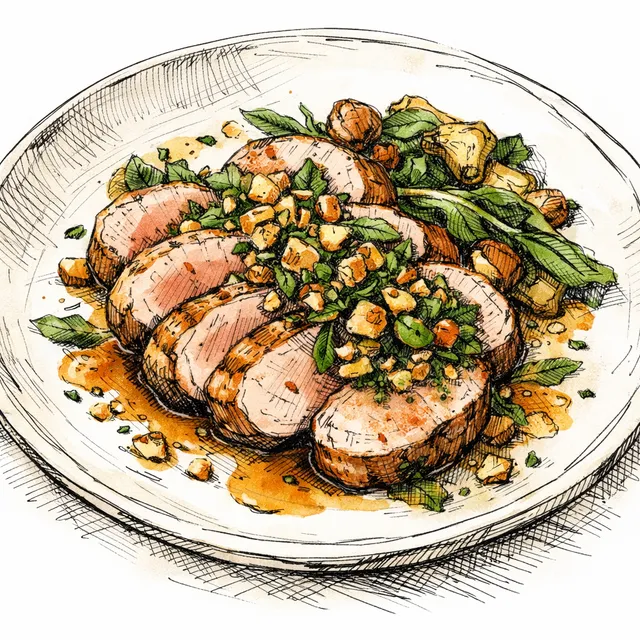
The Piedmontese Pillar: Pan-Roasted Pork Tenderloin with Hazelnut-Sage Gremolata
An elegant weeknight centerpiece engineered for maximum impact and minimal fuss. We build a load-bearing crust on a tender cut of pork, bridging the gap between old-world tradition and modern speed with a sharp vermouth-mustard reduction and a textural crunch of toasted hazelnuts.

Save a copy to your collection for editing
Timeline
Ingredients
- 1.25 lbs Pork tenderloin(Silver skin removed. A lean, structural cut that requires precision cooking.)
- 1.5 tsp Kosher salt(Divided use for seasoning the meat and finishing the sauce.)
- 0.5 tsp Black pepper(Freshly ground.)
- 2 tbsp Extra-virgin olive oil(For the initial sear.)
- 1/4 cup Toasted hazelnuts(Roughly chopped. The textural aggregate of the dish.)
- 1 tbsp Fresh sage(Finely chopped.)
- 1 tsp Lemon zest(Freshly grated to cut through the richness.)
- 1/2 cup Dry vermouth(My trusted liquid shortcut for deep, complex flavor.)
- 1/2 cup High-quality store-bought chicken brodo(Let the ingredients do the heavy lifting here.)
- 1 tbsp Dijon mustard(Acts as an emulsifier for the pan sauce.)
- 2 tbsp Cold unsalted butter(Cut into cubes to mount the sauce.)
Instructions
- 1
Preheat your oven to 400°F (200°C). Season 1.25 lbs pork tenderloin aggressively with 1 tsp kosher salt and 0.5 tsp black pepper. Let it sit at room temperature to take the chill off. This ensures even cooking from edge to center.
5 min
Tip: Never cook meat straight from the fridge; cold meat lowers the pan temperature and ruins your sear.
- 2
In a heavy-bottomed, ovenproof skillet (cast iron or stainless steel), heat 2 tbsp extra-virgin olive oil over medium-high heat. Once shimmering, add the pork and sear on all sides until a deeply browned, load-bearing crust forms.
6 min
Tip: Do not touch the meat until it releases naturally from the pan. Patience builds the foundation.
- 3
Transfer the skillet directly to the preheated oven. Pan-roast the pork until an instant-read thermometer inserted into the thickest part registers 140°F (60°C) for a perfect, juicy medium.
12 min
Tip: Visual cues are helpful, but a thermometer guarantees structural integrity.
- 4
While the pork roasts, construct your gremolata. In a small bowl, toss together 1/4 cup toasted hazelnuts, 1 tbsp fresh sage, and 1 tsp lemon zest. Set aside.
5 min
Tip: This mixture functions like decorative masonry—bright, textured, and finishing the facade perfectly.
- 5
Carefully remove the skillet from the oven (the handle will be scorching). Transfer the pork to a cutting board to rest, allowing the interior juices to redistribute.
10 min
Tip: Resting is not optional; it is a critical phase of the cooking architecture.
- 6
Place the hot skillet back on the stove over medium-high heat. Pour in 1/2 cup dry vermouth to deglaze the pan, using a wooden spoon to scrape up all the caramelized fond (the true flavor mortar). Let it reduce by half.
3 min
Tip: Stand back slightly when adding the vermouth; the steam is potent.
- 7
Whisk 1/2 cup high-quality store-bought chicken brodo and 1 tbsp Dijon mustard into the skillet. Simmer vigorously until the sauce thickens enough to lightly coat the back of a spoon. Season with the remaining 0.5 tsp kosher salt.
4 min
Tip: The mustard naturally thickens and stabilizes the reduction.
- 8
Remove the skillet from the heat entirely. Swirl in 2 tbsp cold unsalted butter until melted, creating a glossy, perfectly emulsified pan sauce.
1 min
Tip: The butter must be cold to mount the sauce properly without breaking the emulsion.
- 9
Slice the rested pork into 1/2-inch thick medallions. Plate immediately, spooning the pan-sauce over the meat and generously scattering the hazelnut-sage gremolata on top.
2 min
Tip: Pour any accumulated juices from the cutting board directly into your sauce before plating.
Chef's Notes
Walking home past the Duomo after a chaotic day at the firm, the Milanese air always feels sharp and electric, yet somehow, my mind always wanders back to my grandmother's kitchen in Piedmont. It smelled of toasted hazelnuts, woodsmoke, and roasting meat. This dish is my modern homage to those memories. By combining a classic pan-roasting technique with the high-impact shortcuts of dry vermouth and a bold mustard reduction, we achieve profound, slow-cooked depth in under 40 minutes. Remember, weeknight cooking should feel like an escape, not a chore. Let the ingredients do the heavy lifting.
Frequently Asked Questions
How long does The Piedmontese Pillar: Pan-Roasted Pork Tenderloin with Hazelnut-Sage Gremolata take to make?
The Piedmontese Pillar: Pan-Roasted Pork Tenderloin with Hazelnut-Sage Gremolata takes about 35 minutes total. That includes 10 minutes of prep and 25 minutes of cooking.
How many servings does this recipe make?
This recipe makes 4 servings.
What skill level is needed for The Piedmontese Pillar: Pan-Roasted Pork Tenderloin with Hazelnut-Sage Gremolata?
This recipe is rated medium — it's intermediate, requiring some cooking experience.
What ingredients do I need for The Piedmontese Pillar: Pan-Roasted Pork Tenderloin with Hazelnut-Sage Gremolata?
The main ingredients are: Pork tenderloin, Kosher salt, Black pepper, Extra-virgin olive oil, Toasted hazelnuts, Fresh sage, Lemon zest, Dry vermouth, High-quality store-bought chicken brodo, Dijon mustard, Cold unsalted butter.
What type of meal is The Piedmontese Pillar: Pan-Roasted Pork Tenderloin with Hazelnut-Sage Gremolata?
The Piedmontese Pillar: Pan-Roasted Pork Tenderloin with Hazelnut-Sage Gremolata is categorized as: dinner.
Ask Elena Rossi a question
Sign in to chat about this recipe, get cooking tips, and ask for substitutions.
Sign in to chat