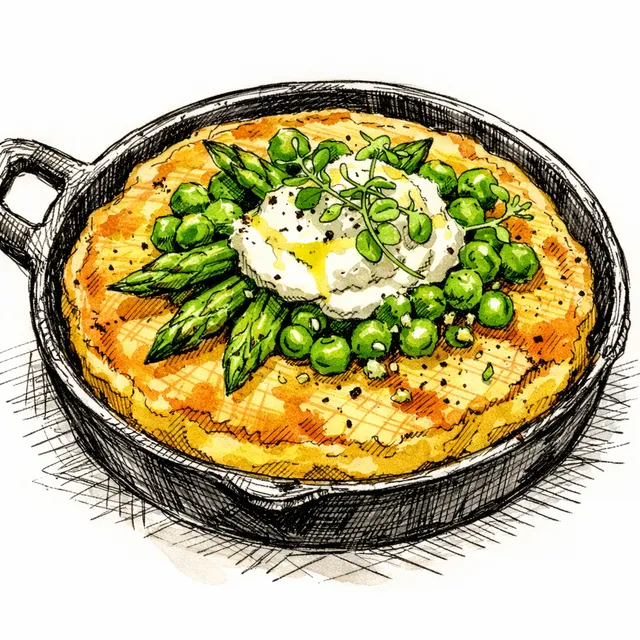
The Venetian Elevation: Spring Pea and Polenta Skillet Soufflé
A towering, soufflé-like skillet that completely redefines weeknight polenta. By whisking quick-cooking polenta into a savory foundation and gently folding in whipped egg whites, we build incredible structural lift in a fraction of the time.

Save a copy to your collection for editing
Timeline
Ingredients
- 2.5 cups high-quality vegetable brodo(Warmed)
- 1/4 cup dry vermouth(A load-bearing flavor component)
- 1 cup quick-cooking polenta(Our shortcut to a solid foundation)
- 1/3 cup mascarpone cheese(Brings essential richness)
- 1/2 cup Parmigiano-Reggiano(Freshly grated)
- 4 large eggs(Separated into yolks and whites)
- 1.5 cups spring peas(Freshly blanched or thawed from frozen)
- 2 tbsp fresh mint(Finely chopped)
- 1 tsp lemon zest(Freshly grated)
- 1 tbsp extra-virgin olive oil(For the finishing garnish)
- 1 pinch salt and black pepper(To taste)
Instructions
- 1
Preheat your oven to 400°F (200°C). In a large 10-inch oven-safe skillet over medium-high heat, combine 2.5 cups high-quality vegetable brodo and 1/4 cup dry vermouth. Bring the liquid to a gentle, active boil. This fragrant bath is the site where we will pour our foundation.
5 min
Tip: Using a well-seasoned cast iron or non-stick oven-safe skillet ensures the edges of your soufflé won't stick during the bake.
- 2
Once boiling, slowly and steadily whisk 1 cup quick-cooking polenta into the skillet to prevent any structural flaws or lumps. It will thicken almost immediately into a dense mortar. Cook for 2 minutes, then remove entirely from the heat. Vigorously whisk in 1/3 cup mascarpone cheese, 1/2 cup Parmigiano-Reggiano, and the yolks from your 4 large eggs. Season generously with 1 pinch salt and black pepper. This rich mixture is our load-bearing foundation.
4 min
Tip: Whisking the yolks off the heat prevents them from scrambling. The residual heat of the polenta will pasteurize them gently.
- 3
In a spotlessly clean glass or metal bowl, use a hand mixer to whip the whites from the 4 large eggs until they hold medium-firm peaks. We are creating aeration and volume—the true architectural lift that transforms heavy cornmeal into a soaring canopy.
4 min
Tip: Ensure absolutely no yolk gets into the whites, or they will refuse to whip to their proper volume.
- 4
Here is where we construct our elevation. Add about one-third of the whipped egg whites into the dense polenta mixture, whisking gently to loosen the structure. Next, using a wide silicone spatula, carefully fold in the remaining egg whites along with 1 cup spring peas. Fold by drawing the spatula down the side of the pan and sweeping up through the center, being mindful not to deflate your aeration.
3 min
Tip: Patience is key here. Do not overmix; a few white streaks are perfectly acceptable and actually preserve the structural integrity.
- 5
Smooth the top of the skillet with your spatula to create an even facade. Transfer immediately to the middle rack of your preheated oven. Bake until the canopy is puffed, beautifully golden brown, and just set in the center.
18 min
Tip: Do not open the oven door for the first 15 minutes, or a sudden draft could cause your elevation to collapse.
- 6
While the skillet bakes and your kitchen fills with the scent of toasted corn and vermouth, prepare your topping. In a small bowl, toss the remaining 1/2 cup spring peas with 2 tbsp fresh mint, 1 tsp lemon zest, and 1 tbsp extra-virgin olive oil.
3 min
Tip: This bright, acidic garnish acts as the perfect decorative counterbalance to the rich, warm foundation beneath.
- 7
Remove the puffed polenta from the oven. Let the ingredients do the heavy lifting by immediately crowning the golden crust with your vibrant, dressed pea mixture. Serve straight from the skillet right at the table before the delicate structural integrity begins to settle.
2 min
Tip: Soufflés wait for no one! Have your plates ready and pour a crisp Northern Italian white wine while you slice.
Chef's Notes
Weeknight cooking should feel like an escape, not a chore. By utilizing quick-cooking polenta, we bypass the 45 minutes of constant stirring traditionally required. The key to the dish's lightness lies in your folding technique—treat the egg whites as delicate glass panels. The result is a savory, comforting dinner that looks like an architectural marvel but requires incredibly minimal effort.
Frequently Asked Questions
How long does The Venetian Elevation: Spring Pea and Polenta Skillet Soufflé take to make?
The Venetian Elevation: Spring Pea and Polenta Skillet Soufflé takes about 40 minutes total. That includes 15 minutes of prep and 25 minutes of cooking.
How many servings does this recipe make?
This recipe makes 4 servings.
What skill level is needed for The Venetian Elevation: Spring Pea and Polenta Skillet Soufflé?
This recipe is rated medium — it's intermediate, requiring some cooking experience.
What ingredients do I need for The Venetian Elevation: Spring Pea and Polenta Skillet Soufflé?
The main ingredients are: high-quality vegetable brodo, dry vermouth, quick-cooking polenta, mascarpone cheese, Parmigiano-Reggiano, large eggs, spring peas, fresh mint, lemon zest, extra-virgin olive oil, salt and black pepper.
What type of meal is The Venetian Elevation: Spring Pea and Polenta Skillet Soufflé?
The Venetian Elevation: Spring Pea and Polenta Skillet Soufflé is categorized as: dinner, lunch.
Ask Elena Rossi a question
Sign in to chat about this recipe, get cooking tips, and ask for substitutions.
Sign in to chat