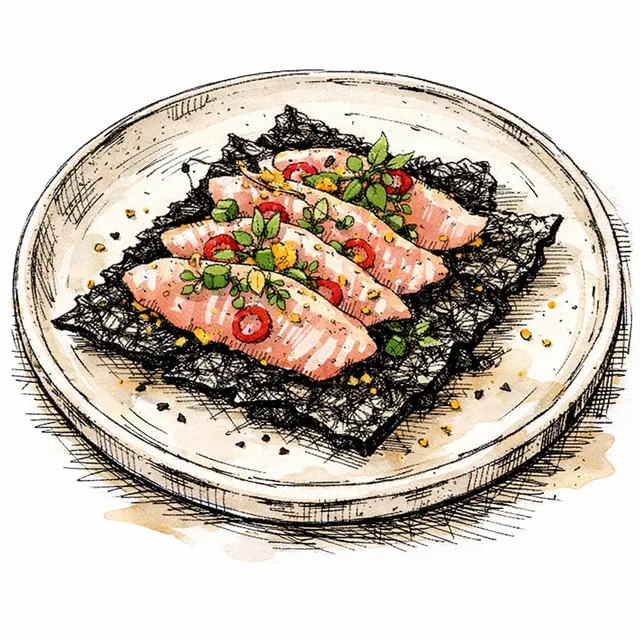
4-Minute Yuzu & Aji Limo Cured Hamachi on Crispy Nori
I still remember the first time I walked through a bustling seafood market in Lima. The sharp citrus hitting the air, the bright, fruity heat of the aji limo peppers—it felt intensely familiar yet completely foreign. It immediately took me back to my early days slicing sashimi in Tokyo, where we worshipped the delicate, buttery fat of hamachi. I realized right then that Peruvian ceviche and Japanese tataki share the exact same DNA. That is how this 4-Minute Yuzu and Aji Limo Cured Hamachi was born. It is my ultimate Nikkei snack. We take that rich yellowtail and give it a highly precise flash-cure in a yuzu-laced leche de tigre. Why exactly four minutes? Here is the science: any less, and the surface proteins do not firm up enough to hold the marinade; any longer, and the acid completely cooks out the hamachi's luscious, melt-in-your-mouth texture. It is all about hitting that structural sweet spot. I serve it over shatteringly crisp tempura-fried nori chips for a crazy textural contrast. This dish is special to me because it is a literal map of my culinary journey balanced on a single bite. Want to make it your own? Swap the hamachi for fresh scallops, or if you cannot find aji limo, try a dash of fermented habanero paste. Play with the heat, but always respect the clock!
Featured Recipe
4-Minute Yuzu & Aji Limo Cured Hamachi on Crispy Nori
This is my ultimate Nikkei snack. We're taking fatty, rich hamachi and giving it a highly precise 4-minute acid flash-cure in a yuzu-leche de tigre, then serving it on shattering tempura-fried nori chips.
Save a copy to your collection for editing
Timeline
Ingredients
- 2 cups cups neutral oil(for frying (canola, grapeseed, or rice bran))
- 4 sheets sheets nori(sushi-grade roasted seaweed)
- 1/2 cup cup all-purpose flour
- 1/4 cup cup cornstarch
- 3/4 cup cup ice water(must be ice cold for a lacy tempura)
- 2 tbsp tbsp Kewpie mayo
- 1 tbsp tbsp aji amarillo paste(store-bought or homemade)
- 2 tbsp tbsp yuzu juice(bottled is fine if fresh is unavailable)
- 2 tbsp tbsp lime juice(freshly squeezed)
- 1 tsp tsp kosher salt(plus extra for dusting chips)
- 1/2 whole aji limo(minced (substitute habanero or red serrano))
- 2 tbsp tbsp red onion(brunoise (finely diced) and rinsed under cold water)
- 8 oz oz sashimi-grade hamachi(yellowtail fillet, kept very cold)
- 1/4 cup cup cilantro microgreens(for garnish)
Instructions
- 1
Pour 2 cups neutral oil into a heavy-bottomed pot and begin heating over medium heat to 350°F. Meanwhile, take 4 sheets nori and use scissors to cut each sheet into 4 smaller squares.
5 min
Tip: Use a deep-fry thermometer to monitor the oil. If the oil is too cold, the nori will absorb it and get greasy.
- 2
In a medium bowl, loosely whisk together 1/2 cup all-purpose flour, 1/4 cup cornstarch, and 3/4 cup ice water. Do not overmix; lumps are fine.
2 min
Tip: Gluten development is the enemy of crispy tempura. Keep the batter lumpy and freezing cold.
- 3
Once the oil hits 350°F, dip one side of a nori square into the batter, letting excess drip off. Carefully drop it into the oil. Fry for 45-60 seconds until crispy. Transfer to a wire rack and immediately season lightly with a pinch of kosher salt. Repeat with remaining nori.
8 min
Tip: Frying only one side of the nori gives you a beautiful visual contrast between the glossy green seaweed and the golden tempura web.
- 4
In a small bowl, mix 2 tbsp Kewpie mayo with 1 tbsp aji amarillo paste. Transfer to a small piping bag or zip-top bag and set aside.
2 min
Tip: The fat in the mayo acts as a barrier, keeping the nori chip crispy when you place the wet hamachi on top.
- 5
In a non-reactive glass or ceramic bowl, whisk together 2 tbsp yuzu juice, 2 tbsp lime juice, 1 tsp kosher salt, 1/2 minced aji limo, and 2 tbsp minced red onion.
3 min
Tip: Always rinse minced red onion in cold water before adding it to ceviche/leche de tigre bases to remove the harsh sulfurous compounds.
- 6
Take your chilled 8 oz sashimi-grade hamachi and use a very sharp knife to cut it into neat, 1/4-inch cubes.
3 min
Tip: If the fish is too soft to cut cleanly, pop it in the freezer for 10 minutes before dicing.
- 7
Add the diced hamachi to the yuzu-leche de tigre. Set a timer for EXACTLY 4 minutes. Toss gently. The outside of the fish will begin to turn opaque.
4 min
Tip: Do not exceed 4 minutes! See my notes below on the science of acid-curing fatty fish.
- 8
Using a slotted spoon, immediately drain the hamachi from the curing liquid. Lay out your crispy nori chips. Pipe a dime-sized dot of aji amarillo mayo onto each chip. Top with a spoonful of the cured hamachi. Garnish with 1/4 cup cilantro microgreens and serve immediately.
4 min
Tip: Assemble these right before your guests eat them so the nori shatters perfectly when bitten.
Chef's Notes
Let's geek out about acid curing for a second. If you throw this beautiful hamachi in lime juice and walk away to answer an email, you've ruined it. Hamachi has incredibly delicate fat structure. In a traditional ceviche using lean white fish (like flounder or snapper), a 15 to 20-minute cure is standard because the acid (usually pH ~2) slowly denatures the proteins, essentially 'cooking' the fish. But with fatty fish? Seven minutes, and the fat turns horribly chalky. Three minutes? Not enough structural change to bind the bite. At EXACTLY four minutes, the exterior proteins denature and tighten just enough to give a satisfying 'pop' on the tooth, while leaving the center buttery, rich, and raw. This is where Japanese sashimi precision meets Peruvian street food soul.

Kenji Nakamura
Where Japanese precision meets global flavors
I trained in Tokyo for eight years, mastering the discipline of washoku—traditional Japanese cuisine. But I got restless. So I cooked my way through Southeast Asia, spent a year in Mexico City, and fell hard for the food of Peru. Now I see connections between cuisines that others miss: the umami in dashi and fish sauce, the heat in shishito and Szechuan peppercorns, the way Japanese technique can unlock flavors from any tradition. I'm always fermenting something.