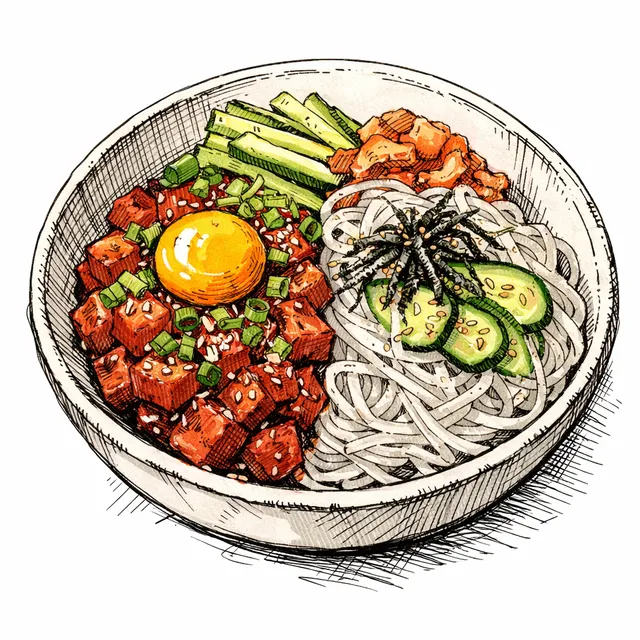
The Ahi Tuna Yukhoe Bowl: A Tokyo-Seoul Mashup
I was walking through a bustling night market in Seoul a few years ago when a plate of raw beef yukhoe stopped me in my tracks. The sweet Asian pear, the rich egg yolk, the savory sesame it was absolute perfection. But my Tokyo-trained brain immediately started connecting dots: what if we treated sashimi-grade ahi tuna with this exact same flavor profile? That late-night craving sparked this Ahi Tuna Yukhoe Bowl. We are taking beautiful tuna, slicing it into thin strips, and hitting it with a high-speed 3-minute cure of Korean gochujang, Japanese yuzu juice, and white soy. Let me geek out for a second on why this works: why exactly 3 minutes? Any longer and the citric acid from the yuzu starts denaturing the proteins essentially cooking the fish like a Latin American ceviche which ruins that pristine, buttery raw texture we want. Three minutes is the absolute sweet spot where the umami penetrates the surface just enough without altering the core protein structure. Tossed over bouncy, ice-cold sweet potato glass noodles with crisp pear, it is the ultimate fast-prep umami lunch. This recipe is incredibly special to me because it proves culinary traditions are meant to talk to each other. Want to make it your own? Break my rules! Swap the tuna for fatty salmon, or toss in a massive spoonful of whatever funky fermented chili paste you have hiding in the back of your fridge. Trust your palate and let the flavors collide.
Featured Recipe
Ahi Tuna "Yukhoe" Bowl with Gochujang-Yuzu Cure & Cold Glass Noodles
This is what happens when you cross the DNA of Korean raw beef yukhoe with Japanese sashimi traditions. We are taking beautiful ahi tuna, slicing it into thin strips, and hitting it with a high-speed 3-minute cure of gochujang, yuzu, and white soy. Served over bouncy, ice-cold sweet potato glass noodles with crisp Asian pear, it is the ultimate fast-prep umami lunch bowl.
Save a copy to your collection for editing
Timeline
Ingredients
- 8 oz Ahi tuna block (sushi-grade)(Keep as cold as possible until the moment you slice it)
- 4 oz Dangmyeon (Korean sweet potato glass noodles)(Can substitute soba if you are in a pinch, but the chewy texture of dangmyeon is ideal)
- 1 tbsp Gochujang(Korean fermented chili paste)
- 1.5 tbsp Yuzu juice(If unavailable, use 1 tbsp lime juice and 0.5 tbsp Meyer lemon juice)
- 1 tbsp Shiro shoyu (white soy sauce)(Keeps the color bright; light soy sauce works too)
- 1 tbsp Toasted sesame oil(For the marinade, plus an extra drop for the noodles)
- 0.5 cup Nashi (Asian pear)(Peeled and cut into fine matchsticks)
- 5 Perilla (shiso) leaves(Rolled and sliced into a fine chiffonade)
- 2 tbsp Pine nuts(Lightly toasted)
- 4 cup water(Needed to boil noodles)
Instructions
- 1
Bring a medium pot of 4 cup water to a rolling boil. Drop in the 4 oz Dangmyeon (Korean sweet potato glass noodles) and cook according to package directions, usually about 6 minutes.
6 min
Tip: Glass noodles are incredibly resilient, so do not worry about overcooking them by a minute, but do not undercook them or they will be unpleasantly stiff.
- 2
While the noodles boil, grab a medium mixing bowl and whisk together the 1 tbsp Gochujang, 1.5 tbsp Yuzu juice, 1 tbsp Shiro shoyu (white soy sauce), and 1 tbsp Toasted sesame oil until the gochujang completely dissolves into a glossy, emulsified sauce.
2 min
Tip: The high viscosity of the gochujang acts as an emulsifier here, grabbing onto the sesame oil so it doesn't separate.
- 3
Using your sharpest knife, slice the cold 8 oz Ahi tuna block (sushi-grade) into 1/4-inch thick strips, mimicking the traditional cut of beef yukhoe. Gently fold the tuna strips into the gochujang-yuzu mixture until evenly coated. Set aside to cure at room temperature.
3 min
Tip: We only want this to cure for about 3 to 5 minutes. The yuzu will begin to micro-denature the proteins on the surface, giving it a slightly firm exterior while the center remains buttery.
- 4
Drain the cooked glass noodles into a colander and immediately blast them with ice-cold running water, tossing them thoroughly with your hands until completely chilled. Shake off all excess water and toss with just a drop of 1 tsp Toasted sesame oil to prevent sticking.
2 min
Tip: The cold shock is crucial. It halts the cooking immediately and tightens the starch structure, giving you that incredible signature chew.
- 5
Prep your garnishes. Peel the 0.5 cup Nashi (Asian pear) and slice it into very fine, crisp matchsticks. Roll the 5 Perilla (shiso) leaves into a tight cigar and slice them crosswise into thin, aromatic ribbons.
3 min
Tip: Asian pear oxidizes slowly, but you can toss the matchsticks in a tiny splash of yuzu juice if you are prepping ahead.
- 6
Assemble the bowls. Swirl the chilled glass noodles into the base of your serving bowls. Pile the gochujang-cured ahi tuna generously in the center, ensuring you scrape out every drop of the remaining marinade from the bowl to sauce the noodles. Arrange the Asian pear matchsticks on one side, crown with the perilla chiffonade, and scatter the 2 tbsp Pine nuts over the top.
2 min
Tip: Mix everything vigorously with chopsticks right before taking your first bite so the sweet pear, herbal perilla, and spicy tuna intermingle with every noodle.
Chef's Notes
Why this works: A 3-minute cure in this specific emulsion is the sweet spot. The lactic tang and chili heat of the gochujang penetrate the tuna's surface, while the yuzu juice causes a micro-denaturation (a tiny bit of firming) on the very outside. If you left it for 20 minutes, it would turn mushy. At 3 minutes, you get a beautiful flavor gradient—bold and punchy on the outside, buttery and raw in the center. The dangmyeon (sweet potato noodles) provide an unmatched resilient chew that prevents this soft-on-soft dish from feeling one-dimensional.

Kenji Nakamura
Where Japanese precision meets global flavors
I trained in Tokyo for eight years, mastering the discipline of washoku—traditional Japanese cuisine. But I got restless. So I cooked my way through Southeast Asia, spent a year in Mexico City, and fell hard for the food of Peru. Now I see connections between cuisines that others miss: the umami in dashi and fish sauce, the heat in shishito and Szechuan peppercorns, the way Japanese technique can unlock flavors from any tradition. I'm always fermenting something.