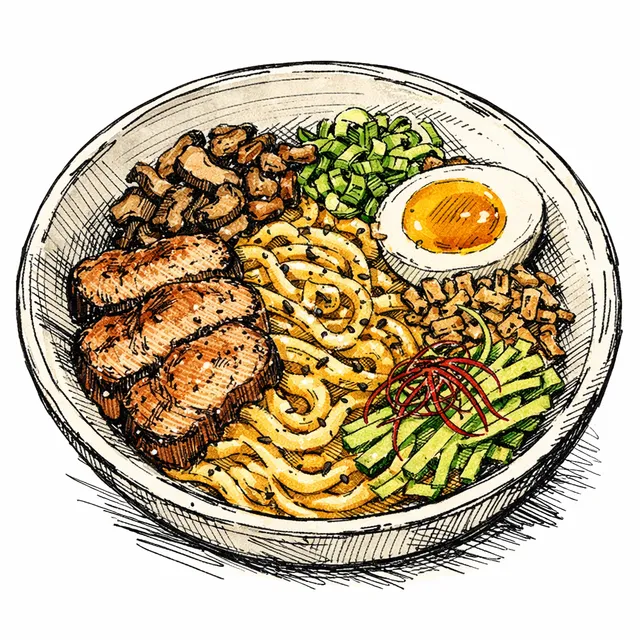
Aji Amarillo & Brown Butter Miso Mazemen: A Global Slurp
Let me tell you about the best mashup that ever happened in my kitchen. The inspiration for this Aji Amarillo & Brown Butter Miso Mazemen hit me somewhere between slurping late-night noodles in a sweaty Tokyo alley and wandering a vibrant produce market in Lima. Mazemen is ramen's unsung, brothless cousin. It relies entirely on a rich, emulsified sauce clinging to every single strand. I realized that structurally, mazemen shares DNA with Italian Cacio e Pepe. So, I started playing. I swapped the cheese and pepper for sweet, fruity Peruvian aji amarillo paste, nutty brown butter, and a hefty dollop of Japanese white miso. Why this works: The milk solids in the browned butter and the proteins in the miso act as powerful emulsifiers, binding the rich fat to the starchy noodle water. The result? A glossy, umami-bomb of a sauce that coats the thick noodles perfectly. The aji amarillo brings a bright, sun-kissed heat that cuts right through the intense richness of the butter and fermented soy. Do not be afraid to break the rules here. Swap the aji amarillo for Korean gochujang, or toss in whatever funky, fermented veg you have sitting in your fridge right now. Grab your chopsticks and enjoy every slurp!
Featured Recipe
Aji Amarillo & Brown Butter Miso Mazemen
Mazemen is the unsung hero of the ramen shop—a brothless noodle dish that relies entirely on a rich, emulsified sauce clinging to every strand. In this version, we're taking the structural DNA of an Italian Cacio e Pepe, but building it with Peruvian aji amarillo, nutty brown butter, and Japanese white miso.
Save a copy to your collection for editing
Timeline
Ingredients
- 12 oz Thick ramen noodles(Fresh if possible. Sun Noodle brand is ideal.)
- 4 tbsp Unsalted butter(Cut into cubes for even melting.)
- 2 Garlic cloves(Smashed whole.)
- 2 tbsp Aji amarillo paste(Found in Latin markets; brings floral heat.)
- 2 tbsp White miso (shiro miso)(Adds sweet, earthy umami.)
- 1/2 cup Parmigiano-Reggiano(Finely grated on a microplane.)
- 1/2 cup Noodle cooking water(Reserved from boiling the noodles.)
- 2 Egg yolks(Raw, for garnishing the hot noodles.)
- 2 Scallions(Finely sliced.)
- 2 tbsp Shredded nori(For garnish.)
- 1 tbsp Lime juice(Freshly squeezed.)
Instructions
- 1
Prep your garnishes and grate the 1/2 cup Parmigiano-Reggiano. Slice the 2 scallions and separate the 2 egg yolks.
5 min
Tip: Getting this done now is crucial. Emulsions wait for no one, and once the noodles are cooked, you need to move fast.
- 2
Bring a large pot of water to a rolling boil. Do not salt the water heavily like pasta—fresh ramen noodles already contain sodium and alkaline salts (kansui).
10 min
Tip: You want plenty of water so the noodles don't turn into a gummy mass.
- 3
In a large, cold skillet, add 4 tbsp unsalted butter and the 2 garlic cloves. Turn the heat to medium. Swirl the pan occasionally until the butter foams, stops sizzling, and smells deeply nutty with brown milk solids at the bottom. Discard the garlic cloves.
5 min
Tip: Watch carefully. The line between browned butter and burnt butter is about 15 seconds.
- 4
Remove the skillet from the heat. Let it cool for 30 seconds, then vigorously whisk in the 2 tbsp aji amarillo paste and 2 tbsp white miso until it forms a smooth, homogenous paste in the warm butter.
2 min
Tip: Doing this off the heat prevents the miso from seizing and protects its delicate fermented flavors.
- 5
Drop the 12 oz thick ramen noodles into the boiling water. Stir vigorously for the first 30 seconds so they don't stick. Cook according to package directions until just chewy (usually about 3-4 minutes).
4 min
Tip: Thick ramen is essential here—its wide surface area and alkaline chew stand up to heavy sauces.
- 6
Using tongs, transfer the hot noodles directly into the skillet with the miso-butter base. Pour in 1/2 cup noodle cooking water and add the 1/2 cup Parmigiano-Reggiano. Turn the heat to medium-low and toss aggressively. You are forcing the fat, starchy water, and melted cheese to hold hands and form a glossy, thick cream.
3 min
Tip: If it looks greasy, add a splash more hot starchy water and keep tossing. Agitation is the key to a stable emulsion.
- 7
Immediately divide the glistening noodles between two warm bowls. Make a small well in the center of each and gently drop in 2 egg yolks (one per bowl). Garnish with the 2 scallions, 2 tbsp shredded nori, and finish with a squeeze of 1 tbsp lime juice.
2 min
Tip: The lime juice cuts the richness right at the end. Tell your guests to break the yolk and mix vigorously before eating.
Chef's Notes
Why this works: A brothless emulsion requires three things: fat (brown butter), liquid (noodle water), and an emulsifier. Starchy water gives us a physical thickener, but the secret weapon here is actually the miso and cheese. Both contain proteins and naturally occurring emulsifying compounds that help bind the butterfat and water together. When we aggressively toss it in the pan, we're mechanically shearing those fat droplets into suspension. Breaking the raw egg yolk into the hot noodles at the table adds a secondary emulsion layer right before you eat it. It's food science, but it tastes like pure indulgence.

Kenji Nakamura
Where Japanese precision meets global flavors
I trained in Tokyo for eight years, mastering the discipline of washoku—traditional Japanese cuisine. But I got restless. So I cooked my way through Southeast Asia, spent a year in Mexico City, and fell hard for the food of Peru. Now I see connections between cuisines that others miss: the umami in dashi and fish sauce, the heat in shishito and Szechuan peppercorns, the way Japanese technique can unlock flavors from any tradition. I'm always fermenting something.