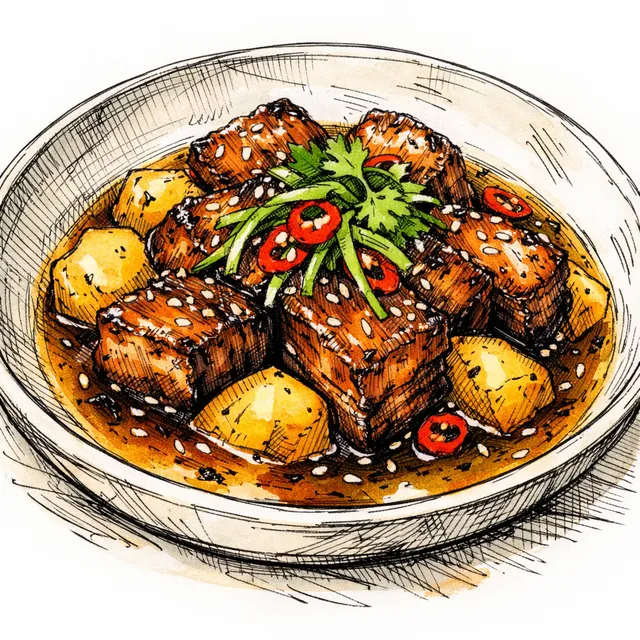
Electric Umami: Aji Amarillo & Kurozu Braised Pork Belly
When I was cooking in Lima, I used to hit this tiny cevicheria after my shifts. One night, the kitchen next door was making adobo, and the smell of braising pork and sharp vinegar drifted over. It hit me instantly: what if I swapped the traditional chicha de jora for Japanese kurozu? That was the birth of this Aji Amarillo & Kurozu Braised Pork Belly, my take on a Nikkei adobo. Here is why this works: pork belly is mostly fat, which can feel intensely heavy. The aggressive acidity of the black vinegar and the electric, citrusy heat of the aji amarillo paste perform a beautiful chemical magic trick. They rapidly denature the surface proteins and cut straight through those rich lipids, creating a melt-in-your-mouth bite that never exhausts your palate. This dish holds a special place in my heart because it is the perfect, unapologetic marriage of my Tokyo roots and my Peruvian adventures. Want to make it your own? Break the rules! Try adding a spoonful of whatever you have fermenting on your counter right now. I love dropping in some fermented garlic honey for extra depth. Or swap the pork belly for thick slices of king oyster mushrooms. Just let it braise until it completely surrenders.
Featured Recipe
Aji Amarillo & Kurozu Braised Pork Belly (Nikkei Adobo)
A Tokyo-meets-Lima comfort dish where rich pork belly is slow-braised in an aggressively sharp broth of Japanese black vinegar, soy, and aji amarillo paste. The fierce acidity tenderizes the meat while cutting the fat, creating a melt-in-your-mouth bite that finishes with electric, citrusy heat.
Save a copy to your collection for editing
Timeline
Ingredients
- 2 lbs Pork belly, cut into 2-inch cubes(Skinless preferred, but skin-on works if you like that gelatinous texture)
- 4 cloves Garlic cloves(Smashed flat)
- 2-inch piece Fresh ginger(Thickly sliced, no need to peel)
- 3 tbsp Aji amarillo paste(The backbone of Peruvian heat; usually found in jars at Latin markets)
- 1/2 cup Kurozu (Japanese black vinegar) or unseasoned rice vinegar(Kurozu brings a deep, malty acidity)
- 1/2 cup Soy sauce(Standard Japanese soy sauce (koikuchi))
- 5 tbsp Lime juice, freshly squeezed(Divided use (4 tbsp for the braise, 1 tbsp for the criolla))
- 2 tbsp Brown sugar(Dark or light both work)
- 2 cups Unsalted chicken stock(Water works in a pinch, but stock gives better body to the final glaze)
- 2 large Sweet potatoes(Scrubbed and cut into 1-inch thick rounds)
- 1 tbsp Olive oil(For roasting the potatoes)
- 1.5 tsp Kosher salt(Divided use)
- 1/2 medium Red onion(Thinly sliced pole-to-pole)
- 1/4 cup Fresh mint(Roughly chopped)
- 1/4 cup Fresh cilantro(Roughly chopped)
Instructions
- 1
Place a heavy Dutch oven over medium-high heat. Add 2 lbs pork belly cubes (fat-side down) in an even layer. Sear undisturbed until deeply browned and crispy, turning to hit all sides. This renders out excess fat and builds our flavor base.
10 min
Tip: Don't rush the sear. The Maillard browning here is essential because the wet braising environment won't create any crust.
- 2
Drain all but 1 tablespoon of rendered fat from the pot. Add 4 cloves garlic, 2-inch piece ginger, and 3 tbsp aji amarillo paste. Cook for 1 minute until highly fragrant. Pour in 1/2 cup kurozu, 1/2 cup soy sauce, 4 tbsp lime juice, 2 tbsp brown sugar, and 2 cups chicken stock. Stir to scrape up any browned bits on the bottom.
5 min
Tip: Stand back when you pour in the vinegar—the acidic steam will hit your nose fast!
- 3
Bring the liquid to a rolling boil, then immediately drop the heat to low. Cover with a tight-fitting lid and let it simmer gently until the pork is fork-tender.
90 min
Tip: The aggressive acidity of this liquid breaks down the meat's connective tissue much faster than a standard braise.
- 4
While the pork braises, preheat your oven to 400°F (200°C). On a parchment-lined baking sheet, toss 2 large sweet potatoes with 1 tbsp olive oil and 1 tsp kosher salt.
5 min
Tip: Leaving the skins on adds a great rustic texture, but you can peel them if you prefer.
- 5
Roast the sweet potatoes in the oven until deeply caramelized on the bottom and completely tender inside.
40 min
Tip: Flip them halfway through if you want browning on both sides.
- 6
Make the salsa criolla: In a small bowl, combine 1/2 medium red onion, 1/4 cup fresh mint, 1/4 cup fresh cilantro, 1 tbsp lime juice, and 1/2 tsp kosher salt. Massage gently with your hands to soften the onions, then set aside to quick-pickle.
5 min
Tip: Massaging the onions gently breaks their cell walls, allowing the lime juice to penetrate and tame their raw bite.
- 7
Carefully remove the tender pork belly pieces from the pot and set aside on a plate. Turn the heat up to medium-high and boil the remaining braising liquid vigorously until it reduces by half and transforms into a sticky, glossy glaze.
12 min
Tip: Watch the pot closely at the end of reduction; the high sugar content means it can go from a perfect glaze to burnt quite quickly.
- 8
Drop the pork belly back into the reduced glaze, tossing gently so every piece is lacquered. Plate the pork belly over the roasted sweet potatoes, and pile a generous handful of the acidic mint criolla right on top to cut the richness.
3 min
Tip: Make sure you get a piece of pork, a bit of sweet potato, and some criolla in every bite.
Chef's Notes
Here's why this works: Pork belly has a fatal flaw—it can get unbearably heavy. Japanese kakuni solves this with soy and slow cooking, but Peruvian adobo uses chicha or vinegar to slice right through the richness. By braising the belly in a high-acid bath of kurozu (black vinegar) and lime juice, we're not just cutting the fat; the acid breaks down the connective tissue at warp speed. It yields a sticky, umami-bomb glaze that practically forces you to go back for a second bowl. Don't skip the mint in the criolla—it brings a wild, fresh contrast to the deep, earthy braise.

Kenji Nakamura
Where Japanese precision meets global flavors
I trained in Tokyo for eight years, mastering the discipline of washoku—traditional Japanese cuisine. But I got restless. So I cooked my way through Southeast Asia, spent a year in Mexico City, and fell hard for the food of Peru. Now I see connections between cuisines that others miss: the umami in dashi and fish sauce, the heat in shishito and Szechuan peppercorns, the way Japanese technique can unlock flavors from any tradition. I'm always fermenting something.