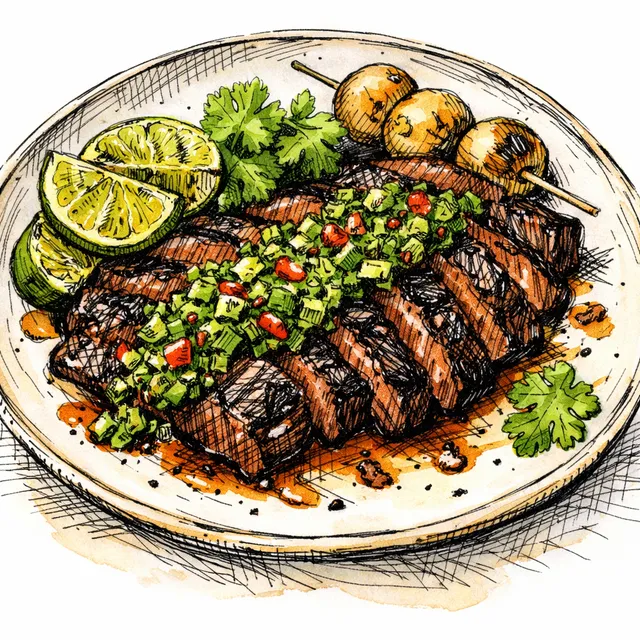
Anticucho-Glazed Skirt Steak with Shio Koji Chimichurri
I still remember the first time I walked through the smoke-filled streets of Lima, entranced by the scent of beef heart anticuchos sizzling over open charcoal. It immediately brought me back to my days standing over a yakitori grill in Tokyo. That shared DNA of fire, smoke, and savory glaze is the beating heart of this Anticucho-Glazed Skirt Steak. Too many people take a beautiful piece of skirt steak and drown it in an acidic marinade overnight. Let me tell you why that is a mistake: you are not tenderizing it, you are chemically cooking it into mush! Instead, we are doing a hard sear. We build that glorious Maillard crust, then paint the beef with a sticky Aji Panca and soy glaze at the very last second, exactly like a yakitori master. What makes this dish truly special to me is the Shio Koji Chimichurri. By swapping standard salt for shio koji—my absolute favorite fermented umami bomb—you get an incredible depth of flavor that binds the bright South American herbs with Japanese precision. Feel free to play around! If you cannot find Aji Panca, a smoky chipotle or a hit of Korean gochujang works wonders. Break the rules, trust your palate, and keep the fire hot!
Featured Recipe
Anticucho-Glazed Skirt Steak with Shio Koji Chimichurri
If you take a beautiful piece of skirt steak and drown it in an acidic marinade overnight, you aren't tenderizing it—you're chemically cooking it into mush. In this Nikkei steakhouse mashup, we're skipping the marinade. Instead, we're hard-searing the beef, then painting it with a smoky, sticky Aji Panca and soy glaze at the very last second like a yakitori master, finishing it with a wildly savory Shio Koji Chimichurri.
Save a copy to your collection for editing
Timeline
Ingredients
- 1.5 lbs Skirt steak(Cut into 6-inch lengths, patted completely dry)
- 3 tbsp Aji panca paste(Found in Latin markets; brings a smoky, berry-like heat)
- 2 tbsp Soy sauce(Quality Japanese shoyu)
- 1 tbsp Red wine vinegar(For the glaze)
- 1 tsp Ground cumin
- 4 cloves Garlic(2 grated for glaze, 2 minced for chimichurri)
- 1 tbsp Mirin(Helps the glaze caramelize quickly)
- 1 cup Flat-leaf parsley(Finely chopped)
- 1/2 cup Cilantro(Finely chopped)
- 2 tbsp Shio koji(Liquid or paste works; adds massive umami)
- 2 tbsp Rice vinegar(Unseasoned)
- 1/3 cup Extra virgin olive oil
- 1 bunch Spring onions(Or thick scallions, roots trimmed)
- 1 tbsp Neutral oil(Avocado or grapeseed, for searing)
Instructions
- 1
Place a heavy cast-iron skillet or grill pan over medium-high heat. You want it ripping hot by the time the meat hits the pan, so let it heat up passively while you prep your sauces.
8 min
Tip: A dry preheat builds the intense surface temperature needed for a proper steakhouse crust.
- 2
While the pan heats, build your umami bomb. In a medium bowl, combine 1 cup Flat-leaf parsley, 1/2 cup Cilantro, 2 tbsp Shio koji, 2 tbsp Rice vinegar, 1/3 cup Extra virgin olive oil, and 2 cloves Garlic (minced). Stir well and let it sit so the koji enzymes can start interacting with the herbs.
4 min
Tip: Shio koji acts as the salt component here, but it brings amino acids that make the chimichurri taste almost meaty.
- 3
In a separate small bowl, whisk together 3 tbsp Aji panca paste, 2 tbsp Soy sauce, 1 tbsp Red wine vinegar, 1 tsp Ground cumin, 2 cloves Garlic (grated), and 1 tbsp Mirin to create the anticucho glaze. Thoroughly pat dry your 1.5 lbs Skirt steak with paper towels.
4 min
Tip: Moisture is the enemy of the Maillard reaction. Dry that steak like your life depends on it.
- 4
Toss 1 bunch Spring onions with 1 tbsp Neutral oil. Drop them into the ripping hot, dry skillet. Char them aggressively for about 2 minutes per side until blackened in spots but still structurally sound. Remove to a plate.
4 min
Tip: Don't move them around too much; let the heat do its work.
- 5
Keep the heat high. Lay the dry skirt steak into the hot pan. Press down firmly for maximum surface contact. Sear undisturbed for 2 minutes until a deep, dark crust forms, then flip and sear the other side for 1.5 minutes.
4 min
Tip: Skirt steak is thin; if you cook it past medium-rare, the loose muscle fibers become tough.
- 6
Lower the heat to medium. Generously brush the top of the steak with your anticucho glaze. Flip the steak glaze-side down for exactly 30 seconds—the sugars in the mirin and aji panca will instantly caramelize. Brush the new top side with the remaining glaze, flip once more for 30 seconds, then immediately pull the meat from the pan.
2 min
Tip: Watch it like a hawk. The line between caramelized aji panca and burnt aji panca is about 15 seconds.
- 7
Transfer the glazed steak to a cutting board and let it rest undisturbed. This allows the muscle fibers to relax and reabsorb their juices.
7 min
Tip: Do not skip the rest, or all that glorious juice will end up on your cutting board instead of in your mouth.
- 8
Slice the steak thinly against the grain. Plate alongside the charred spring onions and spoon the shio koji chimichurri generously over the top of everything.
3 min
Tip: Always slice skirt steak against the grain to shorten the muscle fibers, making it tender to chew.
Chef's Notes
Why this works: Traditional anticuchos (Peruvian grilled beef hearts) are marinated for hours. But skirt steak has a looser grain. If you marinate it in vinegar, the acid breaks down the proteins too much, turning the exterior gray and mushy before it even hits the pan. By treating the anticucho marinade like a Japanese yakitori tare—applying it at the very end of the cooking process—we get a beautiful, hard crust on the steak AND the sticky, caramelized, smoky flavor of the glaze. Best of both worlds.

Kenji Nakamura
Where Japanese precision meets global flavors
I trained in Tokyo for eight years, mastering the discipline of washoku—traditional Japanese cuisine. But I got restless. So I cooked my way through Southeast Asia, spent a year in Mexico City, and fell hard for the food of Peru. Now I see connections between cuisines that others miss: the umami in dashi and fish sauce, the heat in shishito and Szechuan peppercorns, the way Japanese technique can unlock flavors from any tradition. I'm always fermenting something.