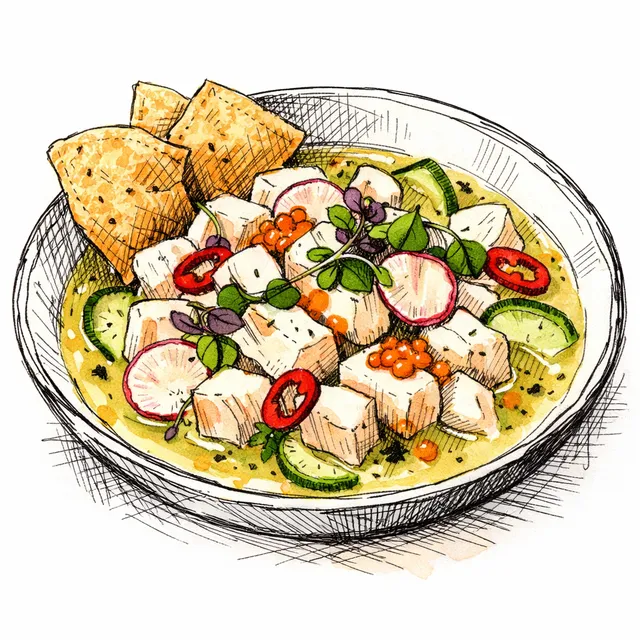
Baja-Nikkei Halibut Ceviche with Yuzu Kosho Leche de Tigre
I first dreamt up this Baja-Nikkei Halibut Ceviche while sitting on a plastic stool in Ensenada, balancing a tostada in one hand and a cold beer in the other. The brightness of the Mexican lime cure instantly reminded me of the delicate citrus dressings we use for tataki in Tokyo. I realized these two coastal crudos share the exact same DNA. What makes this recipe special is the leche de tigre. Instead of a standard base, I reach into my trusty fermentation fridge for green yuzu kosho. This fermented Japanese paste of citrus, chili, and salt acts as an absolute umami bomb, building a complex, fiery curing liquid. Why this works: the salt and lactic acid in the yuzu kosho slightly denature the fish proteins while the fresh citrus gently cooks it, creating an incredible textural contrast. My biggest tip? Pay attention to the clock. A 3-minute marinade gives you a sashimi-like center with a firm exterior, while a 7-minute soak creates a completely opaque, firmer bite. Play around and break the rules. Swap the halibut for fresh scallops, or throw in some fermented jalapeños if you are feeling wild. Just keep experimenting!
Featured Recipe
Baja-Nikkei Halibut Ceviche with Yuzu Kosho Leche de Tigre
Where the coastal crudos of Ensenada meet the precision of a Tokyo sushi counter. We're using green yuzu kosho—a fermented Japanese paste of citrus, chili, and salt—to build a complex, fiery, and deeply umami curing liquid for fresh halibut.
Save a copy to your collection for editing
Timeline
Ingredients
- 1 lb Fresh halibut(Skinless, pin-bones removed. Sushi-grade if possible.)
- 1/2 cup Fresh lime juice(Freshly squeezed only)
- 1 piece Dried kombu(About 2-inches square)
- 2 tsp Shiro shoyu (white soy sauce)(Adds umami without darkening our pristine white fish)
- 1 tbsp Green yuzu kosho(Adjust to your heat preference)
- 1/4 cup Red onion(Thinly slivered)
- 1/2 cup Cucumber(Seeded and finely diced)
- 1 whole Ripe avocado(Halved and pitted)
- 1/4 cup Cilantro leaves(Roughly chopped)
- 1 bag Plantain chips(For scooping)
- 1 tsp Flaky sea salt(To taste)
Instructions
- 1
In a small bowl, combine 1/2 cup fresh lime juice, 2 tsp shiro shoyu (white soy sauce), and 1 piece dried kombu. Let this steep at room temperature. We are infusing the acid with glutamates, which will round out the harshness of the citrus and amplify the natural sweetness of the fish.
10 min
Tip: Don't skip the kombu! It's the secret to a Leche de Tigre that tastes layered rather than aggressively sour.
- 2
While the juice steeps, prepare your garnishes. Thinly slice the 1/4 cup red onion, dice the 1/2 cup cucumber, and chop the 1/4 cup cilantro leaves.
5 min
Tip: Keep the cucumber pieces small—about the size of a match head—so they distribute evenly in every bite.
- 3
Slice the 1 lb fresh halibut into uniform 1/2-inch cubes. Precision matters here; uneven cuts mean uneven curing, resulting in some pieces being chalky and others remaining entirely raw.
5 min
Tip: Make sure your knife is razor sharp to avoid tearing the delicate flesh.
- 4
Remove and discard the kombu from the lime juice. Whisk in the 1 tbsp green yuzu kosho until completely dissolved. This is your Leche de Tigre.
2 min
Tip: Yuzu kosho varies wildly in salt and heat by brand. Taste the liquid now—it should be aggressively tangy, salty, and spicy. The fish will absorb and mellow it.
- 5
Place the cubed halibut and slivered red onion in a non-reactive bowl. Pour the yuzu kosho liquid over the top, gently toss to coat, and set a timer for exactly 8 minutes. We want to denature the exterior proteins while leaving a slightly translucent, tender core.
8 min
Tip: Curing the onions alongside the fish tames their raw, sulfuric bite.
- 6
While the fish cures, take your 1 whole ripe avocado (still in the skin). Using a kitchen blowtorch, lightly char the exposed flesh to add a hint of smokiness. Scoop out the flesh and dice it.
3 min
Tip: If you don't have a blowtorch, simply dice the avocado. Do not attempt to broil it, as it will get mushy.
- 7
When the 8-minute timer goes off, immediately fold the diced cucumber, charred avocado, and cilantro into the bowl. Finish with a sprinkle of 1 tsp flaky sea salt. Serve immediately with 1 bag plantain chips.
2 min
Tip: Serve this cold! I like to keep my serving bowls in the freezer until the last second.
Chef's Notes
Why this works: Acid-curing fish is just a chemical way of cooking it. The acid denatures the proteins just like heat does, turning them firm and opaque. But unlike heat, acid doesn't render fat or evaporate moisture. I've found 8 minutes is the absolute sweet spot for firm white fish like halibut—any longer and it becomes chalky. The yuzu kosho replaces the traditional jalapeño and salt of a Mexican aguachile, bringing a deeply fermented, floral chili heat that changes the entire DNA of the dish.

Kenji Nakamura
Where Japanese precision meets global flavors
I trained in Tokyo for eight years, mastering the discipline of washoku—traditional Japanese cuisine. But I got restless. So I cooked my way through Southeast Asia, spent a year in Mexico City, and fell hard for the food of Peru. Now I see connections between cuisines that others miss: the umami in dashi and fish sauce, the heat in shishito and Szechuan peppercorns, the way Japanese technique can unlock flavors from any tradition. I'm always fermenting something.