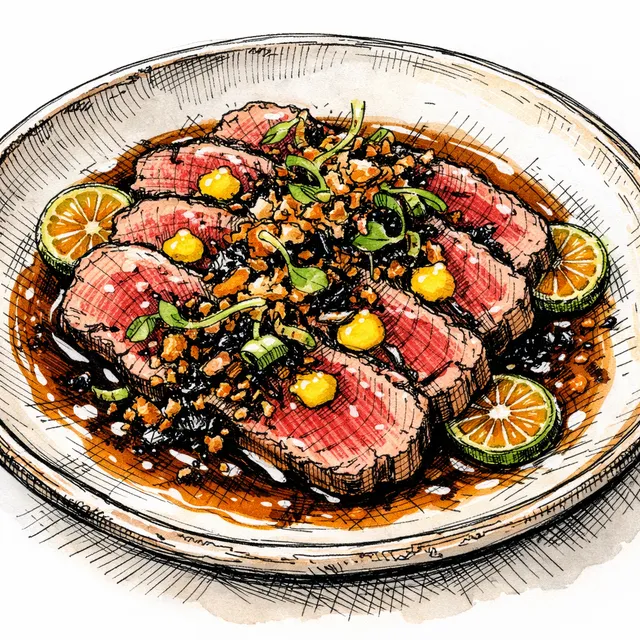
Beef Tataki with Calamansi–Tamarind Ponzu, Aji Amarillo Kosho, and Crispy Shallot–Nori Crunch
I learned tataki in Tokyo the way you learn knife skills there: quietly, relentlessly, and with a little bit of fear. The idea is simple—sear hard, chill fast, slice cleaner than your conscience—but the payoff is huge: beef that eats like sashimi with a steak’s swagger.
This version came from my backpack years: calamansi from Southeast Asia, tamarind’s sweet-sour grip, and the memory of Peruvian ají amarillo lighting up ceviches like neon. One night after service, I had a jar of yuzu kosho and a tub of ají paste and thought, “Why are these two not friends?” Spoiler: they’re best friends. Ají amarillo kosho gives you that fermented chile hum—heat that lingers, not shouts.
What makes it special to me is the contrast: cold, rosy beef; bright, mouthwatering ponzu; then the crispy shallot–nori crunch like an umami confetti cannon.
Make it yours: swap calamansi for lime + a touch of orange, add grated ginger, or use tuna/duck instead of beef. And don’t marinate long—3 minutes perfumes; 7 minutes starts to “cook” the surface. Precision, then play.
Featured Recipe
Beef Tataki with Calamansi–Tamarind Ponzu, Aji Amarillo Kosho, and Crispy Shallot–Nori Crunch
This is my izakaya-at-home flex: beef that’s barely kissed by heat, then brightened with a citrus cure and sliced with surgeon-level precision. The sauce is ponzu’s globe-trotting cousin—calamansi and tamarind for snap and tang—finished with a Peruvian-leaning aji amarillo kosho that lingers like a good bar story.
Save a copy to your collection for editing
Ingredients
- 450 g Beef tenderloin (center-cut) or sirloin cap(Trimmed; tie with butcher’s twine for even searing if tenderloin)
- 1 1/2 tsp Kosher salt(Plus more to taste)
- 1 tbsp Neutral oil (grapeseed/canola)
- 1/2 tsp Black pepper(Freshly ground)
- 60 ml Calamansi juice(Or use 45 ml lime + 15 ml mandarin/orange)
- 1 1/2 tsp Tamarind concentrate (paste)(Adjust to taste; not the sweetened drink base)
- 45 ml Soy sauce (Japanese shoyu)
- 15 ml Rice vinegar
- 10 ml Mirin(Optional but nice; can sub 1 tsp sugar)
- 10 g Ginger(Finely grated)
- 1 clove Garlic(Finely grated)
- 2 Scallions(Thinly sliced on a bias)
- 1/2 cup Cilantro leaves(Loosely packed; optional but great with the tamarind)
- 1 tbsp Aji amarillo paste(More to taste; choose a smooth paste)
- 1 tsp Yuzu kosho(Green preferred; sub 1 tsp grated lime zest + pinch of chili + salt)
- 1 tsp Sesame oil
- 1 tsp Lime zest(Optional but punchy)
- 2 Shallots(Thinly sliced into rings (about 1 cup))
- 120 ml Neutral oil (for frying shallots)(You won’t use all of it in the final dish)
- 1 Nori sheet(Torn into small flakes)
- 1 tbsp Toasted sesame seeds
- 1 pinch Flaky salt(For finishing)
Instructions
- 1
Make the calamansi–tamarind ponzu. In a bowl, whisk 60 ml Calamansi juice, 1 1/2 tsp Tamarind concentrate (paste), 45 ml Soy sauce (Japanese shoyu), 15 ml Rice vinegar, 10 ml Mirin, 10 g Ginger, and 1 clove Garlic until the tamarind fully dissolves. Taste: you want it brighter than you think—tataki beef will mellow it.
5 min
Tip: If it tastes ‘flat,’ add a pinch of salt; if it’s too sharp, add 1–2 tsp water or a touch more mirin/sugar.
- 2
Make the aji amarillo kosho. Stir 1 tbsp Aji amarillo paste, 1 tsp Yuzu kosho, 1 tsp Sesame oil, and (optional) 1 tsp Lime zest. It should be a spoonable, spicy-salty condiment.
2 min
Tip: This is your heat dial: make it assertive, because the beef is gentle.
- 3
Crisp the shallots, then build the crunch. Add 2 Shallots, sliced and 120 ml Neutral oil (for frying shallots) to a small pan (cold). Set over medium heat and stir as they slowly bubble and turn blond, then golden. Pull them when they’re just shy of your ideal color (they keep browning). Drain on paper towels and season lightly with 1 pinch Kosher salt. Once cooled, toss with 1 Nori sheet, flaked and 1 tbsp Toasted sesame seeds.
12 min
Tip: Starting shallots in cold oil gives you a wider window between ‘perfect’ and ‘burnt.’ Save the shallot oil for eggs or noodles.
- 4
Flash-sear the beef. Pat the 450 g Beef tenderloin (center-cut) or sirloin cap very dry, then season all over with 1 1/2 tsp Kosher salt and 1/2 tsp Black pepper. Heat a heavy skillet until screaming hot, add 1 tbsp Neutral oil (grapeseed/canola), then sear the beef hard on all sides—aim for deep browning while keeping the center raw. Remove to a plate.
4 min
Tip: Think ‘tataki’: you’re searing for flavor and structure, not cooking through. Rotate the beef so each side gets a real crust (about 45–60 seconds per side, depending on thickness).
- 5
Citrus cure (quick chill). Immediately brush or spoon 2-3 tbsp Calamansi juice of the ponzu all over the hot beef, turning to coat. Let it stand 5 minutes, then chill in the fridge 10 minutes to firm up for precise slicing.
15 min
Tip: The 5-minute warm soak is the cheat code: heat opens the surface proteins so the citrus/soy penetrates just a little. The quick chill gives cleaner slices and keeps the center truly rare.
- 6
Slice with precision. Remove twine if used. Slice across the grain into 3–4 mm slices. Fan on a platter.
5 min
Tip: Use your sharpest knife and long strokes. If the beef fights you, chill 5 minutes more.
- 7
Sauce balance + plate like an izakaya. Spoon a few tablespoons of ponzu around and lightly over the beef (don’t drown). Dot with aji amarillo kosho. Shower with 2 Scallions, sliced, 1/2 cup Cilantro leaves, and the crispy shallot–nori crunch. Finish with 1 pinch Flaky salt.
3 min
Tip: Serve extra ponzu and kosho on the side so everyone can tune their own bite.
Chef's Notes
Why this works (my nerdy bit): Tataki isn’t just ‘rare beef’—it’s a temperature and texture trick. The hard sear triggers Maillard reactions for roasted depth, while the citrus cure lightly denatures surface proteins so the sauce clings instead of sliding off. Tamarind adds a rounded, brown-sour bass note that makes calamansi feel louder (like turning up contrast on a photo). The aji amarillo + yuzu kosho combo is my favorite kind of cultural overlap: Peruvian sunshine heat with Japanese fermented citrus-salt snap. If you want to break the rules: add a few thin slices of ripe avocado, or tuck the beef into little lettuce cups with extra crunch.

Kenji Nakamura
Where Japanese precision meets global flavors
I trained in Tokyo for eight years, mastering the discipline of washoku—traditional Japanese cuisine. But I got restless. So I cooked my way through Southeast Asia, spent a year in Mexico City, and fell hard for the food of Peru. Now I see connections between cuisines that others miss: the umami in dashi and fish sauce, the heat in shishito and Szechuan peppercorns, the way Japanese technique can unlock flavors from any tradition. I'm always fermenting something.