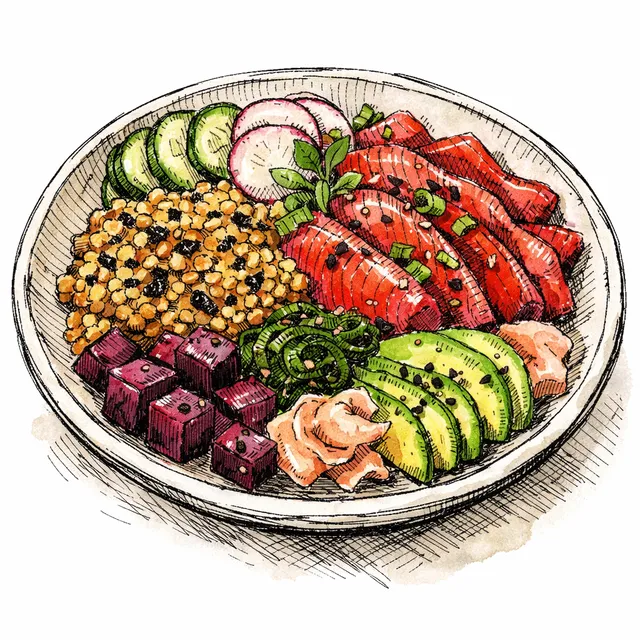
Beetroot, Sumac & Yuzu-Cured Atlantic Salmon Bowl with Warm Furikake Farro
Have you ever looked at a traditional Nordic gravlax and wondered what would happen if it took a vacation through the markets of Tokyo and the Middle East? That is exactly how this bowl was born. I was tinkering in my Tokyo kitchen one rainy Tuesday, staring at a massive bunch of beets and a jar of tart sumac I had hauled back from a trip. I love playing with the science of curing—how salt and sugar draw out moisture while proteins tighten up to create that silky, melting texture. By packing the Atlantic salmon in grated beets, crushed sumac, and fragrant yuzu zest, you get a cure that not only flavors the fish but stains the outer edges a striking, electric ruby. I nestle those delicate slices over warm, chewy farro tossed with nutty furikake, adding chilled shaved cucumber for crunch and a velvety yuzu-tahini drizzle to tie it all together. Why does this work? You are hitting every single note on the palate: the rich fat of the salmon, earthy sweetness from the beets, sharp citrus, and deep umami from the seaweed and sesame. Want to make it your own? Swap the farro for quinoa or even sticky sushi rice. Break the rules and make it yours.
Featured Recipe
Beetroot, Sumac & Yuzu-Cured Atlantic Salmon Bowl with Warm Furikake Farro
Silky, rich Atlantic salmon gets a stunning ruby-rimmed cure infused with earthy roasted beets, tart sumac, and floral yuzu zest. Sliced thin and nestled over nutty furikake farro with chilled shaved cucumber and a velvety yuzu-tahini drizzle, this bowl is an electrifying collision of Nordic gravlax technique and Japanese street-food soul.
Save a copy to your collection for editing
Timeline
Ingredients
- 1 lb center-cut Atlantic salmon fillet(skinless, pin bones removed)
- 1/4 cup kosher salt(Diamond Crystal preferred)
- 3 tbsp turbinado sugar(or raw sugar)
- 1/2 cup red beet(peeled and finely grated on a microplane)
- 1 tbsp ground sumac(for bright, citrusy acidity)
- 1 tbsp fresh yuzu zest(or Meyer lemon zest)
- 1 tsp freshly cracked black pepper
- 1 tbsp sake(dry junmai preferred)
- 1 cup pearled farro(rinsed thoroughly)
- 2 cups water(or light kombu dashi)
- 1/2 tsp kosher salt(for boiling farro)
- 1 tbsp toasted sesame oil
- 2 tbsp furikake(sesame, nori, and kombu blend)
- 2 scallions(thinly sliced)
- 3 tbsp well-stirred tahini
- 2 tbsp fresh yuzu juice(or equal parts lemon and lime juice)
- 1 tbsp white shoyu(or light Japanese soy sauce)
- 1 tbsp mirin
- 1 tsp fresh ginger(grated on a microplane)
- 3 tbsp ice-cold water(to loosen tahini)
- 1 English cucumber(shaved into thin ribbons using a vegetable peeler)
- 1 tbsp unseasoned rice vinegar
- 1 ripe avocado(pitted, peeled, and sliced into fans)
- 1 tsp toasted sesame seeds(mix of black and white)
- 4 fresh shiso leaves(stacked, rolled, and thinly sliced into ribbons)
Instructions
- 1
In a medium bowl, combine 1/4 cup kosher salt, 3 tbsp turbinado sugar, 1/2 cup finely grated red beet, 1 tbsp ground sumac, 1 tbsp fresh yuzu zest, 1 tsp freshly cracked black pepper, and 1 tbsp sake. Stir vigorously until a wet, neon-magenta paste forms.
5 min
Tip: Grating the raw beet finely releases its natural cell juices and betalain pigments, which carry the cure deep into the perimeter of the salmon while accelerating osmosis.
- 2
Lay a large sheet of plastic wrap on your counter. Spread half the beet-sumac cure in a strip matching the size of the salmon. Place 1 lb center-cut Atlantic salmon fillet directly on top, then pack the remaining cure evenly over the surface and sides of the fish. Wrap tightly in plastic wrap, set on a rimmed plate, and refrigerate to cure undisturbed for 35 minutes.
35 min
Tip: For this lunch bowl, 35 minutes is the sweet spot: it firms the exterior into a candy-like jewel ring while keeping the interior buttery and tender.
- 3
While the fish cures, combine 1 cup pearled farro, 2 cups water, and 1/2 tsp kosher salt in a medium saucepan. Bring to a rolling boil over medium-high heat, then lower the heat to low, cover with a tight-fitting lid, and simmer until the grains are tender with a pleasant al dente chew, about 22 to 25 minutes.
25 min
Tip: Pearled farro cooks faster than whole farro and absorbs the seasoning like a sponge.
- 4
In a small mixing bowl, whisk 3 tbsp well-stirred tahini, 2 tbsp fresh yuzu juice, 1 tbsp white shoyu, 1 tbsp mirin, and 1 tsp grated fresh ginger. The mixture will seize up and thicken initially; whisk in 3 tbsp ice-cold water one tablespoon at a time until the sauce transforms into a glossy, pourable emulsion.
6 min
Tip: Tahini is high in oil and proteins that hydrate aggressively when acid is introduced—ice water forces it into a velvety, stabilized emulsion.
- 5
Prep your vegetable toppings: Toss 1 English cucumber ribbons with 1 tbsp unseasoned rice vinegar and a pinch of salt in a small bowl, letting it sit to soften slightly. Slice 1 ripe avocado into thin fans and set aside.
8 min
Tip: Ribboning the cucumber creates ribbons that fold gracefully in the bowl, catching pools of dressing.
- 6
Check the farro. Uncover and drain any faint lingering liquid. Drizzle in 1 tbsp toasted sesame oil and gently fold in 2 tbsp furikake and 2 scallions. Cover off the heat to keep warm until plating.
5 min
Tip: Folding sesame oil directly into hot grains coats the starch granules, preventing clumping and locking in nutty aroma.
- 7
Remove the salmon from the refrigerator and unwrap. Gently rinse away the beet-sumac cure under a thin stream of cold running water. Immediately pat the fillet completely dry with paper towels. Using a very sharp slicing knife at a 45-degree angle, slice the salmon against the grain into 1/4-inch thick slices, showcasing the vibrant magenta edges and silky orange interior.
8 min
Tip: Be thorough when patting dry; any excess water left on the surface dilutes the cure's seasoning and muddles the clean knife cuts.
- 8
To assemble, divide the warm furikake farro among four wide shallow bowls. Shingle the sliced cured salmon on one side. Arrange the quick-pickled cucumber ribbons and avocado slices alongside. Generously drizzle the yuzu-tahini sauce across the bowl, then finish by scattering 1 tsp toasted sesame seeds and 4 fresh shiso leaves ribbons over the top.
5 min
Tip: Serve right away so you get the contrast between the warm, nutty farro and the chilled, velvety cured salmon.
Chef's Notes
Why this works: Atlantic salmon (Salmo salar) carries abundant intramuscular fat, making it structurally distinct from wild sockeye or coho. When exposed to a high-osmotic dry cure, salt draws free water out of the surface myocytes while denaturing the superficial myosin proteins. This compacts the perimeter of the fillet into a firm, glistening border while leaving the center buttery and supple. The malic acid from the Middle Eastern sumac synergizes with the betalain pigments in the beet to create a sharp ruby border, while cutting right through the rich omega-3 oils of the fish. Pairing Nordic gravlax philosophy with Japanese yuzu-shoyu and Levantine tahini proves that borders disappear when technique leads the way.

Kenji Nakamura
Where Japanese precision meets global flavors
I trained in Tokyo for eight years, mastering the discipline of washoku—traditional Japanese cuisine. But I got restless. So I cooked my way through Southeast Asia, spent a year in Mexico City, and fell hard for the food of Peru. Now I see connections between cuisines that others miss: the umami in dashi and fish sauce, the heat in shishito and Szechuan peppercorns, the way Japanese technique can unlock flavors from any tradition. I'm always fermenting something.