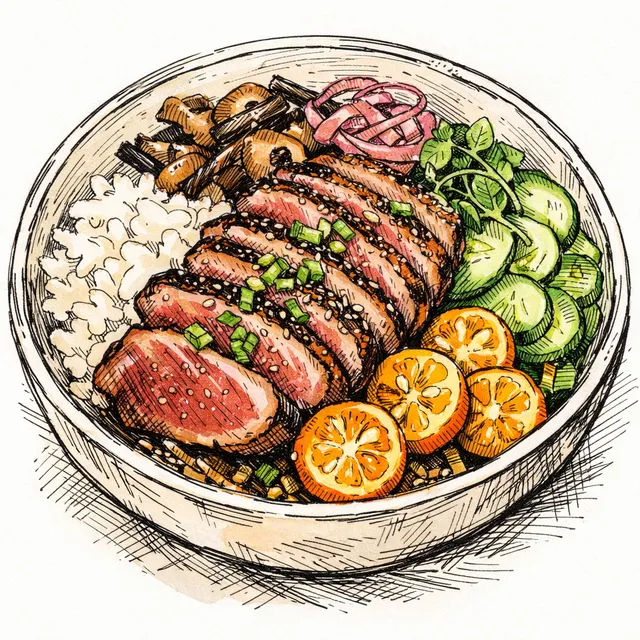
Black Cardamom & Kumquat-Cured Duck Breast Bowl
I still remember the night in a tiny Osaka izakaya when I first realized how obsessively duck skin craves citrus and smoke. That obsession followed me through street markets in Southeast Asia and eventually landed right here, in my own kitchen, bubbling away in a fermentation jar. This Black Cardamom and Kumquat-Cured Duck Bowl is the delicious result of those travels. The magic here is the cure. By pressing crushed black cardamom and bright kumquat zest into the duck breast, we pull out surface moisture while driving those punchy aromatics deep into the meat. Why this works: drawing out that water is the absolute secret to achieving shatter-crisp skin when it hits the hot pan. Layer that over warm ginger-jasmine rice, add a crunchy Asian pear and herb slaw to cut through the richness, and drizzle everything with a zippy kumquat-tamari tare. It is my ultimate weeknight flex. Feel free to make it your own by swapping the pear for green mango if you want more tartness, or play with the tare. Break the rules, have fun, and get some citrus fermenting while you are at it!
Featured Recipe
Black Cardamom & Kumquat-Cured Duck Breast Bowl
Rich, succulent duck breast undergoes a quick citrus-spice cure that seasons the meat deeply while drawing out surface moisture for impossibly shatter-crisp skin. Served over warm ginger-jasmine rice with a bright Asian pear and herb slaw, finished with a zippy kumquat-tamari tare.
Save a copy to your collection for editing
Timeline
Ingredients
- 2 boneless duck breasts(about 10-12 oz each, trimmed of excess flap fat)
- 2 tbsp coarse sea salt(for cure)
- 1 tbsp turbinado sugar(raw cane sugar also works)
- 1 tsp black cardamom seeds(cracked from pods, coarsely ground)
- 1/2 tsp coriander seeds(lightly cracked)
- 1 tbsp fresh kumquat zest(finely grated from about 5-6 kumquats)
- 1 cup jasmine rice(rinsed until water runs clear)
- 1 1/4 cups water(for cooking rice)
- 1 tbsp fresh ginger(peeled and finely minced)
- 1/2 tsp fine sea salt(for rice seasoning)
- 1 tbsp toasted sesame oil(for finishing the rice)
- 1 cup Asian pear(thinly shaved on a mandoline)
- 1/2 cup watermelon radish(scrubbed and shaved into paper-thin half-moons)
- 2 tbsp unseasoned rice vinegar(for slaw dressing)
- 1 tsp honey(to balance slaw acidity)
- 1/4 cup fresh Thai basil leaves(roughly torn)
- 1/4 cup fresh mint leaves(roughly torn)
- 3 tbsp fresh kumquat juice(strained of seeds)
- 2 tbsp tamari(or dark soy sauce)
- 1 tbsp mirin(Japanese sweet rice wine)
- 1 tbsp dashi(kombu or bonito dashi)
- 1 tsp chili crisp(or Japanese rayu)
Instructions
- 1
Score the skin of 2 boneless duck breasts in a tight 1/4-inch diamond pattern, being careful not to cut into the meat. In a small mortar or bowl, mix 2 tbsp coarse sea salt, 1 tbsp turbinado sugar, 1 tsp black cardamom seeds, 1/2 tsp coriander seeds, and 1 tbsp fresh kumquat zest. Rub the cure all over both duck breasts, coating the flesh and the scored skin thoroughly.
5 min
Tip: Scoring allows the cure to penetrate the dense subcutaneous fat layer and guarantees even rendering later.
- 2
Place the cured duck breasts skin-side up on a small wire rack set over a rimmed plate and refrigerate uncovered for 25 minutes. Meanwhile, in a small saucepan, combine 1 cup jasmine rice, 1 1/4 cups water, 1 tbsp fresh ginger, and 1/2 tsp fine sea salt. Bring to a boil over medium-high heat, cover with a tight lid, reduce heat to low, and cook for 15 minutes undisturbed.
20 min
Tip: Leaving the duck uncovered in the fridge pulls moisture out of the skin via osmosis and cold air circulation—the secret to hyper-crispy skin.
- 3
While the rice simmers, whisk together 3 tbsp fresh kumquat juice, 2 tbsp tamari, 1 tbsp mirin, 1 tbsp dashi, and 1 tsp chili crisp in a small bowl until emulsified to create the tare. In a separate bowl, toss 1 cup Asian pear and 1/2 cup watermelon radish with 2 tbsp unseasoned rice vinegar and 1 tsp honey.
10 min
Tip: Don't add the fresh herbs to the slaw yet; keep them dry so they don't wilt before plating.
- 4
Remove the duck breasts from the refrigerator. Quickly rinse the excess surface salt and spices off under a gentle stream of cold water, then thoroughly pat them completely bone-dry with clean paper towels.
5 min
Tip: Water is the enemy of Maillard browning! Take an extra 30 seconds to make sure the duck skin is completely dry.
- 5
Place the duck breasts skin-side down into a cold, dry stainless steel or cast-iron skillet. Set the heat to medium-low. Let the duck render slowly as the pan comes up to temperature, spooning off excess accumulated fat into a jar, until the skin is deep golden brown and completely crisp, about 10-12 minutes. Flip and cook on the flesh side for 2 minutes for medium-rare (around 130°F/54°C internally).
14 min
Tip: Starting in a completely cold skillet is essential; it melts the thick subcutaneous fat slowly before the meat can overcook.
- 6
Transfer the seared duck to a cutting board to rest for 6 minutes. Fluff the rested ginger rice with a fork and fold in 1 tbsp toasted sesame oil. Gently fold 1/4 cup fresh Thai basil leaves and 1/4 cup fresh mint leaves into the pickled pear and radish slaw.
6 min
Tip: Resting redistributes the pressurized juices throughout the muscle fibers so you don't lose that rich duck jus on your cutting board.
- 7
Slice the rested duck breasts on a 45-degree bias into 1/4-inch medallions. Divide the warm ginger rice between two shallow bowls. Arrange the sliced duck alongside a generous heap of the pear-herb slaw. Drizzle the kumquat-tamari tare generously over the duck and rice, and serve immediately.
4 min
Tip: Slice with a single fluid draw of a sharp knife so you don't crush the crisp skin.
Chef's Notes
Why this works: Duck breast fat has a melting point of around 57°F (14°C), making it intensely rich. By using a 25-minute dry cure seasoned with crushed black cardamom and fresh kumquat zest, we trigger osmosis—drawing out moisture from the surface cells, tightening the skin proteins, and infusing the smoky, camphor-rich cineole compounds of black cardamom deep into the tissue. When seared slowly from a cold pan, that dehydrated skin transforms into pure chicharrón-grade crispness. Paired against the sharp citric acid of kumquat tare and cooling Asian pear, every bite cuts right through the decadence.

Kenji Nakamura
Where Japanese precision meets global flavors
I trained in Tokyo for eight years, mastering the discipline of washoku—traditional Japanese cuisine. But I got restless. So I cooked my way through Southeast Asia, spent a year in Mexico City, and fell hard for the food of Peru. Now I see connections between cuisines that others miss: the umami in dashi and fish sauce, the heat in shishito and Szechuan peppercorns, the way Japanese technique can unlock flavors from any tradition. I'm always fermenting something.