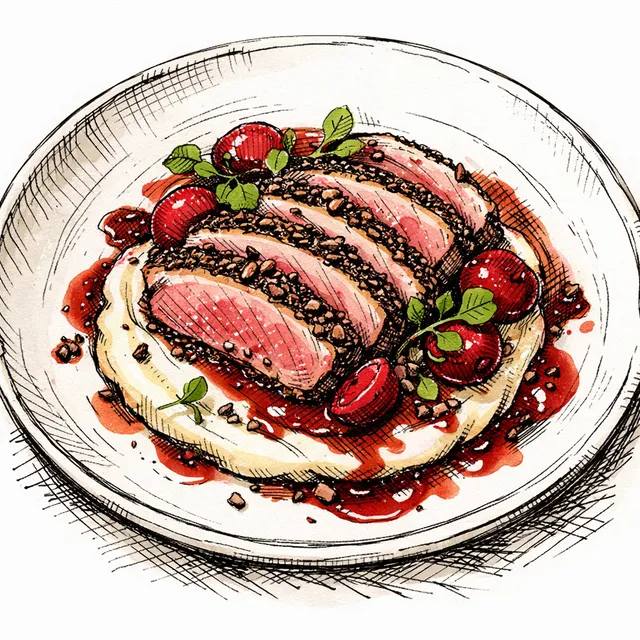
Cacao Nib & Sansho-Cured Duck Breast with Celery Root Silk and Tart Cherry-Umeshu Gastrique
I still remember the night this dish was born in my Tokyo kitchen, staring at a jar of leftover umeshu and a bag of Oaxacan cacao nibs. I realized rich, fatty duck breast is the ultimate canvas for bridging Latin American depth with Japanese precision. We cure the duck briefly in roasted cacao and tongue-tingling sansho pepper—a spice cousin to Sichuan peppercorns that brings bright citrus notes rather than just heat. Why this works: the bitterness of the cacao cuts right through the rich duck fat, while the sansho wakes up your palate just in time for the velvety, kombu-infused celery root silk. Pour over a tart cherry gastrique sharpened by Japanese plum liqueur, and you have a masterclass in fat-cutting acidity. Tip for making it your own? Don't skip the cold-pan sear; starting in a cold pan lets the fat render out slowly, giving you glass-crisp skin every single time. Break the rules, play with the cure time, and most importantly, have fun in the kitchen!
Featured Recipe
Cacao Nib & Sansho-Cured Duck Breast with Celery Root Silk and Tart Cherry-Umeshu Gastrique
Succulent duck breast quick-cured in roasted cacao and tingling sansho pepper, seared to glass-crisp perfection in a cold pan. Paired with a velvety kombu-dashi celery root purée and a tart cherry gastrique sharpened by Japanese plum liqueur, this dish is a masterclass in balance, texture, and fat-cutting acidity.
Save a copy to your collection for editing
Timeline
Ingredients
- 2 duck breasts(boneless, skin-on, about 8 oz each)
- 1.5 tbsp roasted cacao nibs(finely ground in a spice grinder)
- 1 tsp sansho pepper(freshly ground (or sub green Sichuan peppercorns))
- 1.5 tsp fine sea salt(divided: 1 tsp for the duck cure, 0.5 tsp for the celery root purée)
- 1 tsp turbinado sugar(or raw cane sugar)
- 1 lb celery root(peeled and cut into 1/2-inch cubes (about 3 cups))
- 1 cup kombu dashi(light Japanese kelp stock (or vegetable stock))
- 0.5 cup heavy cream
- 2 tbsp shiro miso(sweet white fermented soybean paste)
- 4 tbsp unsalted butter(divided and chilled: 2 tbsp for purée, 1 tbsp for basting duck, 1 tbsp for gastrique)
- 3 garlic cloves(lightly crushed)
- 3 sprigs fresh thyme
- 2 tbsp yellow mustard seeds
- 0.25 cup unseasoned rice vinegar(divided: 3 tbsp for pickled mustard seeds, 1 tbsp for gastrique)
- 2 tbsp mirin(Japanese sweet rice wine)
- 0.5 cup umeshu(Japanese green plum liqueur)
- 0.5 cup tart cherries(thawed frozen Morello cherries or pitted fresh sour cherries, halved)
- 0.25 cup micro red shiso(for garnish (substitute with watercress or chervil))
- 1/4 cup cup duck fat(This is mentioned as being spooned away from the duck, implying it was rendered and used.)
Instructions
- 1
In a small mortar or bowl, combine 1.5 tbsp roasted cacao nibs, 1 tsp sansho pepper, 1 tsp fine sea salt, and 1 tsp turbinado sugar. Pat 2 duck breasts dry and use a sharp knife to lightly score the fat cap in a tight 1/4-inch diamond lattice, taking care not to cut through to the red meat. Rub the cacao-sansho cure entirely across the flesh side of the breasts, keeping the scored skin dry and bare. Place the duck breasts flesh-side up on a wire rack set over a tray and refrigerate uncovered to cure for 35 minutes.
10 min
Tip: Keeping the skin side unseasoned and exposed to circulating dry fridge air wicks away surface moisture, guaranteeing an impossibly shatter-crisp crust later.
- 2
In a medium saucepan, combine 1 lb celery root, 1 cup kombu dashi, 0.5 cup heavy cream, and 0.5 tsp fine sea salt. Bring to a gentle boil over medium heat, then reduce the heat to medium-low, cover partially with a lid, and simmer until the celery root is tender enough to crush easily against the pot with a wooden spoon, about 18 minutes.
20 min
Tip: Cooking the celery root directly in dashi infuses the root's earthy sweetness with rich glutamates from kombu.
- 3
While the celery root simmers, combine 2 tbsp yellow mustard seeds, 3 tbsp unseasoned rice vinegar, and 2 tbsp mirin in a very small saucepan over medium heat. Bring to a bubbling simmer, then turn heat to low and cook until the liquid reduces into a thick gloss and the seeds plump up and soften slightly, about 10 minutes. Remove from heat and set aside.
10 min
Tip: These quick-pickled seeds pop with acidity in your mouth like caviar, cutting the ultra-rich duck fat.
- 4
Transfer the tender celery root along with all remaining cooking liquid into a high-speed blender. Add 2 tbsp shiro miso and 2 tbsp unsalted butter. Blend on high for 90 seconds until the purée transforms into an ultra-smooth, glossy silk. Taste for seasoning, transfer to a small container, cover tightly, and keep warm.
5 min
Tip: Emulsifying cold butter and fermented miso into the hot starch creates a velvet mouthfeel without needing heavy potato starches.
- 5
Retrieve the cured duck breasts from the refrigerator. Use a clean paper towel to wipe away the excess granular cure from the flesh side, then thoroughly pat both the skin and the meat dry.
3 min
Tip: Don't rinse the meat under water! A firm wipe with a dry paper towel leaves the embedded flavors intact while preventing steam from ruining your sear.
- 6
Place the duck breasts skin-side down in a completely cold, dry cast-iron or carbon steel skillet. Set the burner to medium-low heat. As the pan slowly warms up, the fat will begin to liquefy and render out. Cook undisturbed for 12 to 14 minutes, continuously tilting the pan to spoon away the pooling clear duck fat into a heatproof jar, until the skin turns deep golden brown and glass-crisp.
14 min
Tip: Starting in a cold pan is non-negotiable. If you drop cold duck into a screaming hot pan, the fat shocks and locks in place instead of rendering out smoothly.
- 7
While the duck skin renders, prepare the gastrique base. In a small saucepan, combine 0.5 cup umeshu, 0.5 cup tart cherries, and 1 tbsp unseasoned rice vinegar. Bring to a simmer over medium heat and reduce until the liquid turns into a syrupy, bubbling glaze, about 8 minutes. Turn off the heat and keep warm.
8 min
Tip: The stone-fruit acidity of the sour cherries married with the caramelized sweetness of Japanese plum liqueur creates the ultimate duck companion.
- 8
Once the duck skin is ultra-crisp, flip the breasts over to the flesh side. Immediately toss 1 tbsp unsalted butter, 3 garlic cloves, and 3 sprigs fresh thyme into the skillet. Tilt the pan and spoon the foaming aromatic butter over the crisp skin continuously for 90 seconds to 2 minutes, until an instant-read thermometer inserted into the thickest part reads 130°F (54°C) for medium-rare. Transfer breasts skin-side up to a cutting board to rest for 6 minutes.
6 min
Tip: Baste only the flesh side directly in contact with the pan heat; spooning butter over the skin perfumes it without softening your hard-won crackling.
- 9
Pour any savory resting juices that have seeped onto the cutting board from the duck into the warm cherry-umeshu saucepan over low heat. Swirl in the final 1 tbsp unsalted butter vigorously off the heat until the sauce emulsifies into a dark, mirror-sheen reduction.
3 min
Tip: Mounting the cold butter off the heat binds the fat, acid, and fruit sugars into a luxurious French pan sauce emulsion.
- 10
Divide the warm celery root silk between two dinner plates, smoothing it into an elegant sweep with the back of a spoon. Slice the rested duck breasts on a 45-degree angle into 1/2-inch thick ribbons and fan them across the purée. Spoon the glossy tart cherry-umeshu gastrique around the meat, dot each plate with the pickled mustard seeds, and crown with 0.25 cup micro red shiso.
5 min
Tip: Slice with one smooth pull of a sharp knife so you don't crush the crunchy skin down into the tender pink breast meat.
Chef's Notes
Why this works: Duck breast is often treated like steak, but culinarily it behaves like dark game meat wrapped in a thick blanket of subcutaneous fat. 1. The Science of the Cacao & Sansho Quick-Cure: Salt draws out free water from the surface muscle fibers via osmosis. As that moisture dissolves the turbinado sugar, sansho pepper, and crushed cacao nibs, a seasoned brine forms that is drawn back into the meat, breaking down the muscle proteins (specifically myosin) and locking in moisture during cooking. The cacao nibs bring deep, roasted polyphenols reminiscent of Oaxacan mole, while sansho delivers hydroxy-alpha-sanshool—a molecule that triggers tactile tingling receptors on your tongue, balancing duck's heavy iron richness. 2. The Cold-Pan Technique: Dropping duck skin into a smoking hot pan contracts the fat cells too quickly, trapping raw fat beneath a scorched surface. Starting in a cold pan allows the heat to gently penetrate, melting the fat cap down to paper-thin parchment while rendering out liquid gold you can save for roasting potatoes later. 3. Acid & Umami Interplay: The gastrique balances tart cherries with umeshu (Japanese green ume plum liqueur), providing stone-fruit malic and citric acids that slice right through the duck's unctuousness.

Kenji Nakamura
Where Japanese precision meets global flavors
I trained in Tokyo for eight years, mastering the discipline of washoku—traditional Japanese cuisine. But I got restless. So I cooked my way through Southeast Asia, spent a year in Mexico City, and fell hard for the food of Peru. Now I see connections between cuisines that others miss: the umami in dashi and fish sauce, the heat in shishito and Szechuan peppercorns, the way Japanese technique can unlock flavors from any tradition. I'm always fermenting something.