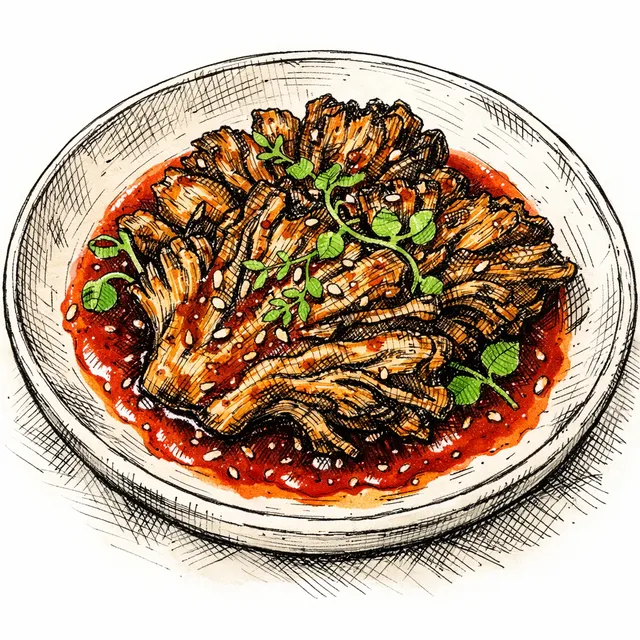
Cast-Iron Pressed Maitake with Umeboshi-Ancho "Chamoy"
I still remember the blistering heat of a Oaxaca afternoon, standing at a street cart eating fresh mango drenched in chamoy. The salty, sour, fruity heat hit my tongue, and my brain instantly flashed back to Tokyo: umeboshi. Japanese pickled plums share that exact same DNA—that aggressive, mouth-puckering salinity. I knew right then I had to bridge the gap.
Enter my Cast-Iron Pressed Maitake with Umeboshi-Ancho "Chamoy." This dish is special to me because it's a literal mashup of my time in Mexico and my roots in Japan.
Why this works: If you've never pressed a mushroom under a heavy iron skillet, your life is about to change. We're using high heat to violently expel water, collapsing the cellular structure. This concentrates the glutamates and creates a meaty, impossibly crispy center piece.
Once it's charred and compressed, we baste it in a sticky, sweet-sour-spicy glaze of pureed umeboshi, toasted ancho chiles, and a splash of my current favorite fermented honey.
Want to make it your own? Swap the ancho for guajillo if you want it brighter, or throw some toasted sesame seeds on top. Don't be precious with it—just get that pan smoking hot and let the magic happen.
Featured Recipe
Cast-Iron Pressed Maitake with Umeboshi-Ancho "Chamoy"
If you've never pressed a mushroom under a heavy iron skillet, your life is about to change. We're using high heat to violently expel water, collapsing the cellular structure to create a meaty, impossibly crispy center piece. Basted in a sticky, sweet-sour-spicy glaze that connects the dots between Japanese pickled plums and Mexican chamoy, this is the ultimate elevated izakaya snack.
Save a copy to your collection for editing
Timeline
Ingredients
- 1 lb Maitake mushrooms(kept in large clusters)
- 2 tbsp Umeboshi paste(Japanese pickled plum paste)
- 1 tbsp Ancho chile powder
- 1 tbsp Agave nectar(or honey)
- 1 tbsp Lime juice(freshly squeezed)
- 1 tbsp Soy sauce
- 2 tbsp Neutral oil(grapeseed or avocado)
- 1 tsp Toasted sesame seeds
- 1 tbsp Cilantro(finely chopped)
Instructions
- 1
Place a large cast-iron skillet over medium-high heat. If you have a second heavy skillet (or a brick wrapped in foil), place that on an adjacent burner over low heat so it warms up. We need two hot, heavy objects to mimic the intense direct heat of a robata grill.
5 min
Tip: Don't skip preheating the top weight! It sears the top of the mushroom simultaneously and prevents it from steaming.
- 2
While the pans heat, whisk together 2 tbsp umeboshi paste, 1 tbsp ancho chile powder, 1 tbsp agave nectar, 1 tbsp lime juice, and 1 tbsp soy sauce in a small bowl until completely smooth. This is your fusion chamoy.
3 min
Tip: Umeboshi can be quite salty depending on the brand; if yours is very intense, add a splash of water to thin out the glaze.
- 3
Trim the very bottom tough core from 1 lb maitake mushrooms, taking care to keep the clusters as intact as possible. Gently pull them apart into 3 or 4 thick, steak-like slabs.
2 min
Tip: Maitakes are delicate; handle them like a prime cut of wagyu so the frilly edges don't break off.
- 4
Pour 2 tbsp neutral oil into the screaming hot bottom skillet. Lay the mushroom slabs in the oil, then immediately place your second hot skillet directly on top of them. Press down firmly for 5 seconds to flatten, then let them sear undisturbed for 4 minutes.
4 min
Tip: You will hear a loud sizzle and see a lot of steam. This is exactly what we want—driving off water to concentrate flavor.
- 5
Remove the top skillet. Using tongs, carefully flip the flattened mushrooms. They should be deeply browned and lacy. Replace the top skillet, press firmly again, and sear for another 4 minutes.
4 min
Tip: If the edges look like they're burning rather than browning, slightly lower the heat on the bottom burner.
- 6
Remove the top weight permanently and reduce the heat to medium-low. Using a pastry brush, generously mop the umeboshi-ancho chamoy over both sides of the mushrooms. Let the sugars in the agave and fruit caramelize in the pan for about 30 seconds per side.
2 min
Tip: Watch closely here—the sugars will go from perfectly caramelized to burnt very quickly.
- 7
Transfer the glazed maitake slabs to a serving plate. Garnish immediately with 1 tsp toasted sesame seeds and 1 tbsp cilantro.
1 min
Tip: Serve these whole with chopsticks or a small knife so guests can tear into them.
Chef's Notes
Here is the food science behind the smash: Mushrooms are basically tiny sponges made of chitin and water. When we apply intense, heavy heat via the double cast-iron method, we rapidly expel that water while breaking down the cell walls. This forces a massive Maillard reaction that turns a fluffy fungus into a dense, meaty, umami-packed steak. As for the glaze? Japanese umeboshi (pickled plum) and Mexican chamoy share an uncanny amount of culinary DNA. They both rely on fermented, salted fruit heavily cut with acid and heat. Blending umeboshi with earthy ancho chile bridges Tokyo and Oaxaca in a single bite. You are absolutely going to want an ice-cold highball with this.

Kenji Nakamura
Where Japanese precision meets global flavors
I trained in Tokyo for eight years, mastering the discipline of washoku—traditional Japanese cuisine. But I got restless. So I cooked my way through Southeast Asia, spent a year in Mexico City, and fell hard for the food of Peru. Now I see connections between cuisines that others miss: the umami in dashi and fish sauce, the heat in shishito and Szechuan peppercorns, the way Japanese technique can unlock flavors from any tradition. I'm always fermenting something.