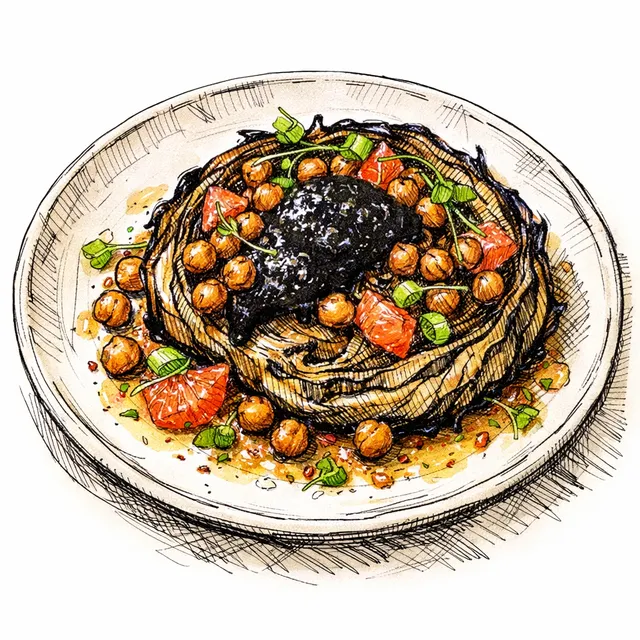
Charred Cabbage Steak with Nori–Mole Negro Butter (My Favorite Winter Umami Trick)
January is when I fall back in love with cabbage. In Tokyo, I learned to respect vegetables the way you respect fish: temperature control, timing, and a little ruthlessness. Years later in Oaxaca, I tasted mole negro so deep it felt like night—chiles, chocolate, smoke, toasted seeds. I kept thinking, this is basically an umami dashi in another language.
That’s where this dish came from: thick cabbage wedges seared like steaks until the cut sides go almost-black, then a quick steam to make the core silky instead of crunchy. The nori–mole negro butter is my shortcut to “why can’t vegetables taste like a full story?” Nori brings oceanic glutamates; mole brings roasted bitterness and bass notes. Together, they melt into the char like lacquer.
I first made this during a cold January service when we were out of “real” garnishes—so I roasted chickpeas until they crackled, and I spiked a grapefruit-honey vinaigrette with yuzu koshō for heat and citrus bite. It’s still my favorite contrast: sweet cabbage, bitter char, funk, crunch, sparkle.
Make it yours: swap chickpeas for toasted pepitas, use blood orange, or stir miso into the butter. Rules are optional—heat is not.
Why this works
Char gives bitterness and aroma; steaming finishes the interior without losing the seared crust. Nori + mole stacks glutamates and roasted compounds, while grapefruit and yuzu koshō cut the fat and reset your palate for the next bite.
Featured Recipe
Charred Cabbage “Steak” with Nori–Mole Negro Butter, Crispy Chickpeas, and Grapefruit-Honey Koshō Vinaigrette
January is cabbage season—cheap, sweet, and built for high heat. I treat thick cabbage wedges like steaks: hard sear, deep char, then a quick steam to turn the core silky. The twist is a Japanese-Mexican umami bomb: nori folded into mole negro butter, finished with bright grapefruit-honey yuzu koshō vinaigrette and crunchy roasted chickpeas.
Save a copy to your collection for editing
Ingredients
- 1 head Green cabbage (or savoy), cut into 4 thick wedges, core intact(Aim for 1 1/2-inch wedges so they don’t fall apart)
- 2 tbsp Neutral oil (grapeseed/canola)
- 1 1/2 tsp Kosher salt(Plus more to taste)
- 1/2 tsp Black pepper
- 1/4 cup Water(For steaming in the pan)
- 1 can (15 oz) Cooked chickpeas, well drained and patted dry(Or 1 1/2 cups cooked)
- 1 1/2 tbsp Olive oil(For roasting chickpeas)
- 1 tsp Smoked paprika
- 1/2 tsp Ground cumin
- 1/2 tsp Garlic powder
- 4 tbsp Unsalted butter(Can sub vegan butter)
- 1 1/2 tbsp Mole negro paste (or prepared mole negro)(Look for a thick paste; if using sauce, reduce briefly in a pan)
- 1 sheet Nori sheets, finely snipped or blitzed to flakes(Adds oceanic glutamates without tasting ‘fishy’)
- 1 tsp Soy sauce(Or tamari)
- 3 tbsp Fresh grapefruit juice(January peak; ruby or white both work)
- 1 tsp Grapefruit zest(Optional but great)
- 1 tbsp Rice vinegar
- 2 tsp Honey(Or maple syrup)
- 1 tsp Yuzu koshō(Adjust to heat tolerance)
- 1 tsp Toasted sesame oil
- 2 Scallions, thinly sliced(Green parts preferred)
- 1/2 cup Cilantro leaves (optional)(I like the Peru-meets-Tokyo vibe here)
Instructions
- 1
Heat oven to 425°F / 220°C. Toss 1 can (15 oz) Cooked chickpeas, well drained and patted dry with 1 1/2 tbsp Olive oil, 1 tsp Smoked paprika, 1/2 tsp Ground cumin, 1/2 tsp Garlic powder, and a pinch of Kosher salt. Spread on a sheet pan and roast until deeply crisp, shaking once, 20–25 minutes. Let cool on the tray (they crisp more as they cool).
25 min
Tip: Dry chickpeas = crunch. If they’re wet, they steam and go chewy.
- 2
Mix the grapefruit-honey koshō vinaigrette: Whisk 3 tbsp Fresh grapefruit juice, 1 tbsp Rice vinegar, 2 tsp Honey, 1 tsp Yuzu koshō, 1 tsp Toasted sesame oil, and a pinch of Kosher salt. Add 1 tsp Grapefruit zest if using. Set aside.
5 min
Tip: Taste for balance: it should be bright, slightly sweet, and gently spicy.
- 3
Make the nori–mole butter: In a small pan over medium-low heat, melt 4 tbsp Unsalted butter. Stir in 1 1/2 tbsp Mole negro paste (or prepared mole negro) and 1 tsp Soy sauce until smooth. Add 1 sheet Nori sheets, finely snipped or blitzed to flakes and cook 30–60 seconds just to bloom the aroma. Keep warm on the lowest heat.
5 min
Tip: Low heat keeps the cocoa/chile notes from turning bitter and preserves nori’s fragrance.
- 4
Char and steam the cabbage: Heat a large cast-iron skillet (or heavy pan) over medium-high until very hot. Add 2 tbsp Neutral oil (grapeseed/canola). Season 1 head Green cabbage (or savoy), cut into 4 thick wedges, core intact with 1 1/2 tsp Kosher salt and 1/2 tsp Black pepper, then sear cut-side down until aggressively charred, 4–6 minutes. Flip to the other cut side and repeat, 3–5 minutes.
11 min
Tip: Don’t baby it. Cabbage wants real heat—char = sweetness.
- 5
Steam to tenderness: Reduce heat to medium. Add 1/4 cup Water to the pan (it will hiss), immediately cover, and steam 3–5 minutes until the core is knife-tender but the wedges still hold shape.
5 min
Tip: This is my favorite ‘restaurant trick’ for home: sear for flavor, steam for texture.
- 6
Glaze and plate: Transfer cabbage to a platter. Spoon warm nori–mole butter over the top so it melts into the leaves. Sprinkle with crispy chickpeas. Drizzle with grapefruit-honey koshō vinaigrette. Finish with 2 Scallions, thinly sliced and 1/2 cup Cilantro leaves (optional).
3 min
Tip: Serve immediately so you get hot cabbage + melting butter + cold bright vinaigrette.
Chef's Notes
WHY THIS WORKS (my nerdy version): 1) Cabbage loves high heat: The outer leaves char fast, building Maillard bitterness that reads as ‘grilled,’ while the natural sugars concentrate and taste sweet. Then a short steam finishes the dense core without drying the leaves. 2) Nori + mole is a glutamate tag-team: Mole already brings roasted chiles, nuts/seeds, and often a hint of cocoa. Nori adds oceanic glutamates and a gentle iodine edge—like adding dashi without making it Japanese-soup obvious. 3) Crunch insurance: Chickpeas stay crunchy longer than breadcrumbs in a saucy dish, and they echo the toasted seed/nut notes inside mole. 4) Temperature contrast = excitement: Warm buttered cabbage, cool citrus vinaigrette, and crunchy chickpeas hit the same ‘contrast plate’ button I love—just in a different lane than my fish/noodle winter dishes. PERSONAL STORY: When I was cooking in Mexico City, I learned that vegetables can absolutely be the main event if you treat them like meat—proper sear, proper fat, proper acid. Back in Tokyo, my mentor taught me to think of seaweed as a seasoning, not a category. This dish is my January bridge between those lessons. SWAPS / HOME-COOK NOTES: - No mole negro? Use 1 tbsp cocoa powder + 1 tbsp chili powder + 1 tbsp tahini + 1 tsp brown sugar in the butter, plus an extra pinch of salt. - Vegan: swap butter for vegan butter or a thick olive-oil emulsion; keep the nori. - Add protein: top with a fried egg or shredded rotisserie chicken tossed in the vinaigrette. - Make ahead: roast chickpeas and mix vinaigrette up to 2 days ahead; char/steam cabbage right before serving.

Kenji Nakamura
Where Japanese precision meets global flavors
I trained in Tokyo for eight years, mastering the discipline of washoku—traditional Japanese cuisine. But I got restless. So I cooked my way through Southeast Asia, spent a year in Mexico City, and fell hard for the food of Peru. Now I see connections between cuisines that others miss: the umami in dashi and fish sauce, the heat in shishito and Szechuan peppercorns, the way Japanese technique can unlock flavors from any tradition. I'm always fermenting something.