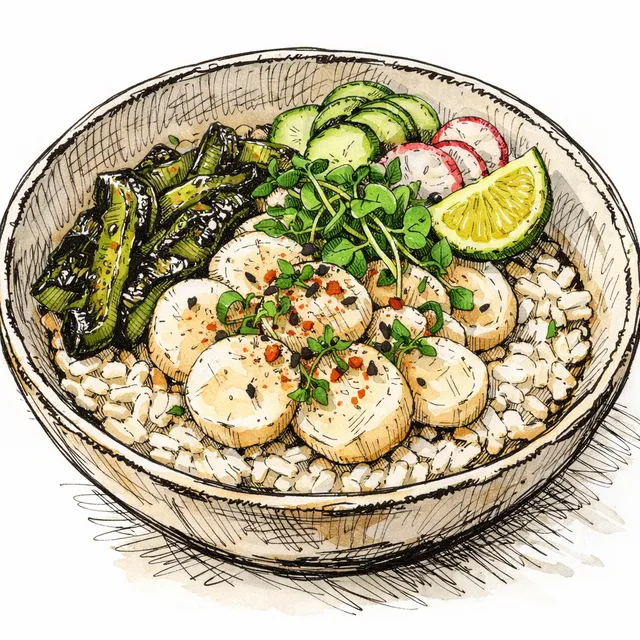
Charred Poblano and Sudachi-Cured Hokkaido Scallop Bowl
I still remember standing in a tiny market stall in Oaxaca, biting into a charred poblano taco while dreaming of the sweet, pristine Hokkaido scallops I used to break down in Tokyo. That collision of flavors sparked something in my brain. Why not treat a raw scallop like a ceviche, but lean into the enzymatic magic of shio koji? In this bowl, we briefly cure sashimi-grade scallops in bright sudachi juice and shio koji, then give them a lightning-fast, blistering char on one side only. You get the smoky soul of a Mexican marisquería paired with the surgical precision of a sushi bar. Toss in creamy avocado, crisp radishes, and warm dashi-scented rice, and you have pure harmony. My biggest tip? Don't overcomplicate the char. Get your pan screaming hot, count to thirty, and pull them off. Want to make it your own? Swap the poblano for a roasted anaheim if you want less heat, or play around with whatever citrus is on your counter. Dive in, break the rules, and enjoy the umami.
Featured Recipe
Charred Poblano and Sudachi-Cured Hokkaido Scallop Bowl
Sashimi-grade Hokkaido sea scallops are briefly cured in citrusy sudachi and enzymatically rich shio koji, then kissed with a blistering one-sided char. Paired with smoky roasted poblano ribbons, crisp market radishes, and creamy avocado over warm dashi-scented rice, this vibrant bowl bridges the precision of a Tokyo sushi bar with the smoky soul of coastal Mexican marisquerías.
Save a copy to your collection for editing
Timeline
Ingredients
- 1 cup Koshihikari sushi rice(rinsed until clear)
- 1 1/4 cups Water
- 1 tsp Toasted sesame oil
- 12 oz Hokkaido sea scallops(dry-pack, U-10 or U-12 count, side muscle removed)
- 2 tbsp Shio koji
- 2 tbsp Fresh sudachi juice(calamansi or lime juice can be substituted)
- 1/2 tsp Sea salt(flaky sea salt)
- 1 Poblano pepper(large)
- 1 Avocado(ripe, sliced into wedges)
- 3 Radishes(medium, thinly shaved)
- 1/2 English cucumber(medium, thinly shaved into half-moons)
- 1 tbsp White shoyu(or light soy sauce)
- 1 tbsp Neutral high-heat oil(such as grapeseed or avocado oil)
- 2 Scallions(thinly sliced on a bias)
- 1 tbsp Furikake(nori-sesame blend)
- 1/4 cup Fresh cilantro leaves(tender leaves and stems)
Instructions
- 1
Rinse 1 cup Koshihikari sushi rice until the water runs clear, drain thoroughly, and transfer to a small saucepan or rice cooker with 1 1/4 cups Water and 1 tsp Toasted sesame oil. Bring to a boil over medium-high heat, cover tightly with a lid, reduce heat to low, and cook for 15 minutes, then remove from heat and let steam covered for 5 minutes undisturbed.
20 min
Tip: Rinsing away excess surface amylose ensures each rice grain stays plump and distinct rather than clumping into mush.
- 2
Place 1 Poblano pepper directly over an open gas flame or under a broiler preheated to high, turning periodically with tongs until the skin is blistered and blackened all over, about 6 to 8 minutes. Place in a bowl covered with a plate for 5 minutes to steam, then gently peel away the charred skin with your fingers, remove the stem and seeds, and slice the tender flesh into thin ribbons.
8 min
Tip: Never rinse charred peppers under water; the running water washes away the water-soluble volatile compounds that give roasted chiles their deep smoky flavor.
- 3
Pat 12 oz Hokkaido sea scallops thoroughly dry with paper towels, then slice each scallop horizontally in half to form two thick discs. In a wide shallow glass dish, whisk together 2 tbsp Shio koji, 2 tbsp Fresh sudachi juice, and 1/2 tsp Sea salt, then lay the scallop rounds flat in the marinade, turning once to coat, and let cure at cool room temperature for exactly 10 minutes.
10 min
Tip: Stick strictly to the 10-minute window. Shio koji breaks down proteins rapidly, and any longer in the acid will start chemically cooking the scallop beyond its prime raw-silk texture.
- 4
While the scallops cure, use a sharp mandoline or knife to shave 3 Radishes and 1/2 English cucumber into paper-thin rounds. Slice 1 Avocado into wedges and bias-cut 2 Scallions.
7 min
Tip: Toss the sliced radishes and cucumber in a tiny bowl of ice water for five minutes if you want extra crunchy snap.
- 5
Remove the cured scallops from the marinade and gently pat the surfaces dry with a paper towel so they char instead of steam. Heat 1 tbsp Neutral high-heat oil in a heavy cast-iron skillet over high heat until lightly smoking, then press the scallop discs flat into the pan and sear undisturbed for just 45 to 60 seconds on one side only until deeply caramelized and blistered, immediately transferring to a cool plate seared-side up.
4 min
Tip: This is the aburi philosophy: blast one side with intense direct heat to unleash sweet Maillard reaction browning while leaving the core translucent, cool, and buttery.
- 6
Fluff the cooked rice with a spatula and divide between two wide lunch bowls. Season the warm grains by spooning 1 tbsp White shoyu evenly over both portions. Arrange the charred scallops, roasted poblano ribbons, avocado wedges, shaved radishes, and sliced cucumbers across the top, finishing each bowl with 1 tbsp Furikake, 1/4 cup Fresh cilantro leaves, and sliced scallions.
5 min
Tip: Assemble and serve immediately so your palate experiences the contrast between the warm rice, smoky charred crust, and chilled raw center of the scallops.
Chef's Notes
Why this works: Hokkaido scallops possess an extraordinary concentration of glycine and natural sugars, giving them their signature milky sweetness. A heavy ceviche soak turns their delicate flesh chalky, but a precise 10-minute quick-cure in shio koji and sudachi works wonders. The enzymes (proteases and amylases) in the fermented rice koji quickly unlock savory glutamates and subtly season the surface, while the sudachi provides bright, aromatic acidity without penetrating too deep. When you flash-char them aburi-style in smoking-hot cast iron on only one side, you trigger intense caramelization without cooking through the center. That smoky char cuts right through the sweet, chilled interior and pairs seamlessly with the roasted poblano.

Kenji Nakamura
Where Japanese precision meets global flavors
I trained in Tokyo for eight years, mastering the discipline of washoku—traditional Japanese cuisine. But I got restless. So I cooked my way through Southeast Asia, spent a year in Mexico City, and fell hard for the food of Peru. Now I see connections between cuisines that others miss: the umami in dashi and fish sauce, the heat in shishito and Szechuan peppercorns, the way Japanese technique can unlock flavors from any tradition. I'm always fermenting something.