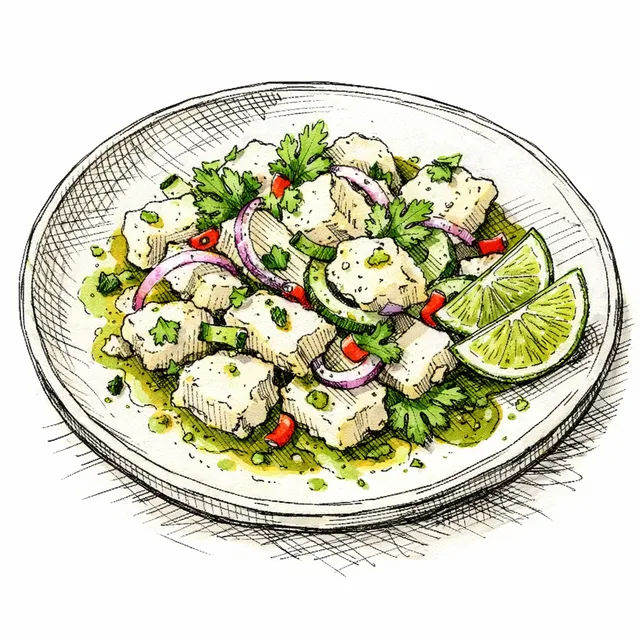
Coconut-Lime Halibut Kinilaw with Charred Jalapeño Oil
The first time I tasted kinilaw on a humid afternoon in Cebu, I was floored by the bright, aggressive acidity. But my Tokyo training kept whispering: what if we treated the fish with just a bit more gentleness? This Coconut-Lime Halibut Kinilaw with Charred Jalapeño Oil is the answer. It is where Filipino tradition meets Japanese precision and Mexican heat. The magic is in the technique, and here is why this works: by quick-curing the halibut with a touch of salt first to draw out excess water, and then buffering our lime juice with rich, fatty coconut milk, we get a melt-in-your-mouth raw fish dish that absolutely refuses to turn chalky. The coconut fat physically coats the proteins, slowing down the acid's denaturation process. I was playing around with Mexican chiles recently and realized a charred jalapeño oil would add the perfect smoky, grassy punch to cut through that coconut cream. This dish is deeply special to me because it traces my exact culinary journey on a single plate. To make it your own, try swapping the halibut for a fatty yellowtail, or toss in some fermented pineapple if you have a jar bubbling on your counter like I always do!
Featured Recipe
Coconut-Lime Halibut Kinilaw with Charred Jalapeño Oil
This cooling summer lunch is where Filipino kinilaw meets Japanese curing techniques and Mexican heat. By quick-curing the halibut and buffering our acid with rich coconut milk, we get a melt-in-your-mouth raw fish dish that refuses to turn chalky.
Save a copy to your collection for editing
Timeline
Ingredients
- 1 lb Fresh halibut fillet(Skinless, pin-bones removed. Sushi-grade if possible.)
- 1 tbsp Kosher salt(Diamond Crystal preferred)
- 1 tsp Granulated sugar
- 2 whole Jalapeños(Stems removed)
- 1/4 cup Grapeseed oil(Or any neutral oil)
- 1/2 cup Full-fat coconut milk(Well-stirred)
- 1/4 cup Fresh lime juice(About 2-3 limes)
- 2 tbsp Unseasoned rice vinegar
- 1 tbsp Fish sauce(High quality, like Red Boat)
- 1 tsp Fresh ginger(Finely grated or microplaned)
- 1/4 cup Red onion(Very thinly sliced)
- 1/2 cup Persian cucumber(Cut into thin half-moons)
- 1/4 cup Fresh cilantro leaves(Loosely packed)
- 2 tbsp Crispy shallots(Store-bought or homemade)
Instructions
- 1
Mix 1 tbsp kosher salt and 1 tsp granulated sugar in a small bowl. Cut 1 lb fresh halibut fillet into 1/2-inch cubes. Toss the fish in the salt-sugar mixture until evenly coated, then place in the fridge to quick-cure. This step draws out excess moisture and firms the protein structure.
10 min
Tip: Don't skip the cure! It prevents the halibut from turning to mush later when we introduce the acid.
- 2
While the fish cures, heat a dry cast-iron skillet over high heat. Add 2 whole jalapeños and blister them, turning occasionally, until heavily charred and blackened on all sides.
8 min
Tip: You want them genuinely blackened—the charred skin is what gives our oil its smoky depth.
- 3
Transfer the charred jalapeños to a blender. Pour in 1/4 cup grapeseed oil and blend on high until smooth and vibrant green. Pour through a fine mesh strainer into a small bowl and set aside.
5 min
Tip: If you want less heat, scrape out the jalapeño seeds before blending.
- 4
Remove the halibut from the fridge. Rinse the cubes thoroughly under cold running water to remove all the salt and sugar. Pat them incredibly dry with paper towels. The fish should feel noticeably firmer now.
3 min
Tip: Moisture is the enemy of a good cure. Dry the fish like you mean it.
- 5
In a medium mixing bowl, whisk together 1/2 cup full-fat coconut milk, 1/4 cup fresh lime juice, 2 tbsp unseasoned rice vinegar, 1 tbsp fish sauce, and 1 tsp fresh ginger. This is our acid-modulated marinade.
5 min
Tip: Notice how the coconut milk prevents the lime juice from tasting overly sharp.
- 6
Prep your vegetables by slicing 1/4 cup red onion and 1/2 cup Persian cucumber. Have them ready to go.
5 min
Tip: Keep the slices razor-thin so they don't overpower the delicate fish.
- 7
Add the cured halibut cubes, sliced red onion, and sliced cucumber into the coconut-lime base. Gently toss to combine. Let it sit for exactly 3 minutes—no longer. The fat in the coconut milk slows the acid down, giving us a perfect tender 'cook'.
3 min
Tip: This is a 3-minute marinade, not a 3-hour one! Serve it immediately after tossing.
- 8
Using a slotted spoon, divide the halibut mixture among chilled shallow lunch bowls. Spoon a little of the coconut broth over the top. Drizzle generously with the charred jalapeño oil, and garnish with 1/4 cup fresh cilantro leaves and 2 tbsp crispy shallots.
4 min
Tip: Chill your bowls beforehand—raw dishes pop so much more when served ice-cold.
Chef's Notes
Let's geek out about acid for a second. If you drop delicate halibut straight into pure lime juice (citric acid), the pH plummets immediately. The exterior of the fish seizes up, turning chalky and opaque before the center even knows what's happening. I hate chalky fish. By doing a 10-minute dry salt/sugar cure first, we draw out moisture and tighten the protein structure. Then, we use a buffered acid bath—combining sharp lime juice with milder rice vinegar (acetic acid) and suspending it all in fatty coconut milk. The fat coats the proteins, physically slowing the acid denaturalization process. You get the brightness of ceviche, the creaminess of a crudo, and a texture that melts in your mouth.

Kenji Nakamura
Where Japanese precision meets global flavors
I trained in Tokyo for eight years, mastering the discipline of washoku—traditional Japanese cuisine. But I got restless. So I cooked my way through Southeast Asia, spent a year in Mexico City, and fell hard for the food of Peru. Now I see connections between cuisines that others miss: the umami in dashi and fish sauce, the heat in shishito and Szechuan peppercorns, the way Japanese technique can unlock flavors from any tradition. I'm always fermenting something.