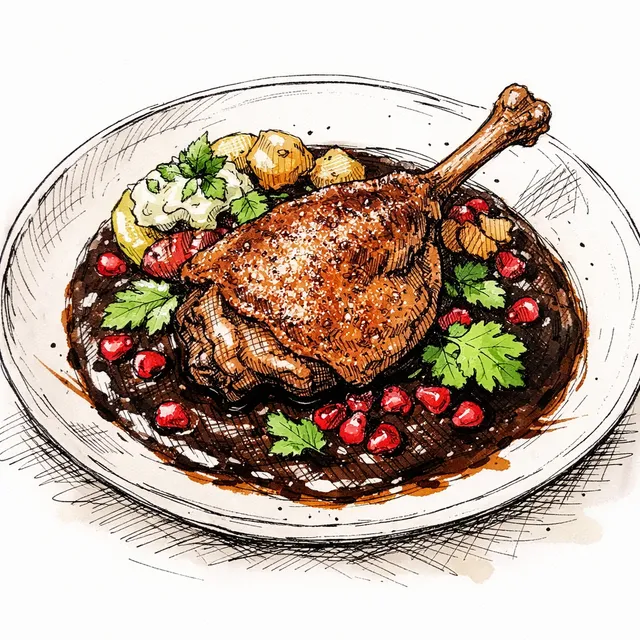
Crisp Duck Leg Confit with Pomegranate-Oaxacan Mole Pan Reduction
I still remember the night in Oaxaca when I tasted a true mole negro for the first time. Standing in a bustling market, smelling the roasted chiles, chocolate, and spices, my brain immediately started doing what it always does: connecting dots. Back in my Tokyo days, I used to obsess over the deep, savory umami of slow-braised meats. Why not bridge the gap? That is how this Crisp Duck Leg Confit was born. We take meltingly tender duck legs, sear them to glass-like skin perfection, and blanket them in a glossed pan reduction of tart fall pomegranate, rich Oaxacan mole negro, a splash of sake, and sweet roasted garlic. Paired with a buttery edamame-sweet potato mash, it is the ultimate collision of Mexican warmth and Japanese precision. Here is why this works: the acidity of the pomegranate cuts right through the rich, unctuous duck fat, while the sake lifts the earthy, complex spices of the mole. Want to make it your own? Don't be precious with the mash. Toss in some freshly shelled edamame for a vibrant pop of green and a nutty bite that ties the whole globe-trotting plate together. Get fermenting, stay curious, and break some rules.
Featured Recipe
Crisp Duck Leg Confit with Pomegranate-Oaxacan Mole Pan Reduction
Slow-cooked, meltingly tender duck legs are pan-seared to glass-like skin perfection, then paired with a glossed pan reduction of tart fall pomegranate, rich Oaxacan mole negro, sake, and roasted garlic. Served alongside buttery edamame-sweet potato mash for the ultimate collision of Mexican warmth and Japanese umami precision.
Save a copy to your collection for editing
Timeline
Ingredients
- 4 whole legs Pre-cooked duck leg confit(excess fat gently wiped off and reserved for searing)
- 2 medium Shallots(finely minced)
- 1 tbsp Fresh ginger(microplaned)
- 2 tbsp Mole negro paste(high-quality artisanal Oaxacan mole paste)
- 0.5 cup Dry junmai sake(for deglazing the pan)
- 0.75 cup 100% tart pomegranate juice(unsweetened)
- 0.5 cup Rich chicken or duck stock(unsalted or low-sodium)
- 1 tbsp Dark soy sauce (koikuchi shoyu)
- 1 tsp Pomegranate molasses(for acidity and gloss)
- 2 tbsp Unsalted cold butter(cubed, kept refrigerator-cold for monter au beurre)
- 1.5 lbs Japanese sweet potatoes (satsumaimo)(peeled and cut into 1-inch chunks)
- 1 cup Shelled edamame(thawed if frozen)
- 0.25 cup Whole milk(warmed)
- 2 tbsp Unsalted butter for mash(softened)
- 0.25 cup Fresh pomegranate arils(for garnish)
- 4 leaves Fresh shiso leaves(chiffonade cut, for finishing herbal punch)
- 0.5 tsp Flaky sea salt(such as Maldon to finish)
- 1 tsp Kosher salt(divided, for boiling water and seasoning)
Instructions
- 1
Place 1.5 lbs Japanese sweet potatoes (satsumaimo) into a medium pot, cover with cold water, add 0.75 tsp Kosher salt, and bring to a rolling boil over medium-high heat. Simmer until completely knife-tender, about 15 minutes.
18 min
Tip: Starting sweet potatoes in cold salted water ensures even gelatinization of starches without the outer layers turning mushy.
- 2
Place 4 whole legs Pre-cooked duck leg confit skin-side down in a cold, heavy stainless steel or cast-iron skillet without adding extra oil. Turn the heat to medium-low to slowly render out residual fat and crisp the skin evenly without scorching, about 10-12 minutes. Flip and warm the flesh side for just 2 minutes. Transfer legs to a warm wire rack skin-side up.
14 min
Tip: Starting in a cold pan prevents thermal shock and allows the duck skin fat to render out smoothly, turning paper-thin and shattering-crisp.
- 3
While the duck crisps, toss 1 cup Shelled edamame into the boiling sweet potato pot during their final 3 minutes of cooking to tenderize them together. Drain potatoes and edamame thoroughly, then return to the hot, dry pot.
4 min
Tip: Cooking the edamame directly with the satsumaimo saves pots and infuses sweet vegetable notes into the mash.
- 4
Mash the hot sweet potatoes and edamame with 0.25 cup Whole milk, 2 tbsp Unsalted butter for mash, and the remaining 0.25 tsp Kosher salt until rustic and textured. Cover and keep warm on the back burner.
4 min
Tip: Leave some texture in the edamame for a pop of freshness and chew against the velvety sweet potato.
- 5
Pour off all but 1 tablespoon of duck fat from the skillet, reserving the rest for roasted veggies later. Over medium heat, add 2 medium Shallots and 1 tbsp Fresh ginger to the skillet and sauté until fragrant, soft, and lightly browned, picking up the rich duck fond, about 2 minutes.
2 min
Tip: Keep that flavorful pan residue (fond); it holds the glutamates that anchor our sauce reduction.
- 6
Stir in 2 tbsp Mole negro paste and cook for 1 minute to bloom its spices and cacao. Pour in 0.5 cup Dry junmai sake to deglaze the pan, scraping up all browned bits, and simmer until reduced by half.
3 min
Tip: Blooming mole paste in duck fat unlocks fat-soluble aroma compounds before introducing water-based liquids.
- 7
Add 0.75 cup 100% tart pomegranate juice, 0.5 cup Rich chicken or duck stock, 1 tbsp Dark soy sauce (koikuchi shoyu), and 1 tsp Pomegranate molasses. Bring to a vigorous simmer and reduce until sauce is syrupy, glossy, and coats the back of a spoon, about 5 minutes.
5 min
Tip: The high tannin and malic acid content in pomegranate mimics the acidity of red wine reductions while adding a punchy fruit dimension that cuts right through rich duck fat.
- 8
Remove skillet from heat. Vigorously whisk in 2 tbsp Unsalted cold butter piece by piece until the reduction becomes ultra-silky, glossy, and emulsified.
2 min
Tip: Taking the pan completely off the heat before swirling in cold butter prevents the dairy emulsion from breaking.
- 9
Spoon a generous bed of warm edamame-satsumaimo mash onto each plate. Perch a crispy seared duck leg confit atop the mash. Pool the glossy mole-pomegranate reduction around the duck, then scatter 0.25 cup Fresh pomegranate arils, 4 leaves Fresh shiso leaves, and a sprinkle of 0.5 tsp Flaky sea salt across the crackling skin.
3 min
Tip: Keep the crisp skin un-sauced—pour the reduction around the base so the crunch remains pristine until the first bite.
Chef's Notes
Why this works: Duck confit already possesses monumental depth from curing and slow poaching in fat, but it desperately craves two things: shattering texture on the skin and sharp, aromatic acid to cut the richness. In this pan reduction, I combine Junmai sake and tart pomegranate juice with complex Oaxacan mole negro. Pomegranate provides natural tannins and bright malic acid that function like a fortified wine reduction, while dark shoyu and mole supply layered pyrazines, cacao bitterness, and glutamates. The cold butter emulsifies the reduction into a glossy nappe. The final hit of shiso adds a refreshing herbal anisic note that ties the entire plate together.

Kenji Nakamura
Where Japanese precision meets global flavors
I trained in Tokyo for eight years, mastering the discipline of washoku—traditional Japanese cuisine. But I got restless. So I cooked my way through Southeast Asia, spent a year in Mexico City, and fell hard for the food of Peru. Now I see connections between cuisines that others miss: the umami in dashi and fish sauce, the heat in shishito and Szechuan peppercorns, the way Japanese technique can unlock flavors from any tradition. I'm always fermenting something.