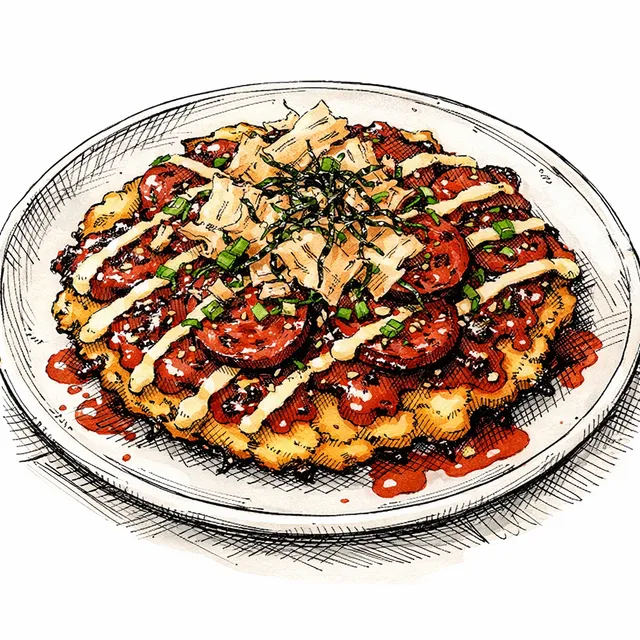
Crispy Masa Okonomiyaki: A Tokyo-Oaxaca Street Food Collision
I’ve always believed that street food across the globe speaks the same language. The inspiration for this Crispy Masa Okonomiyaki hit me years ago while eating a crispy-edged tamal on a bustling corner in Oaxaca, right after spending a month in Osaka inhaling okonomiyaki. I realized both are just brilliant, savory vehicles for cabbage, fat, and intense sauces.Here is why this works: Masa harina replaces the traditional wheat flour, giving the pancake a deeply toasted corn flavor and a crispy, tamal-like edge. We fry it directly in rendered chorizo fat because, honestly, why wouldn't you? But the real magic is the sauce. Japanese umeboshi (pickled plums) and Mexican fruit sauces share the exact same salty-sour-sweet DNA. Blending umeboshi into a makeshift chamoy creates an absolute umami bomb that cuts right through the rich pork fat.This dish is special to me because it proves that borders are an illusion when it comes to flavor. My tip? Don't stress about making it perfect. Throw in whatever fermented veggies you have sitting in your fridge jars—kimchi or pickled jalapeños work beautifully. Break the rules, fry it hard, and let the masa work its magic!
Featured Recipe
Crispy Masa Okonomiyaki with Chorizo & Umeboshi-Chamoy
A street food collision that makes too much sense. Masa harina replaces wheat flour for a crispy, tamal-like edge, fried in rendered chorizo fat. We top it with an umeboshi "chamoy" because Japanese pickled plums and Mexican fruit sauces share the exact same salty-sour DNA.
Save a copy to your collection for editing
Timeline
Ingredients
- 1 cup Masa harina(Nixtamalized corn flour (like Maseca))
- 3/4 cup Warm dashi(Can substitute chicken broth)
- 2 Large eggs(Lightly beaten)
- 3 cups Shredded green cabbage(About half a small head, sliced very thin)
- 1/2 cup Aged kimchi(Finely chopped. The older and sourer, the better.)
- 8 oz Mexican raw chorizo(Casings removed)
- 2 tbsp Umeboshi paste(Japanese pickled plum paste)
- 1 tsp Ancho chile powder
- 1 tbsp Lime juice(Freshly squeezed)
- 1 tbsp Agave syrup(Maple syrup also works)
- 2 tbsp Kewpie mayo(For drizzling)
- 1/4 cup Katsuobushi(Bonito flakes)
- 2 Scallions(Thinly sliced)
Instructions
- 1
Let's build our sauce first. In a small bowl, whisk together 2 tbsp umeboshi paste, 1 tsp ancho chile powder, 1 tbsp lime juice, and 1 tbsp agave syrup. Add a few drops of water if it's too thick. This is our Tokyo-style Chamoy.
5 min
Tip: Umeboshi is intensely salty and sour. The agave and ancho chile balance it out, creating a profile nearly identical to Mexican chamoy.
- 2
Prep your vegetables. Finely slice 3 cups shredded green cabbage, chop 1/2 cup aged kimchi, and thinly slice 2 scallions.
10 min
Tip: Make sure your cabbage is sliced paper-thin so it cooks evenly and doesn't poke through the batter.
- 3
In a large mixing bowl, whisk together 1 cup masa harina, 3/4 cup warm dashi, and 2 large eggs. Masa absorbs liquid much more aggressively than wheat flour, so let it hydrate for about 2 minutes. Fold in the cabbage and kimchi.
5 min
Tip: If the batter seems too stiff after resting, add another splash of dashi. It should be thick but foldable.
- 4
Heat a 10-inch cast-iron skillet over medium-high heat. Add 8 oz Mexican raw chorizo and cook until crispy and the fat has completely rendered out. Using a slotted spoon, transfer the cooked chorizo to your batter bowl and fold it in. Leave all that beautiful, red chorizo fat in the skillet.
7 min
Tip: The rendered chorizo fat is going to give our masa an incredible tamal-like crust.
- 5
Reduce the heat under the skillet to medium-low. Pour the batter directly into the hot chorizo fat, using a spatula to press it gently into an even, round pancake. Cover the skillet with a lid and let it cook undisturbed.
8 min
Tip: Covering the pan traps steam, which cooks the thick cabbage interior while the masa crisps on the bottom.
- 6
Time for the flip. Remove the lid. Carefully slide the okonomiyaki onto a large plate. Place another plate upside down over it, invert the plates to flip the pancake, and slide it back into the skillet. Cook uncovered to crisp the second side.
8 min
Tip: Don't try to use a spatula to flip this—it's too heavy and will break. The double-plate slide is foolproof.
- 7
Transfer the finished okonomiyaki to a cutting board. Drizzle aggressively with 2 tbsp Kewpie mayo and your umeboshi-chamoy. Scatter the reserved scallions and 1/4 cup katsuobushi over the top.
3 min
Tip: Watch the bonito flakes dance from the heat! Cut it into wedges like a pizza to serve.
Chef's Notes
WHY THIS WORKS: I've always loved the comforting, fridge-clearing nature of okonomiyaki. But when I swapped standard wheat flour for masa harina, something magical happened. Masa crisps up with a distinct, sweet-corn crunch that immediately reminds you of the crispy edges of a griddled tamal. Cooking it in rendered chorizo fat bridges the gap between Osaka street food and a Mexico City fonda. The real star here, though, is the Umeboshi-Chamoy. Mexican chamoy is traditionally made from pickled stone fruit (like apricots or plums), seasoned with chili and lime. Japanese umeboshi are salted, pickled plums. They share the exact same flavor DNA. By mixing umeboshi with ancho chile and agave, you get an intense, salty-sour-sweet glaze that cuts right through the rich pork fat and masa. The kimchi in the batter? That's just because I can't resist sneaking in some extra fermentation.

Kenji Nakamura
Where Japanese precision meets global flavors
I trained in Tokyo for eight years, mastering the discipline of washoku—traditional Japanese cuisine. But I got restless. So I cooked my way through Southeast Asia, spent a year in Mexico City, and fell hard for the food of Peru. Now I see connections between cuisines that others miss: the umami in dashi and fish sauce, the heat in shishito and Szechuan peppercorns, the way Japanese technique can unlock flavors from any tradition. I'm always fermenting something.