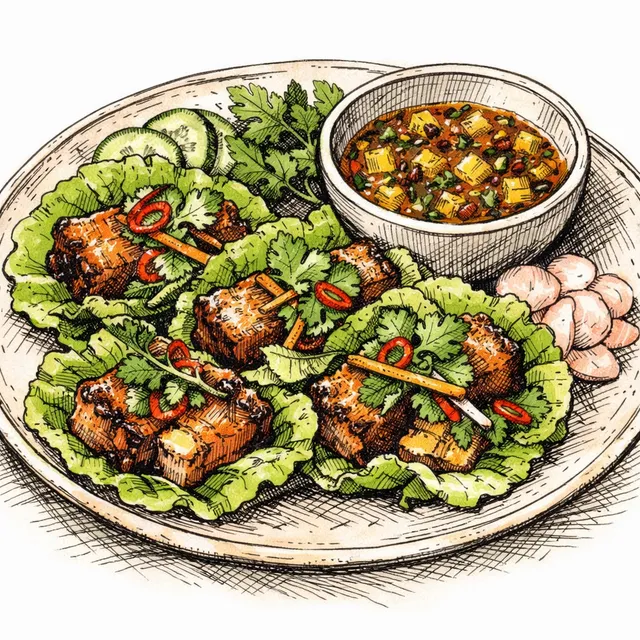
Crispy Shio Koji Pork Belly Ssam with Charred Pineapple Nuoc Cham
This dish is my ultimate izakaya party trick, born from a humid night in Hanoi and refined in my Tokyo test kitchen. I remember sitting on a tiny plastic stool, eating blistered pork skewers with a fiery nuoc cham, thinking: how can I push this umami even further? Enter shio koji. Curing pork belly in shio koji does something magical. The enzymes break down the proteins, rendering the meat meltingly tender while supercharging the savory notes. We slow-roast it, then hit it with a brutal hard sear for a shatteringly crisp crust. The science is simple but wild: those fermented sugars caramelize instantly to create incredible texture. Wrapping this rich, fatty pork in fresh shiso and butter lettuce cuts right through the heaviness. But the real kicker is the charred pineapple nuoc cham. The smoke from the fruit mimics Mexican al pastor, bridging Southeast Asia and Latin America in one bite. Make it your own by swapping the pineapple for charred mango or even grilled peaches in the summer. Do not be afraid to push the limits of that sear, you want it bordering on burnt for that true textural contrast. Grab a cold beer, get your hands messy, and dive in.
Featured Recipe
Crispy Shio Koji Pork Belly "Ssam" with Charred Pineapple Nuoc Cham
This is my ultimate izakaya party trick. We are slow-roasting a shio koji-cured pork belly until it is meltingly tender, then hitting it with a brutal hard sear to create a shatteringly crisp crust. Wrapped in fresh shiso and butter lettuce with a sweet-tart-spicy charred pineapple sauce, it is a global flavor explosion.
Save a copy to your collection for editing
Timeline
Ingredients
- 2 lbs skinless pork belly(try to find a piece with an even meat-to-fat ratio)
- 1/2 cup shio koji(store-bought or homemade)
- 1 tbsp black peppercorns(coarsely cracked)
- 1 head garlic(halved horizontally)
- 1 inch piece fresh ginger(thickly sliced)
- 1 cup fresh pineapple(finely diced)
- 1 jalapeño(finely diced, seeds kept if you like heat)
- 3 tbsp fish sauce(high quality, like Red Boat)
- 2 tbsp lime juice(freshly squeezed)
- 1 tbsp agave syrup(or light brown sugar)
- 1 head butter lettuce(leaves separated and washed)
- 1 bunch fresh shiso leaves(green or red, washed)
- 1/4 cup water(for the roasting pan)
Instructions
- 1
Preheat your oven to 275°F (135°C). Rub 2 lbs skinless pork belly all over with 1/2 cup shio koji and 1 tbsp black peppercorns. Place it fat-side up in a snug baking dish along with the halved 1 head garlic and sliced 1 inch piece fresh ginger. Pour 1/4 cup water into the bottom of the dish (avoiding the top of the pork) and tightly seal the dish with aluminum foil.
10 min
Tip: Make sure the foil is tight to trap the steam, which aids in breaking down the tough connective tissue.
- 2
Transfer the sealed baking dish to the oven. We are going low and slow here to gently coax the collagen into gelatin without squeezing the moisture out of the meat.
120 min
- 3
While the pork roasts, heat a dry cast-iron skillet over high heat. Toss in the 1 cup fresh pineapple and dry-toast it until the edges are nicely charred and caramelized. Transfer to a bowl and mix with the 1 jalapeño, 3 tbsp fish sauce, 2 tbsp lime juice, and 1 tbsp agave syrup. Let this nuoc cham sit at room temperature so the flavors can marry.
15 min
Tip: Charring the pineapple adds a subtle smokiness that bridges the gap between the rich pork and the bright citrus.
- 4
Wash and gently spin dry the 1 head butter lettuce and 1 bunch fresh shiso leaves. Arrange them on a serving platter and set aside in the fridge to stay crisp.
10 min
Tip: Crisp greens are essential for textural contrast against the rich pork belly.
- 5
Remove the foil from the baking dish. Increase the oven temperature to 400°F (200°C) and continue roasting uncovered. This dries out the exterior and kickstarts the Maillard reaction, getting the surface ready for our final sear.
30 min
Tip: Keep an eye on the liquid level; if the pan looks bone dry and the drippings are burning, add a tiny splash of water.
- 6
Take the pork belly out of the oven. Carefully transfer it to a cutting board and let it rest. Do not skip this! Letting it cool slightly helps the rendered fat firm up so you get clean, thick slices.
15 min
Tip: Slicing hot pork belly straight from the oven will result in shredded, messy chunks.
- 7
Using a sharp slicing knife, cut the rested pork belly into 3/4-inch thick slabs.
5 min
Tip: Cut across the grain if your cut of belly has a pronounced muscle direction.
- 8
Heat a large cast-iron skillet over medium-high heat. No oil needed because the pork has plenty. Sear the pork belly slices for 2 to 3 minutes per side. The residual sugars from the shio koji will caramelize aggressively, giving you a beautiful, shatteringly crisp crust. Serve immediately alongside the crisp greens and the charred pineapple nuoc cham.
5 min
Tip: Press the slices down gently with a spatula as they sear to ensure even contact and maximum crust.
Chef's Notes
People always try to rush pork belly. They crank the heat, hoping for crispy edges, but end up with chewy, unrendered fat. Here is the science: collagen does not even think about melting into gelatin until it hits 160°F, and it takes time at that temperature. By slow-roasting the slab in a shio koji cure, we let the koji's enzymes tenderize the meat while the low heat gently renders the fat. Then, we cool it, slice it thick, and hit it with an aggressive hard sear. The sugars in the koji caramelize instantly in the cast iron, giving you a shatteringly crisp exterior and a center that dissolves like butter.

Kenji Nakamura
Where Japanese precision meets global flavors
I trained in Tokyo for eight years, mastering the discipline of washoku—traditional Japanese cuisine. But I got restless. So I cooked my way through Southeast Asia, spent a year in Mexico City, and fell hard for the food of Peru. Now I see connections between cuisines that others miss: the umami in dashi and fish sauce, the heat in shishito and Szechuan peppercorns, the way Japanese technique can unlock flavors from any tradition. I'm always fermenting something.