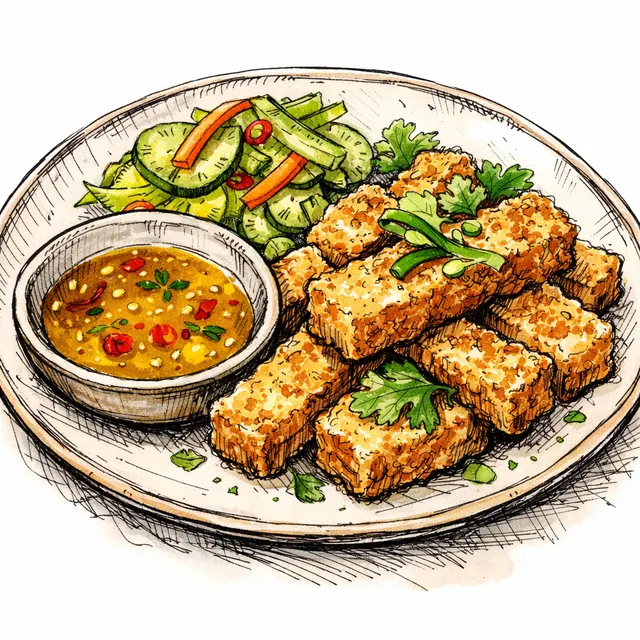
Crispy Tofu “Karaage” Sticks with Ginger–Celery Quick Pickles & Sudachi-Style Citrus–Chili Dip
I stole the spirit of this snack from two places: Tokyo izakaya karaage nights (where everything arrives loud, hot, and meant for beer) and the bright, lime-forward heat I fell in love with cooking through Southeast Asia and Mexico. One day I wanted that same “grab another one” crunch—without chicken and without a deep fryer—so tofu got the assignment.
The key memory: a tiny counter spot in Shinjuku where the cook would fry, salt aggressively, and slide a little dish of citrus on the side like it was a secret. That’s what the sudachi-style dip is doing here—ponzu energy, but it took a vacation to a lime grove and came back with chili.
What makes this recipe special to me is the rhythm: shattery tofu → zingy dip → cold snap of ginger–celery pickles. The pickles are a reset button, so every bite feels like the first.
Make it yours: go heavier on black pepper, swap celery for thin cucumber, or add yuzu kosho to the dip for extra mischief. And press the tofu longer than you think—dry tofu is how you earn the crunch.
Why this works
Pressing removes water so the starch coating can dehydrate and crisp; shallow-frying gives you surface area without deep-fry fuss; acid in the dip/pickles cuts oil and keeps your palate awake.
Featured Recipe
Crispy Tofu “Karaage” Sticks with Ginger–Celery Quick Pickles & Sudachi-Style Citrus–Chili Dip
This is my izakaya-at-home snack when I want maximum crunch, bright acid, and a little troublemaking heat—without needing a deep fryer. Extra-firm tofu gets pressed, seasoned hard, then shallow-fried into shattery sticks, dunked in a citrusy, spicy dip that tastes like ponzu took a vacation to a lime grove. The quick pickles are the reset button between bites: cold, snappy, gingery.
Save a copy to your collection for editing
Ingredients
- 14 oz Extra-firm tofu(1 block; the firmer the better)
- 1 tsp Kosher salt(plus more to taste)
- 0.75 cup Neutral oil (rice bran, canola, grapeseed)(for shallow-frying)
- 0.5 cup Potato starch(or cornstarch; potato starch gets crispier)
- 2 tbsp All-purpose flour(helps the starch cling and brown evenly)
- 0.5 tsp White pepper(optional but very izakaya)
- 0.5 tsp Garlic powder(or 1 small grated clove)
- 1 tsp Toasted sesame oil(for aroma)
- 2 stalks Celery(thinly sliced on a bias)
- 0.5 Cucumber(1/2 English cucumber, thinly sliced)
- 15 g Fresh ginger(julienned (about a 2-inch knob))
- 0.33 cup Rice vinegar
- 0.33 cup Water
- 2 tbsp Sugar(adjust to taste)
- 1 tbsp Soy sauce(for the pickle brine)
- 3 tbsp Lime juice(fresh-squeezed)
- 1 tbsp Yuzu juice(optional; or use more lime)
- 2 tbsp Soy sauce(for the dip)
- 1 tbsp Rice vinegar(for the dip)
- 2 tsp Honey(or sugar)
- 1.5 tsp Gochujang(spicy-sweet backbone)
- 0.5 tsp Shichimi togarashi(or crushed red pepper)
- 1 tbsp Toasted sesame seeds(optional garnish)
- 2 Scallions(thinly sliced; optional garnish)
Instructions
- 1
Press the 14 oz Extra-firm tofu: wrap in a clean towel, set on a plate, and weight with a skillet + a can. Press 20 minutes, then cut into sticks about 1/2-inch thick and 3–4 inches long.
20 min
Tip: Pressing isn’t about dryness for its own sake—it reduces steam so the crust can actually crisp in a shallow fry.
- 2
Make the quick pickles: in a bowl, whisk 0.33 cup Rice vinegar, 0.33 cup Water, 2 tbsp Sugar, and 1 tbsp Soy sauce until dissolved. Add 2 stalks Celery, 0.5 Cucumber, and 15 g Fresh ginger; toss. Refrigerate while you cook.
5 min
Tip: Slice thin. Surface area is speed—thin slices taste pickled in minutes, thick slices taste like regret.
- 3
Make the citrus–chili dip: whisk 3 tbsp Lime juice, 1 tbsp Yuzu juice, 2 tbsp Soy sauce, 1 tbsp Rice vinegar, 2 tsp Honey, 1.5 tsp Gochujang, and 0.5 tsp Shichimi togarashi until smooth. Set aside.
3 min
Tip: I want this dip bright first, spicy second. If it tastes ‘dark,’ add a squeeze of lime.
- 4
Season and coat: toss tofu sticks with 1 tsp Kosher salt and 1 tsp Toasted sesame oil. In a shallow dish, mix 0.5 cup Potato starch, 2 tbsp All-purpose flour, 0.5 tsp White pepper, and 0.5 tsp Garlic powder. Dredge tofu sticks, pressing lightly so a shaggy coat forms; shake off excess.
7 min
Tip: A slightly uneven coating creates micro-ridges—more crunch, more sauce cling.
- 5
Shallow-fry: heat 0.75 cup Neutral oil (rice bran, canola, grapeseed) in a wide skillet over medium-high until 350°F / 175°C (or a pinch of starch sizzles instantly). Fry tofu in a single layer, 2–3 minutes per side, turning 3–4 times total, until deeply golden and crisp. Drain on a rack or paper towels; lightly salt while hot.
12 min
Tip: Keep the oil hot but not smoking. If the tofu browns too fast, the coating will taste bitter before it’s crisp—drop heat slightly.
- 6
Serve: pile tofu sticks on a plate with the cold quick pickles. Pour dip into a small bowl. Finish with 1 tbsp Toasted sesame seeds and 2 Scallions if you want. Eat immediately—this is a ‘now’ snack.
2 min
Tip: For peak crunch, don’t sauce the tofu—dip each bite.
Chef's Notes
Why this works (my nerdy version): Pressing tofu reduces free water, which means less steam blasting your coating from the inside. Potato starch gelatinizes into a thin, glassy shell—especially in shallow fry where the oil temp drops faster than deep-frying—so you still get that karaage-style crackle. The pickle is your contrast engine: cold + crunchy + acidic to reset the palate, so the next bite tastes as loud as the first. And the dip is basically ‘ponzu’s spicy cousin’: acid + salt + a little sugar to round the corners, with gochujang for body so it clings instead of running off. Break the rules: add grated garlic to the dip, or swap celery for thin-sliced kohlrabi if you want extra snap.

Kenji Nakamura
Where Japanese precision meets global flavors
I trained in Tokyo for eight years, mastering the discipline of washoku—traditional Japanese cuisine. But I got restless. So I cooked my way through Southeast Asia, spent a year in Mexico City, and fell hard for the food of Peru. Now I see connections between cuisines that others miss: the umami in dashi and fish sauce, the heat in shishito and Szechuan peppercorns, the way Japanese technique can unlock flavors from any tradition. I'm always fermenting something.