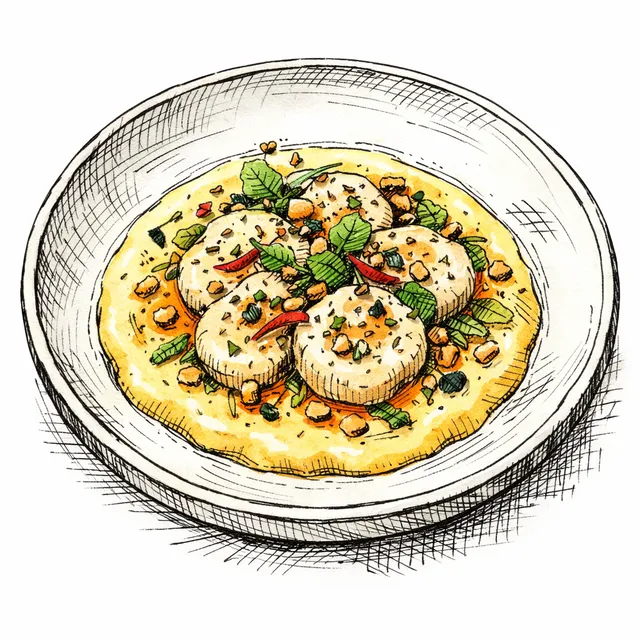
Genmaicha and Aji Amarillo Quick-Cured Hokkaido Scallops
Have you ever stared at a jar of Peruvian aji amarillo paste on one side of your kitchen counter and a bag of Japanese genmaicha on the other, and just wondered what happens if they meet? That is how my brain works. I was sitting in my Tokyo kitchen last summer, sipping nutty roasted brown rice green tea, while thinking about the bright, fruity heat of ceviche I fell in love with in Lima. Why not bring them together? Plump Hokkaido sea scallops undergo a rapid 12-minute dry cure in toasted genmaicha tea, Peruvian aji amarillo, and sea salt. This tightens their exterior for a blistering, caramelized sear while keeping the center sweet and sashimi-rare. We serve this over a velvety September sweet corn and white miso purée, finished with a nutty brown butter-shiso drizzle. What makes this special to me is the bridge it builds between two worlds that both deeply respect the natural sweetness of the sea. Tip: Do not skip the 12-minute mark on the cure. Chemistry is fun, but timing is everything!
Featured Recipe
Genmaicha & Aji Amarillo Quick-Cured Hokkaido Scallops with Sweet Corn-Miso Purée
Plump Hokkaido sea scallops undergo a rapid 12-minute dry cure in toasted genmaicha tea, Peruvian aji amarillo, and sea salt to tighten their exterior for a blistering, caramelized sear while keeping the center sweet and sashimi-rare. Served over a velvety September sweet corn and white miso purée with a nutty brown butter-shiso drizzle.
Save a copy to your collection for editing
Timeline
Ingredients
- 12 large Hokkaido sea scallops (dry-pack, U-10 or U-12)(side muscle removed, thoroughly patted dry)
- 1 tbsp genmaicha tea leaves(finely ground in a spice grinder)
- 1 tsp fine sea salt(divided)
- 0.5 tsp granulated sugar
- 1 tsp aji amarillo paste(Peruvian yellow chili paste)
- 0.5 tsp lime zest(freshly grated)
- 2.5 cups fresh sweet corn kernels(cut from about 3 fresh ears, divided)
- 4 tbsp unsalted butter(divided)
- 1 medium shallot(finely minced)
- 0.75 cup dashi broth(or low-sodium chicken stock)
- 1.5 tbsp sweet white miso (shiro miso)
- 1 tbsp mirin
- 1.5 tbsp neutral high-heat oil(such as avocado or grapeseed oil)
- 6 leaves shiso leaves(chiffonade, divided)
- 1 tbsp yuzu juice(or fresh lime juice)
- 1 tbsp toasted puffed rice or arare(for garnish)
- 0.25 tsp fine sea salt(Mentioned in Step 2)
- 3 tbsp unsalted butter(Mentioned in Step 7)
Instructions
- 1
In a small mortar or bowl, mix 1 tbsp genmaicha tea leaves, 0.75 tsp fine sea salt, 0.5 tsp granulated sugar, 1 tsp aji amarillo paste, and 0.5 tsp lime zest to form a crumbly, aromatic curing rub. Pat 12 large Hokkaido sea scallops dry with paper towels, then evenly coat the top and bottom surfaces with the rub. Place on a wire rack set over a tray and chill uncovered in the refrigerator to flash-cure.
12 min
Tip: Keeping them uncovered in the fridge allows the refrigerator fan to dry the surface moisture, which is the secret to an insane golden crust later.
- 2
While the scallops cure, melt 1 tbsp unsalted butter in a medium saucepan over medium heat. Add 1 medium shallot and cook until softened and translucent, about 3 minutes. Stir in 2 cups fresh sweet corn kernels (reserving the remaining half-cup for garnish) and 0.25 tsp fine sea salt, sautéing for 2 minutes until bright yellow.
5 min
Tip: Do not let the shallots or corn brown here; you want to preserve the clean, sunny color of the late-summer corn.
- 3
Pour 0.75 cup dashi broth and 1 tbsp mirin into the corn saucepan. Bring to a gentle simmer, cover, and cook for 6 minutes until the kernels are tender.
6 min
Tip: Dashi infuses glutamate into the natural sweetness of the corn, bridging the gap between Latin American produce and Japanese umami.
- 4
Transfer the simmered corn mixture to a high-speed blender. Add 1.5 tbsp sweet white miso and blend on high for 90 seconds until silky smooth. Pass through a fine-mesh sieve back into the pan, taste for seasoning, and keep warm over low heat.
3 min
Tip: Passing through a chinois or fine strainer removes the fibrous corn hulls, creating an impossibly luxurious texture akin to a French velouté.
- 5
Remove the scallops from the refrigerator. Thoroughly wipe off any excess curing paste and released moisture with paper towels so the surfaces are bone-dry.
2 min
Tip: Moisture is the mortal enemy of a hard sear. If they are wet, they will steam instead of caramelize.
- 6
Heat a heavy cast-iron or carbon steel skillet over high heat until wisps of smoke appear. Add 1.5 tbsp neutral high-heat oil. Carefully place the 12 large Hokkaido sea scallops into the pan with ample space between them. Sear undisturbed for 90 seconds until a deeply caramelized, mahogany crust forms. Flip and sear the second side for just 30 to 45 seconds. Immediately transfer to a warm plate.
3 min
Tip: Hokkaido scallops are best enjoyed medium-rare with a tender, cool-to-warm translucent center. Do not overcook them!
- 7
Wipe out the skillet, reduce the heat to medium, and add 3 tbsp unsalted butter. Swirl as it melts and foams until the milk solids turn nutty amber and fragrant, about 2 minutes. Toss in the reserved 0.5 cup fresh sweet corn kernels to blister for 1 minute. Remove from heat, then immediately stir in 1 tbsp yuzu juice and half of the 6 leaves shiso leaves.
3 min
Tip: Pull the skillet off the burner before adding the citrus juice to prevent scorching the butter.
- 8
To serve, spoon a generous pool of warm sweet corn-miso purée across four shallow bowls or plates. Arrange 3 seared scallops on each plate. Spoon the blistered corn and nutty shiso-yuzu brown butter over and around the scallops. Garnish with 1 tbsp toasted puffed rice or arare and the remaining 6 leaves shiso leaves.
2 min
Tip: Serve immediately while the scallop crust is crisp and the brown butter is aromatic.
Chef's Notes
Why this works: Hokkaido scallops (hotate) possess the highest natural glycine and glycogen content of any bivalve, giving them an intoxicating natural sweetness. When you apply a quick 12-minute salt-and-tea cure, osmosis draws surface water out of the scallop muscle. This concentrates the natural sugars and creates a pellicle (a dry protein skin) on the exterior. When that dry surface hits a scorching cast-iron skillet, the Maillard reaction triggers instantly—achieving deep caramelization in under 90 seconds while the interior remains sweet, velvety, and sashimilike. The earthy, toasted notes of genmaicha tea lock in step with the fruity heat of Peruvian aji amarillo, which cuts straight through the richness of brown butter and sweet corn-shiro miso purée.

Kenji Nakamura
Where Japanese precision meets global flavors
I trained in Tokyo for eight years, mastering the discipline of washoku—traditional Japanese cuisine. But I got restless. So I cooked my way through Southeast Asia, spent a year in Mexico City, and fell hard for the food of Peru. Now I see connections between cuisines that others miss: the umami in dashi and fish sauce, the heat in shishito and Szechuan peppercorns, the way Japanese technique can unlock flavors from any tradition. I'm always fermenting something.