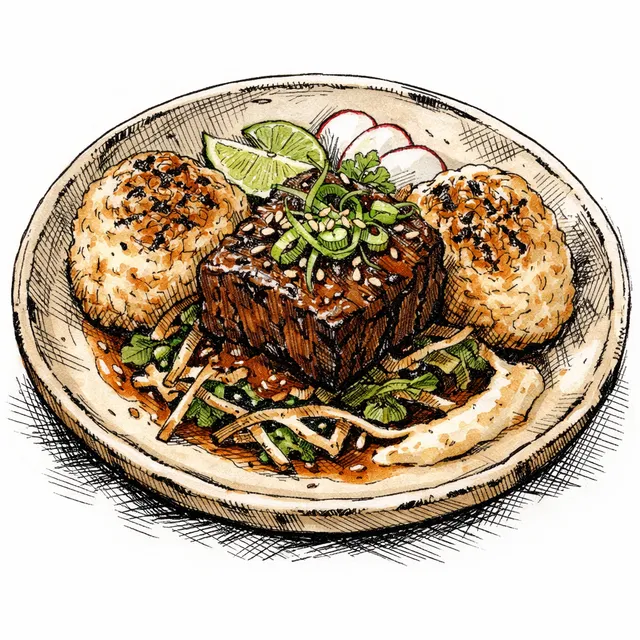
Guajillo & Black Garlic Yaki-Onigiri: A Japanese-Mexican Mashup
I remember standing at a late-night taco cart in Oaxaca, eating a slow-braised beef taco, and suddenly thinking about the yaki-onigiri my grandmother used to grill over charcoal back in Tokyo. The culinary connection clicked instantly. Both are the ultimate street foods, relying on rich, slow-cooked, deeply savory elements wrapped in a humble carb. That memory birthed this Guajillo & Black Garlic Braised Short Rib Yaki-Onigiri. We take bone-in beef short ribs and slow-braise them in a Japanese-Mexican collision of dried guajillo chiles and fermented black garlic. Why does this work? The guajillo brings a bright, fruity acidity that cuts right through the rich, gelatinous beef fat, while the black garlic acts as a massive umami amplifier, mimicking the depth of a long-aged soy sauce. When you stuff that tender beef inside a rice ball and grill it with a sweet tare glaze, the beef juices melt beautifully into the toasted, crispy rice crust. It is absolute magic. What makes this so special to me is how it breaks geographical rules while honoring the slow, deliberate techniques of both cultures. Make it your own by tossing some fermented daikon into the filling for crunch, or swap the guajillo for ancho chiles if you want a smokier, raisiny undertone. Grab a jar, start fermenting, and keep experimenting!
Featured Recipe
Guajillo & Black Garlic Braised Short Rib Yaki-Onigiri
This isn't your average convenience store rice ball. It's a weekend project where we take bone-in beef short ribs, slow-braise them in a Japanese-Mexican collision of dried guajillo chiles and black garlic, and stuff them inside crispy, tare-glazed yaki-onigiri. The rich, gelatinous beef melts perfectly into the toasted rice crust, making it the ultimate street food snack.
Save a copy to your collection for editing
Timeline
Ingredients
- 2 lbs Beef Short Ribs (bone-in)(Look for well-marbled English cut)
- 3 whole Dried Guajillo Chiles(Stemmed and seeded)
- 4 cloves Black Garlic(Peeled)
- 0.5 cup Soy Sauce(High quality Japanese shoyu preferred)
- 0.5 cup Sake(Dry cooking sake)
- 0.25 cup Mirin(Sweet cooking rice wine)
- 2 cups Water(For the braise)
- 1 piece Kombu (dried kelp)(About 2x2 inches)
- 3 cups Short-grain sushi rice(Rinsed until water runs clear)
- 3.25 cups Water (for rice)(Adjust slightly based on your rice cooker)
- 2 whole Umeboshi (salted plum)(Pitted and minced to a paste)
- 2 tbsp Toasted Sesame Seeds
- 1 tbsp Sesame Oil(For grilling)
- 4 sheets Nori sheets(Cut into rectangular strips for wrapping)
- 1 tbsp neutral cooking oil(for searing beef)
Instructions
- 1
Let's build that foundational umami. Heat a heavy Dutch oven over medium-high heat. Add a splash of neutral cooking oil and deeply sear 2 lbs Beef Short Ribs (bone-in) on all sides until a dark mahogany crust forms. Don't rush it; the Maillard reaction here is crucial for the depth of our final braise.
15 min
Tip: Take the time to render the fat cap. You want serious color on these bones.
- 2
While the beef sears, toast 3 whole Dried Guajillo Chiles in a dry skillet for 30 seconds per side until fragrant. In a blender, combine the toasted chiles, 4 cloves Black Garlic, 0.5 cup Soy Sauce, 0.5 cup Sake, 0.25 cup Mirin, and 2 cups Water. Blend until completely smooth. Why guajillo and black garlic? The chile's fruity heat perfectly bridges the deep, molasses-like funk of the fermented garlic.
10 min
Tip: Make sure the blender runs long enough to completely pulverize the dried chile skins.
- 3
Drain the excess fat from the Dutch oven. Pour the blended liquid over the seared ribs and tuck in 1 piece Kombu (dried kelp). Bring to a rapid simmer, cover tightly, and transfer to a 300F (150C) oven. We are slow-braising for exactly 3 hours. The low heat gently melts the tough collagen into rich gelatin, giving us that sticky, lip-smacking texture essential for stuffing rice balls.
180 min
Tip: If your lid isn't tight, put a layer of foil under it to trap the steam. We don't want the liquid to evaporate away.
- 4
About 40 minutes before the beef finishes, wash 3 cups Short-grain sushi rice vigorously until the water runs completely clear. Cook in a rice cooker or stovetop with 3.25 cups Water (for rice). Japanese street food relies on impeccable rice architecture. Don't skip the washing step, or your onigiri will be gummy and fall apart on the grill.
40 min
Tip: Let the cooked rice rest for 10 minutes in the pot before opening to finish steaming.
- 5
Carefully remove the tender ribs from the pot. Discard the bones and kombu. Using two forks, shred the meat finely. Skim the fat from the remaining braising liquid, then boil the liquid on the stove over medium-high heat for about 15 minutes until it reduces to a thick, syrupy tare (glaze). Toss the shredded beef with just two spoonfuls of this glaze to keep it moist. Reserve the rest for brushing.
15 min
Tip: Watch the glaze closely at the end of reduction; the sugars in the mirin and black garlic can burn quickly.
- 6
Transfer the hot, cooked rice to a wide bowl. Gently fold in the minced paste of 2 whole Umeboshi (salted plum) and 2 tbsp Toasted Sesame Seeds. Use a slicing motion with your rice paddle so you don't mash the grains. The intense, fruity acidity of the fermented plum is my secret weapon here to cut right through the massive richness of the short rib.
5 min
Tip: Mix the rice while it's still hot so the flavors absorb properly.
- 7
Wet your hands lightly with water to prevent sticking. Take about a half cup of the seasoned rice, flatten it into your palm, and place a generous tablespoon of the glazed shredded beef in the center. Fold the rice over to encapsulate the meat and gently cup your hands to press it into a tight triangle. Repeat to make 8 onigiri.
15 min
Tip: Geek note: Pack them firmly enough to hold shape on the grill, but don't crush the individual grains. You want a structurally sound exterior but a light interior.
- 8
Heat a wide cast-iron skillet over medium heat and brush lightly with 1 tbsp Sesame Oil. Sear the onigiri for 3 to 4 minutes per side until a crispy, golden crust starts to form. Brush the tops generously with the reserved thick tare glaze and flip one last time, cooking for exactly 30 seconds so the sugars caramelize into a sticky crust. Wrap the bottom of each hot rice ball in a strip of 4 sheets Nori sheets and eat immediately.
15 min
Tip: Only glaze at the very end. If you glaze too early, the soy sauce will scorch and turn bitter.
Chef's Notes
If you have leftover braised short rib, it is incredible over cold glass noodles or folded into an omelet the next morning. The intense tare glaze will keep in your fridge for weeks and is phenomenal drizzled over roasted vegetables.

Kenji Nakamura
Where Japanese precision meets global flavors
I trained in Tokyo for eight years, mastering the discipline of washoku—traditional Japanese cuisine. But I got restless. So I cooked my way through Southeast Asia, spent a year in Mexico City, and fell hard for the food of Peru. Now I see connections between cuisines that others miss: the umami in dashi and fish sauce, the heat in shishito and Szechuan peppercorns, the way Japanese technique can unlock flavors from any tradition. I'm always fermenting something.