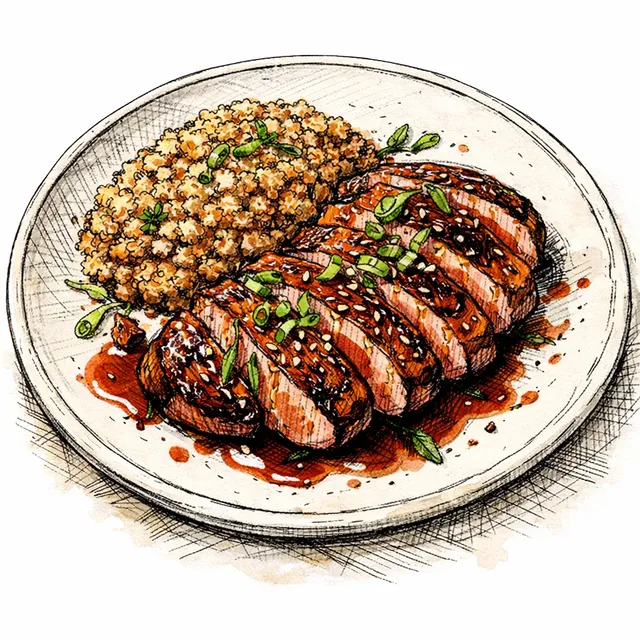
Guajillo Meets Umeboshi: The Ultimate Duck Glaze
I'll never forget sitting in a bustling Oaxaca market, eating a deeply complex mole and realizing: this needs umeboshi. The raisiny, earthy depth of toasted Mexican guajillo chilies shares a culinary DNA with the tart, salty punch of Japanese pickled plums. It was a lightbulb moment. I rushed back to my kitchen to experiment, and that's how this Guajillo-Umeboshi Glazed Duck Breast was born. It's a dish that bridges two worlds I deeply love. We start by slow-rendering the duck breast. Why this works: Starting in a cold pan slowly melts the subcutaneous fat without seizing the meat, giving you a shattering, glass-like skin. We then take that liquid gold—the rendered duck fat—and toast our quinoa in it until it's nutty and popping. Finally, we hit the duck with a sticky guajillo-umeboshi glaze. The salt and acid of the plum cut right through the rich fat, while the chili adds a warm, haunting hum. Make it yours: If you don't have umeboshi, try tamarind paste for a similar sour-sweet funk. Don't be precious about it—play with the ratios, make a mess, and let those global flavors collide!
Featured Recipe
Guajillo-Umeboshi Glazed Duck Breast with Duck-Fat Toasted Quinoa
Here is where the raisiny, earthy heat of Mexican dried chilies meets the tart, salty punch of Japanese pickled plums. We're slow-rendering the duck breast for a shattering, glass-like skin, then hitting it with a sticky umami glaze that bridges two incredible culinary worlds.
Save a copy to your collection for editing
Timeline
Ingredients
- 2 large duck breasts(About 1 lb total, room temperature)
- 1 tsp kosher salt(For dry-brining the duck)
- 1 dried guajillo chile(Stemmed and seeded)
- 2 tbsp umeboshi paste(Japanese pickled plum paste)
- 2 tbsp soy sauce(Shoyu preferred)
- 2 tbsp mirin(Sweet Japanese cooking wine)
- 1 tbsp honey(Helps create the sticky lacquer)
- 1/2 cup water(For the glaze base)
- 1/2 cup white quinoa(Rinsed very well and patted completely dry)
- 1 small head savoy cabbage(Cut into 4 thick wedges, core intact)
- 1 tbsp rice vinegar(For a final hit of brightness)
Instructions
- 1
Using a sharp knife, gently score the skin of 2 large duck breasts in a tight crosshatch pattern, making sure not to cut into the meat. Season evenly with 1 tsp kosher salt. Let them sit at room temperature to pull out initial moisture.
10 min
Tip: Scoring allows the fat to escape and render. If you nick the meat, the juices will bleed out and inhibit skin crisping, so use a light touch.
- 2
In a dry skillet over medium heat, lightly toast 1 dried guajillo chile for about 30 seconds per side until fragrant. Transfer to a bowl, cover with boiling water, and let soak.
10 min
Tip: Toasting wakes up the volatile oils in the dried pepper before rehydrating.
- 3
Place the duck breasts skin-side down in a cold skillet. Turn the heat to medium-low. Let the fat render slowly, occasionally pouring off excess fat into a heatproof bowl, until the skin is deeply browned and crisp (about 12-15 minutes).
15 min
Tip: The cold-pan start is non-negotiable food science! It gently melts the subcutaneous fat before the muscle proteins seize up from sudden heat.
- 4
While the duck renders, pull the softened chile from its soaking water. In a blender, combine the chile with 2 tbsp umeboshi paste, 2 tbsp soy sauce, 2 tbsp mirin, 1 tbsp honey, and 1/2 cup water. Blend until completely smooth.
5 min
Tip: Umeboshi is intensely tart and salty, while guajillo brings an earthy sweetness. Together, they create a beautifully balanced glaze base.
- 5
Flip the duck breasts to sear the flesh side for 2 minutes to achieve medium-rare. Remove from the skillet and set aside on a resting board.
2 min
Tip: Duck breast should feel like the pad of your thumb (medium-rare) when pressed.
- 6
Leave about 2 tablespoons of the rendered duck fat in the skillet. Turn heat to medium-high and add 1/2 cup white quinoa. Toast, stirring constantly, until it turns golden brown, smells nutty, and begins to pop. Scoop the quinoa out onto a paper towel-lined plate.
4 min
Tip: Dry the quinoa thoroughly before this step to prevent violent splattering in the hot fat.
- 7
In the same skillet (still slicked with duck fat remnants), place the 1 small head savoy cabbage wedges flat-side down. Char undisturbed until deeply blackened on one side.
4 min
Tip: Don't move the cabbage. We want an aggressive, smoky char to stand up to the rich duck.
- 8
Pour the blended glaze into the skillet around the cabbage. Let it bubble vigorously, reducing until it forms a sticky, glossy lacquer that coats the bottom of the pan.
4 min
Tip: Scrape the bottom of the pan as the glaze reduces to pick up the fond left behind by the duck.
- 9
Lower the heat and return the duck to the skillet for 1 minute, tossing gently to coat the meat in the sticky glaze (keep the skin side facing up so it stays crispy). Transfer the duck to a clean cutting board to rest for 3 minutes.
4 min
Tip: Resting allows the muscle fibers to relax and redistribute the juices.
- 10
Slice the duck breasts thinly against the grain. Plate alongside the glazed cabbage wedges. Splash the cabbage with 1 tbsp rice vinegar for brightness, and scatter the crispy duck-fat toasted quinoa over the top of the entire dish.
2 min
Tip: The hit of vinegar at the end resets the palate against the rich fat and sticky sweet glaze.
Chef's Notes
Why this works: Pairing duck with fruit is a classic technique, but umeboshi (pickled plum) flips the script. Instead of just adding sweetness, the umeboshi adds an electric jolt of acidity and salinity. By folding in Mexican guajillo, we introduce a backbone of raisiny warmth that grounds the dish. The contrasting textures—shattering duck skin, sticky glaze, tender cabbage, and the crunchy, nutty pop of duck-fat toasted quinoa—make every bite dynamic.

Kenji Nakamura
Where Japanese precision meets global flavors
I trained in Tokyo for eight years, mastering the discipline of washoku—traditional Japanese cuisine. But I got restless. So I cooked my way through Southeast Asia, spent a year in Mexico City, and fell hard for the food of Peru. Now I see connections between cuisines that others miss: the umami in dashi and fish sauce, the heat in shishito and Szechuan peppercorns, the way Japanese technique can unlock flavors from any tradition. I'm always fermenting something.