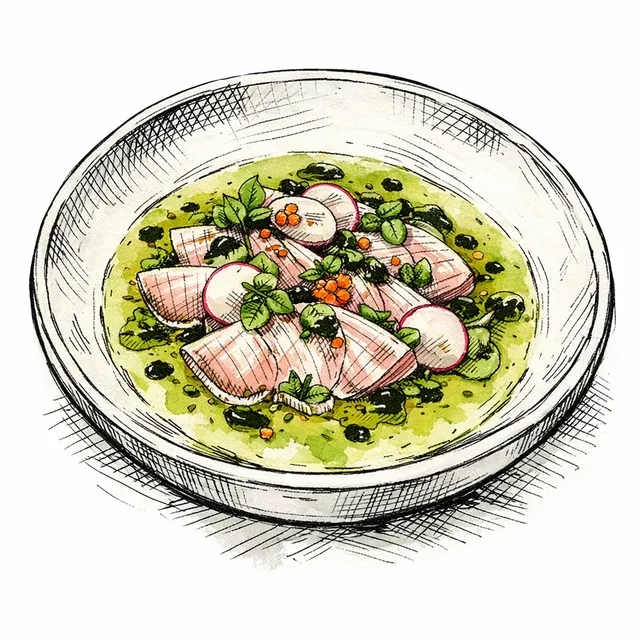
Electric Oceans: Hamachi Crudo with Tomatillo-Yuzu Kosho Broth
The idea for this Hamachi Crudo hit me somewhere between Oaxaca and Osaka. I was standing in a buzzing market in Mexico, tasting a fiery, lime-drenched aguachile, and suddenly my mind snapped back to Tokyo to the fermented, citrusy punch of yuzu kosho. They share the exact same DNA: aggressive acidity, vibrant green heat, and a deeply savory backbone. I knew I had to marry them. Here, rich, fatty yellowtail swims in a bright tomatillo and yuzu kosho broth. Why does this work? The tomatillo acts as a natural thickener while providing a tart canvas that lets the fermented chili-citrus paste shine without chemically cooking the delicate fish too quickly. A quick charred scallion oil adds a whisper of smoke, bridging the gap between raw and roasted flavors. The golden rule here is timing. A crudo is only as good as its cut and its cure, and acidity waits for no one. Slice the fish cold, plate it, and dress it right before the chopsticks hit the bowl. Want to make it your own? Swap the hamachi for sweet scallops, or toss in some lacto-fermented jalapeños from that jar you should definitely have bubbling on your counter right now.
Featured Recipe
Hamachi Crudo with Tomatillo-Yuzu Kosho Broth & Charred Scallion Oil
A crudo is only as good as its cut and its cure. Here, I'm taking pristine hamachi and swimming it in a bright, electric tomatillo and yuzu kosho broth—a nod to both Mexican aguachile and Japanese ponzu. The rich, fatty yellowtail balances the aggressively tart, fermented heat of the yuzu kosho, while a quick charred scallion oil adds a whisper of smoke. Eat it immediately; the acidity waits for no one.
Save a copy to your collection for editing
Timeline
Ingredients
- 12 oz sashimi-grade hamachi (yellowtail) block(Keep as cold as possible until the exact moment of slicing)
- 3 medium tomatillos(Husked and rinsed well to remove stickiness)
- 1/2 English cucumber(Peeled and roughly chopped)
- 1/4 cup fresh lime juice(Freshly squeezed only)
- 1 tsp green yuzu kosho(Fermented Japanese citrus-chili paste)
- 1 tbsp shiro shoyu (white soy sauce)(Keeps the broth bright green while adding deep umami)
- 1/4 cup cilantro leaves(Plus a few micro leaves for garnish)
- 3 scallions(Roughly chopped)
- 1/4 cup neutral oil (like grapeseed)(For the scallion oil)
- 1 jalapeño(Thinly sliced into rings)
- 1 red radish(Shaved paper-thin)
- 1 pinch Flaky sea salt(Maldon or similar, for finishing)
Instructions
- 1
Heat a small dry skillet over high heat. Add 3 scallions and let them char without moving until deeply blackened in spots. This gives us our smoky backbone without having to smoke the fish.
3 min
Tip: Don't be afraid of the black char—that's exactly where the flavor lives.
- 2
While the scallions char, roughly chop 3 medium tomatillos and 1/2 English cucumber.
3 min
Tip: They don't need to be perfectly cut since they're going straight into the blender.
- 3
Transfer the hot, blackened scallions to a blender with 1/4 cup neutral oil (like grapeseed). Blend on high until bright green and fragrant. Strain through a fine-mesh sieve or coffee filter and set aside.
3 min
Tip: Wipe out the blender bowl afterward—we need it again immediately.
- 4
In the clean blender, combine the chopped tomatillos, chopped cucumber, 1/4 cup fresh lime juice, 1 tsp green yuzu kosho, 1 tbsp shiro shoyu (white soy sauce), and 1/4 cup cilantro leaves. Blend until very smooth, strain through a fine-mesh sieve into a bowl, and place in the freezer to chill quickly.
4 min
Tip: We want this broth ice-cold when it hits the fish so it doesn't prematurely 'cook' the hamachi.
- 5
Using a mandoline or very sharp knife, thinly slice 1 jalapeño and 1 red radish into translucent rings.
3 min
Tip: Keep the sliced radish in a bowl of ice water if you want them extra crisp.
- 6
Take 12 oz sashimi-grade hamachi (yellowtail) block out of the fridge. Using a long, very sharp slicing knife (like a yanagiba or a sharp chef's knife), slice the fish against the grain into 1/4-inch thick pieces. Pull the knife toward you in one smooth, continuous motion.
4 min
Tip: Never saw the fish back and forth. A single clean pull protects the muscle structure and yields that gorgeous, glass-like texture.
- 7
Arrange the hamachi slices slightly overlapping on a chilled plate. Pour the cold tomatillo-yuzu broth around the base of the fish, spooning just a little over the top. Top with the sliced jalapeño and radish. Add a pinch of 1 pinch Flaky sea salt over the fish, then finish with several dramatic drops of the charred scallion oil.
3 min
Tip: Serve immediately. In the world of raw fish and citrus, timing is the ultimate ingredient.
Chef's Notes
Why this works: Slicing hamachi is an exercise in respecting the muscle fibers. By cutting exactly perpendicular to the grain with a single draw of the blade, you prevent the fat from smearing and ensure a clean, tender bite. We pair it with this specific cure because hamachi is quite rich—it demands an aggressive, tart, and cold counterpart. The tomatillo provides body and tartness, while the yuzu kosho drops an umami-rich, fermented chili bomb right in the middle of the palate. The shiro shoyu (white soy) is my secret weapon here: it seasons the broth with soy depth without muddying that electric green color.

Kenji Nakamura
Where Japanese precision meets global flavors
I trained in Tokyo for eight years, mastering the discipline of washoku—traditional Japanese cuisine. But I got restless. So I cooked my way through Southeast Asia, spent a year in Mexico City, and fell hard for the food of Peru. Now I see connections between cuisines that others miss: the umami in dashi and fish sauce, the heat in shishito and Szechuan peppercorns, the way Japanese technique can unlock flavors from any tradition. I'm always fermenting something.