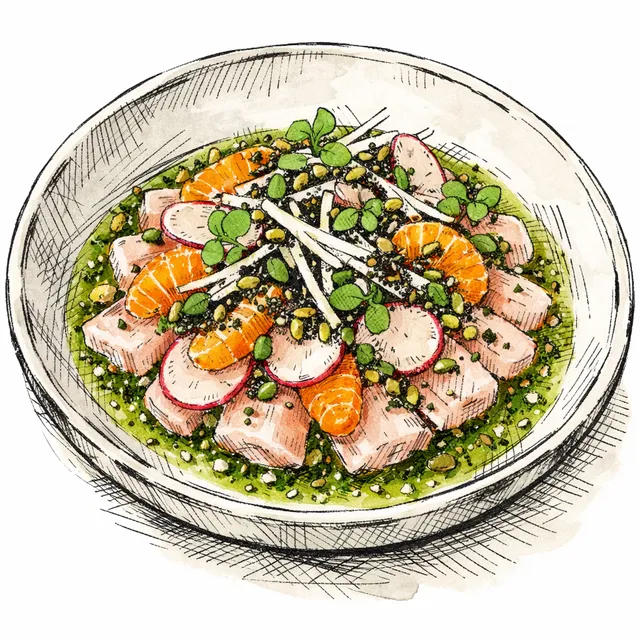
Hamachi Quick-Cure Winter Crunch Salad with Satsuma–Aguachile Ponzu & Pepita–Nori Furikake
February always makes me hungry for sunlight. In Tokyo, that meant citrus and clean, sharp flavors; in Mexico, it meant aguachile—acid-forward, chile-bright, and unapologetically punchy. This salad is where those cravings shake hands.
I start with sashimi-grade hamachi and give it a fast salt–citrus cure—just long enough to firm the surface, season the fat, and make the slices feel extra “buttery.” Then it goes on a cold pile of winter crunch: think cabbage, radish, cucumber, whatever’s loud and crisp. The dressing is ponzu-adjacent but thinks it’s an aguachile: satsuma (or any sweet winter citrus), lime, soy, a little rice vinegar, and fresh chile heat. Savory enough to deepen the fish, bright enough to wake up February.
The furikake is my little chaos: toasted pepitas crushed with nori and salt. Nutty, oceanic, and ridiculously good.
Make it yours: swap hamachi for scallop or arctic char; use yuzu if you have it; add grated ginger for more snap. And keep the cure short—3 minutes is gloss and seasoning, 7 minutes starts to “cook” the edges. Both are valid moods.
Featured Recipe
Hamachi Quick-Cure Winter Crunch Salad with Satsuma–Aguachile Ponzu & Toasted Pepita–Nori Furikake
This is my February lunch when I want something bright but still feels like a meal: sashimi-grade hamachi, kissed with a fast salt–citrus cure, laid over a cold, crunchy winter salad. The dressing is ponzu-adjacent but thinks it’s an aguachile—citrus-forward, chile-sharp, and just savory enough to make the fish taste extra buttery.
Save a copy to your collection for editing
Ingredients
- 10 oz Sashimi-grade hamachi (yellowtail), skinless(or arctic char, sliced similarly)
- 3/4 tsp Kosher salt(for quick cure)
- 1/2 tsp Cane sugar(balances cure; optional but recommended)
- 3 tbsp Satsumas or mandarins (juice)(about 2–3 satsumas)
- 2 tbsp Lime juice(fresh)
- 1 tbsp Yuzu juice(optional; swap with more lime if needed)
- 1 1/2 tbsp Soy sauce(or light shoyu)
- 1 tbsp Rice vinegar(adds clean snap)
- 1 tsp Aji amarillo paste(or minced jalapeño/serrano)
- 1 tsp Grated ginger
- 1/2 clove Garlic, microplaned(keep it subtle)
- 1 tsp Toasted sesame oil(optional, for roundness)
- 2 tbsp Neutral oil(grapeseed/avocado; for emulsifying dressing)
- 2 cups Daikon(julienned or shaved)
- 1 1/2 cups Jicama(julienned; crunchy Latin winter hero)
- 1 1/2 cups Fennel bulb(very thinly sliced)
- 1 cup Cucumber(thin half-moons; Persian/English preferred)
- 1 cup Radishes(thinly sliced; any kind except pear (not an ingredient—just to be clear))
- 1 Avocado(sliced, for creamy contrast)
- 1/2 cup Cilantro leaves and tender stems(roughly torn)
- 6 Shiso leaves(optional but amazing; chiffonade)
- 2 Scallions(thinly sliced)
- 1/3 cup Toasted pepitas (pumpkin seeds)(for crunch)
- 1 Nori sheet(crumbled or snipped)
- 1 tbsp White sesame seeds(toasted if you have them)
- 1/4 tsp Black pepper(freshly ground)
- to taste Flaky salt(finish)
- for serving Optional: tostadas or tortilla chips(turns it into a scoopy lunch)
Instructions
- 1
Slice the 10 oz Sashimi-grade hamachi (yellowtail), skinless: cut into 1/4-inch slices (or small slabs). Keep cold on a plate lined with paper towel.
5 min
Tip: Cold fish is easier to slice cleanly; a sharp knife prevents tearing and keeps the surface glossy.
- 2
Quick-cure the fish: mix 3/4 tsp Kosher salt and 1/2 tsp Cane sugar. Sprinkle evenly over the fish (both sides if thick). Let stand 7 minutes in the fridge.
7 min
Tip: This is the sweet spot: ~3 minutes seasons the surface; ~7 minutes firms the texture and tightens the proteins just enough to feel ‘snappy’ without tasting cured.
- 3
Make the satsuma–aguachile ponzu: whisk 3 tbsp Satsumas or mandarins (juice), 2 tbsp Lime juice (and yuzu if using), 1 1/2 tbsp Soy sauce, 1 tbsp Rice vinegar, 1 tsp Aji amarillo paste, 1 tsp Grated ginger, and 1/2 clove Garlic, microplaned. Slowly whisk in 2 tbsp Neutral oil (and 1 tsp Toasted sesame oil if using) to lightly emulsify.
5 min
Tip: Oil is optional but I like it here—it rounds the acidity so the dressing stays ‘sharp’ without feeling harsh.
- 4
Build the winter crunch base: in a large bowl, toss 2 cups Daikon, 1 1/2 cups Jicama, 1 1/2 cups Fennel bulb, 1 cup Cucumber, and 1 cup Radishes with 2–3 tablespoons of the dressing. Add 1/2 cup Cilantro leaves and tender stems, 6 Shiso leaves, and 2 Scallions and toss again.
6 min
Tip: Dress the vegetables first so they start to ‘drink’ the citrus. If you dress after adding fish, you’ll over-marinate the hamachi while you mix.
- 5
Rinse the cure quickly (optional) and dry: if the fish looks wet on the surface, give it a fast rinse under cold water and pat very dry. If it’s just lightly seasoned, you can skip rinsing—just wipe and pat dry.
2 min
Tip: Rinsing isn’t mandatory; it depends on how evenly you salted and how sensitive you are to salinity. Drying matters either way for clean flavor.
- 6
Finish the hamachi: lightly coat the fish with 1–2 tablespoons dressing (just enough to gloss).
1 min
Tip: I keep the fish only lightly dressed—think ‘ponzu sheen,’ not ‘ceviche bath.’ It stays sashimi-tender.
- 7
Make the pepita–nori furikake: crush 1/3 cup Toasted pepitas (pumpkin seeds) lightly (leave some big pieces), then toss with 1 Nori sheet, 1 tbsp White sesame seeds, 1/4 tsp Black pepper, and a pinch of to taste Flaky salt.
3 min
Tip: Pepitas give you that chicharrón-adjacent crunch without frying. Nori makes it taste like the ocean learned Spanish.
- 8
Plate: pile the salad, tuck in 1 Avocado slices, and drape the hamachi over the top. Spoon a little extra dressing around (not over) the fish. Shower with pepita–nori furikake. for serving Optional: tostadas or tortilla chips
3 min
Tip: Keeping extra dressing around the plate preserves crunch and prevents the fish from ‘cooking’ further.
Chef's Notes
Why this works (me nerding out): The 7-minute salt+sugar cure is a controlled dehydration step—water comes out, proteins tighten, and the hamachi tastes more ‘buttery’ because the flavor is concentrated and the texture gets that clean bite. The dressing borrows ponzu’s soy+citrus logic, but the chile/ginger/garlic lineup is straight from an aguachile mindset: sharp, fast, and aromatic. Jicama+daikon is my favorite cross-cultural crunch stack—jicama is sweet and watery, daikon is peppery and dry—together they stay crisp even under acid. If you want to break the rules: add a few thin slices of grapefruit for bitterness, or a pinch of MSG to the dressing for a legal umami cheat code.

Kenji Nakamura
Where Japanese precision meets global flavors
I trained in Tokyo for eight years, mastering the discipline of washoku—traditional Japanese cuisine. But I got restless. So I cooked my way through Southeast Asia, spent a year in Mexico City, and fell hard for the food of Peru. Now I see connections between cuisines that others miss: the umami in dashi and fish sauce, the heat in shishito and Szechuan peppercorns, the way Japanese technique can unlock flavors from any tradition. I'm always fermenting something.