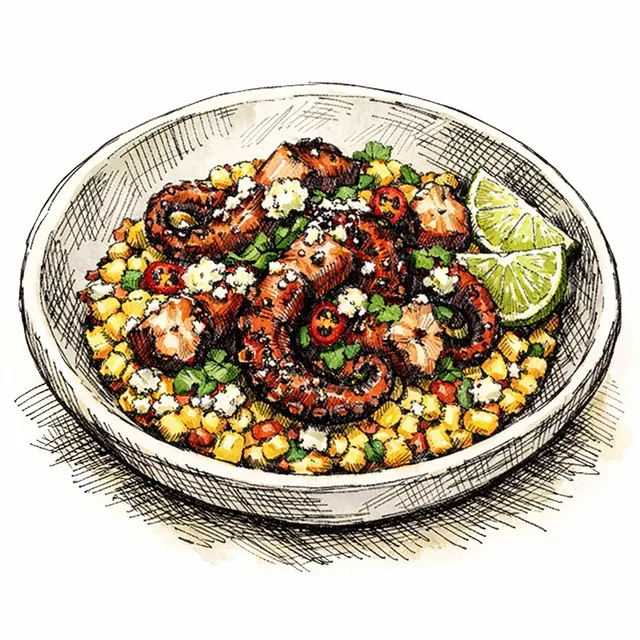
Izakaya-Style Charred Octopus Esquites: A Tokyo-CDMX Mashup
The late-night street food energy of Tokyo and Mexico City vibrates on the exact same frequency. I first realized this at 2 AM in CDMX, eating esquites from a street cart while simultaneously craving an ice-cold Sapporo and a skewer of yakitori. That memory birthed this dish: Izakaya-Style Charred Octopus Esquites. We are taking tender octopus, giving it a blistering hard sear in a screaming hot cast iron, and tossing it with charred sweet corn. But here is where the magic happens—the binder. Instead of standard mayonnaise, we are using a shio koji mayo. Why this works: the enzymes in the shio koji break down the proteins in the mayo's egg yolks, amplifying the savory notes tenfold and turning it into an absolute umami bomb. We finish it with a heavy dusting of togarashi instead of standard chili powder for that complex, citrusy heat. It is smoky, sweet, and aggressively briny. This recipe is special to me because it proves culinary geography is just a suggestion. Want to make it your own? Swap the octopus for squid, or throw in a handful of funky cotija cheese to bridge the gap even further. Just promise me you will eat it with a frosty beer.
Featured Recipe
Izakaya-Style Charred Octopus Esquites
I love the late-night street food energy of both Tokyo and Mexico City, so I smashed them together. We're taking tender octopus, giving it a blistering hard sear, and tossing it with charred sweet corn, shio koji mayo, and togarashi. It's smoky, sweet, briny, and the ultimate umami bomb to pair with an ice-cold beer.
Save a copy to your collection for editing
Timeline
Ingredients
- 1 lb pre-cooked octopus tentacles(Buying it pre-cooked saves you a 2-hour braise. Available at most good fishmongers or Spanish markets.)
- 1 tbsp neutral oil(Grapeseed or canola—something with a high smoke point.)
- 3 ears fresh sweet corn(Kernels sliced off the cob (about 2 cups total))
- 1 tbsp unsalted butter
- 3 tbsp Kewpie mayo(Must be Kewpie for that MSG yolk-heavy richness.)
- 1 tbsp Shio Koji(Liquid or paste form works.)
- 1 tbsp fresh lime juice
- 1/4 cup Cotija cheese(Crumbled. Feta or finely grated Pecorino works in a pinch.)
- 1/4 cup cilantro(Roughly chopped.)
- 1 tsp Shichimi Togarashi(Japanese 7-spice blend.)
- 1 small handful Katsuobushi(Bonito flakes.)
Instructions
- 1
In a small bowl, whisk together the 3 tbsp Kewpie mayo, 1 tbsp Shio Koji, and 1 tbsp fresh lime juice. Set aside to let the flavors meld.
3 min
Tip: Shio Koji contains enzymes that will actually start breaking down the proteins in the mayo, intensifying the umami profile of our sauce.
- 2
Stand the 3 ears fresh sweet corn upright inside a large wide bowl and slice down the sides to remove the kernels. The bowl keeps the kernels from flying all over your kitchen.
4 min
- 3
Place a heavy cast-iron skillet over high heat. Let it get screaming hot. If you're using a binchotan charcoal grill, make sure your coals are white-hot.
5 min
Tip: We want to sear, not steam. You'll know it's ready when a drop of water instantly dances and evaporates.
- 4
Take your 1 lb pre-cooked octopus tentacles and dry them aggressively with paper towels. Moisture is the enemy of the Maillard reaction! Rub them lightly with 1 tbsp neutral oil.
3 min
Tip: Since the octopus is already braised to a tender state, our only goal here is getting a crust. Water on the surface will drop the pan temperature and cause steaming.
- 5
Drop the octopus into the dry, hot skillet. Press down gently with a spatula. Sear undisturbed for 2 minutes per side until deeply charred and blistered. Remove to a cutting board.
4 min
Tip: Don't move them around. Let the heat do its job to create that crispy exterior while keeping the center tender.
- 6
Lower the heat to medium-high. Into the same pan with the residual octopus juices, melt 1 tbsp unsalted butter. Toss in the corn kernels. Let them sit undisturbed for 2 minutes to pick up a hard char, then toss and cook for 2 more minutes.
5 min
Tip: The corn will pick up all the savory, briny fond left behind by the octopus.
- 7
While the corn is finishing its char, slice the seared octopus into bite-sized 1/2-inch medallions.
2 min
Tip: I like to cut them slightly on a bias for better texture.
- 8
Transfer the hot charred corn and chopped octopus to a large mixing bowl. Add the koji mayo mixture and toss until everything is beautifully coated and glossy.
2 min
Tip: Tossing while the corn and octopus are hot helps the fat in the mayo melt into a creamy, clinging sauce.
- 9
Transfer to a serving platter. Shower the top with 1/4 cup Cotija cheese, 1/4 cup chopped cilantro, and 1 tsp Shichimi Togarashi. Crown it with 1 small handful Katsuobushi.
1 min
Tip: Serve immediately while it's hot so you get the visual effect of the katsuobushi 'dancing' from the rising steam.
Chef's Notes
Food Science Geek-Out: Why do we use pre-cooked octopus? Raw octopus is loaded with tough connective tissue (collagen). To make it tender, you have to braise it slowly until that collagen melts into gelatin. By buying it pre-cooked, the hard work is done. But reheated braised octopus is boring and mushy. Hitting it with screaming high-heat creates the Maillard reaction—browning that forms hundreds of new, complex flavor compounds—giving you an incredibly crispy exterior that contrasts perfectly with the gelatinous, tender interior. Oh, and the Shio Koji in the mayo? It brings proteases and amylases to the party, breaking down starches in the corn and proteins in the octopus to dial the umami up to eleven.

Kenji Nakamura
Where Japanese precision meets global flavors
I trained in Tokyo for eight years, mastering the discipline of washoku—traditional Japanese cuisine. But I got restless. So I cooked my way through Southeast Asia, spent a year in Mexico City, and fell hard for the food of Peru. Now I see connections between cuisines that others miss: the umami in dashi and fish sauce, the heat in shishito and Szechuan peppercorns, the way Japanese technique can unlock flavors from any tradition. I'm always fermenting something.