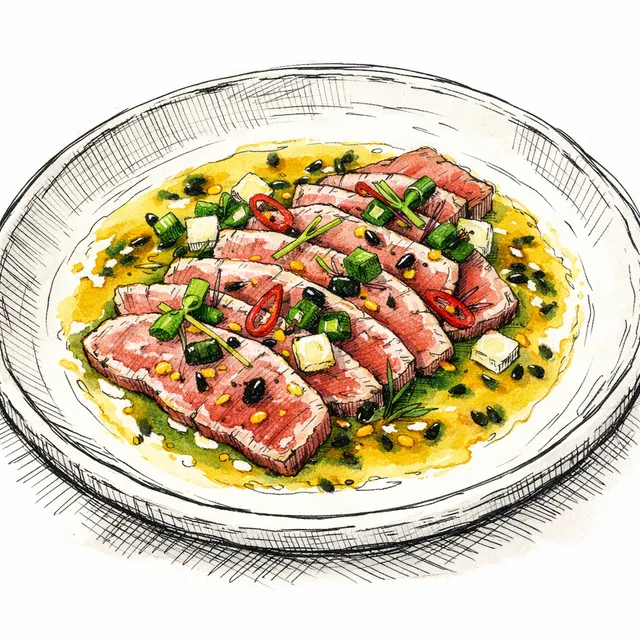
A Collision of Coasts: Kobujime Tuna Meets Peruvian Tiradito
I first had a proper Nikkei tiradito in Lima, sitting on a plastic stool while the sharp, acidic leche de tigre practically rewired my culinary brain. It respected the fish like Japanese sashimi, yet it was so loud and vibrant. That memory birthed this dish: Kobujime Ahi Tuna Tiradito with Passionfruit & Charred Spring Onion Oil. We are using an ancient Edo-period curing technique called kobujime, wrapping the tuna in sake-softened kombu. Why this works: the kelp draws out excess water while aggressively pumping the flesh full of glutamates. It creates an absolute umami bomb and firms up the fish for gorgeous, razor-sharp slicing. We then dress it at the absolute last second with a floral, highly acidic passionfruit and white soy leche de tigre. This recipe is incredibly special to me because it bridges the strict discipline of my Tokyo training with the wild spontaneity I fell in love with in South America. Want to make it your own? Swap the passionfruit for tart tangerine, or blend some of your own fermented jalapenos into the base for an earthy kick. Play with the acid, respect the cure, and never stop experimenting!
Featured Recipe
Kobujime Ahi Tuna Tiradito with Passionfruit & Charred Spring Onion Oil
Listen, if you're just slicing raw tuna and hitting it with soy sauce, you're leaving so much on the table. This is my love letter to both Japanese precision and Peruvian vibrancy. We are using an ancient Edo-period curing technique called kobujime—wrapping the tuna in sake-softened kombu to draw out water and aggressively pump the flesh full of glutamates. It firms up the fish for gorgeous, razor-sharp slicing. Then we treat it like a Nikkei tiradito, dressing it at the absolute last second with a floral, highly acidic passionfruit and white soy leche de tigre.
Save a copy to your collection for editing
Timeline
Ingredients
- 12 oz sushi-grade ahi tuna saku block(A rectangular block is essential for precise, uniform slicing)
- 2 large dried kombu sheets(Look for sheets with lots of white powder on them—that's pure umami)
- 2 tbsp sake(For softening the kombu)
- 3 tbsp unsweetened passionfruit purée(Thawed if frozen)
- 2 tbsp white soy sauce (shiro shoyu)(Lighter color and higher wheat content than standard soy, keeping our sauce bright)
- 1 tbsp fresh lime juice(Freshly squeezed only)
- 1 tsp grated ginger(Grated on a microplane)
- 1 tsp aji amarillo paste(Essential for the Nikkei flavor profile)
- 4 stalks spring onions(Or large scallions if spring onions aren't available)
- 1/4 cup neutral oil (like grapeseed)(For the herb oil)
- 1 tbsp puffed amaranth(For a delicate crunch)
- 1/2 tsp flaky sea salt(Maldon or similar)
Instructions
- 1
Wipe 2 large dried kombu sheets gently with a damp paper towel to remove dust, but do not scrub off the white powder—that is crystallized glutamic acid, your best friend. Brush both sides of the sheets with 2 tbsp sake and let them sit on your cutting board until pliable.
5 min
Tip: If the kombu is stubborn and thick, you can lightly mist it with water alongside the sake to speed up the softening.
- 2
Pat 12 oz sushi-grade ahi tuna saku block completely dry with paper towels. Sandwich the tuna tightly between the softened kombu sheets, ensuring maximum surface contact. Wrap the whole bundle very tightly in plastic wrap and refrigerate. This 30-minute cure pulls excess water from the fish, concentrating its flavor and firming the texture for flawless slicing.
30 min
Tip: Don't exceed 45 minutes on the cure, or the kombu flavor will overpower the delicate tuna and the texture will become gummy.
- 3
Roughly chop 4 stalks spring onions. Heat a dry cast iron skillet over high heat and blister the spring onions until heavily charred and fragrant, about 3 minutes. Transfer to a blender with 1/4 cup neutral oil (like grapeseed) and pulse until vibrant green and smooth. Strain through a fine mesh sieve. You will only use a little, but the rest is a great condiment.
10 min
Tip: Charring the onions dry without oil prevents smoking out your kitchen and develops a deeper, sweeter allium flavor.
- 4
In a small bowl, whisk together 3 tbsp unsweetened passionfruit purée, 2 tbsp white soy sauce (shiro shoyu), 1 tbsp fresh lime juice, 1 tsp grated ginger, and 1 tsp aji amarillo paste. Taste it—it should be aggressively bright, floral, and savory. Chill this leche de tigre in the fridge.
5 min
Tip: White soy sauce is the secret here. It provides massive salinity and umami without turning our beautiful yellow sauce into a muddy brown.
- 5
Remove the tuna from the fridge, unwrap, and discard the kombu. Using your sharpest knife (a yanagiba or a long slicing knife), slice the tuna against the grain into precise 1/4-inch thick pieces. Use one long, smooth pull toward your body—no sawing back and forth.
5 min
Tip: You will notice the texture of the tuna is significantly firmer than when you started. That's the science of kobujime at work.
- 6
Fan the tuna slices out on a chilled serving plate. Spoon the chilled passionfruit leche de tigre generously around the base of the fish, letting it pool slightly. Use a dropper or a small spoon to dot the charred spring onion oil into the sauce. Garnish the fish evenly with 1 tbsp puffed amaranth and 1/2 tsp flaky sea salt. Serve immediately.
5 min
Tip: Wait to dress the fish until the exact moment you carry it to the table. The high acid will begin 'cooking' the fish like ceviche, and we want this raw and pristine.
Chef's Notes
Why this works: The magic here is the contrast in timing. The tuna spends 30 minutes slowly taking on the deep, oceanic umami of the kombu while losing excess water. But the acid? The acid touches the fish for mere seconds before eating. In a traditional ceviche, acid denatures the proteins over time. In a tiradito, the raw texture remains pure, while the sauce acts as an electric, high-voltage condiment. The puffed amaranth is a nod to Andean ingredients, providing a crucial earthy snap against the yielding flesh of the tuna.

Kenji Nakamura
Where Japanese precision meets global flavors
I trained in Tokyo for eight years, mastering the discipline of washoku—traditional Japanese cuisine. But I got restless. So I cooked my way through Southeast Asia, spent a year in Mexico City, and fell hard for the food of Peru. Now I see connections between cuisines that others miss: the umami in dashi and fish sauce, the heat in shishito and Szechuan peppercorns, the way Japanese technique can unlock flavors from any tradition. I'm always fermenting something.