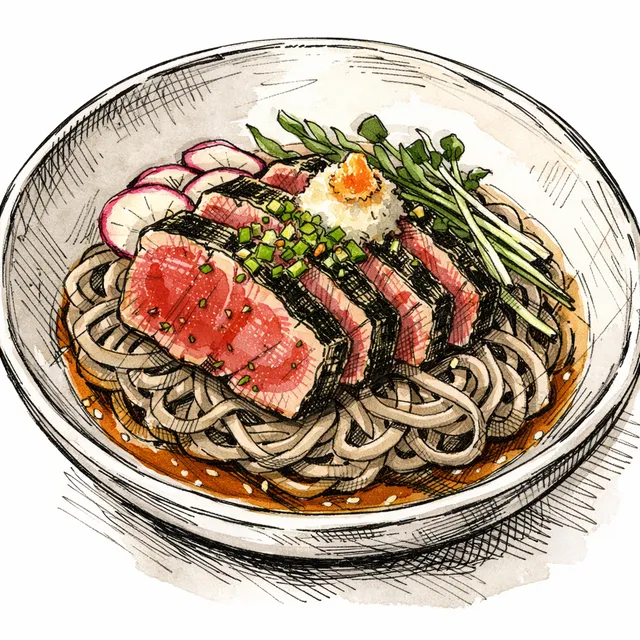
Kobujime Tuna Tataki with Morita-Yuzu Ponzu
Listen, if you are eating raw tuna without curing it first, you are leaving half its potential flavor on the cutting board. This dish was born on a sweltering afternoon in Oaxaca when I was desperately craving cold Japanese soba but only had local chiles and some beautiful yellowfin tuna. I realized that the smoky, raisiny heat of the Mexican morita chile shares DNA with katsuobushi, the smoked bonito flakes we use back in Tokyo. It was a total lightbulb moment! We are using a classic Japanese kobujime, or kombu cure, to pump the fish full of natural glutamates before flash-searing it tataki-style. Why this works: the dried kelp draws out excess moisture from the tuna, firming up the flesh while exchanging its deep oceanic umami for the fish's water. Paired with the smoky morita-yuzu ponzu and cold green tea soba, this is the dinner I make when I want something intensely savory but totally refreshing. It is special because it bridges two culinary worlds I love deeply without feeling forced. Want to make it your own? Swap the tuna for a firm white fish like snapper, or if you cannot find moritas, try a toasted cascabel or even a chipotle. Just do not skip the cure!
Featured Recipe
Kobujime Tuna Tataki with Morita-Yuzu Ponzu over Cold Soba
Listen, if you are eating raw tuna without curing it first, you are leaving half its potential flavor on the cutting board. We are using a classic Japanese kobujime (kombu cure) to pump the fish full of natural glutamates before flash-searing it tataki-style. Paired with a smoky Mexican morita chile ponzu and cold green tea soba noodles, this is the dinner I make when I want something intensely savory but totally refreshing.
Save a copy to your collection for editing
Timeline
Ingredients
- 1 lb sushi-grade tuna saku block(Look for a uniform rectangular block for even searing)
- 2 sheets dried kombu(Large enough to wrap the tuna block)
- 2 tbsp sake(For softening the kombu)
- 1 dried morita chile(Stemmed and seeded)
- 1/4 cup soy sauce(High quality Japanese soy sauce)
- 2 tbsp mirin
- 2 tbsp yuzu juice(Can substitute equal parts lime and mandarin juice)
- 8 oz dried green tea soba noodles(Also called cha soba)
- 1 tbsp toasted sesame oil
- 1 tbsp shichimi togarashi(Japanese 7-spice blend)
- 1 tsp ground cumin
- 1 tbsp grapeseed oil(Or any neutral high-heat oil)
- 2 scallions(Thinly sliced on the bias)
Instructions
- 1
Wipe 2 sheets dried kombu with 2 tbsp sake using a paper towel to slightly soften them and activate the surface glutamates. Tightly wrap the 1 lb sushi-grade tuna saku block in the softened kombu, wrap securely in plastic wrap, and refrigerate to cure.
45 min
Tip: Do not wash the kombu with water; the white powder on the surface is pure umami.
- 2
While the tuna cures, lightly toast the 1 dried morita chile in a dry skillet over medium heat until fragrant, about 30 seconds. Transfer to a mortar and pestle, crush roughly, then whisk together in a small bowl with 1/4 cup soy sauce, 2 tbsp mirin, and 2 tbsp yuzu juice. Set aside to infuse.
5 min
Tip: The longer this ponzu sits, the more the smoky, raisiny flavor of the morita will permeate the sauce.
- 3
Bring a large pot of unsalted water to a rolling boil for the noodles.
10 min
Tip: Never salt the water for Japanese noodles; they are already salted in the dough.
- 4
Drop the 8 oz dried green tea soba noodles into the boiling water and cook according to package directions, usually about 4 to 5 minutes.
5 min
Tip: Stir immediately to prevent sticking.
- 5
Drain the soba immediately and plunge into an ice water bath. Vigorously wash the noodles by rubbing them together with your hands in the cold water to remove excess surface starch, then drain thoroughly. Toss with 1 tbsp toasted sesame oil and refrigerate.
5 min
Tip: Washing the noodles is non-negotiable for the perfect chewy texture.
- 6
Remove the tuna from the fridge, discard the plastic and kombu, and pat the fish completely dry. On a plate, mix the 1 tbsp shichimi togarashi and 1 tsp ground cumin, then firmly press the tuna block into the spices to coat all sides evenly.
5 min
Tip: The kombu will have drawn out moisture; patting it dry ensures a perfect crust.
- 7
Place a cast-iron skillet over high heat until dangerously hot and smoking. Add the 1 tbsp grapeseed oil.
5 min
Tip: Open your windows and turn on your vent hood. You want maximum heat.
- 8
Flash-sear the spice-rubbed tuna in the screaming hot skillet for exactly 30 seconds per side. Remove immediately and transfer to a cutting board.
2 min
Tip: Do not let it cook any longer; we want a violent crust and an icy, untouched center.
- 9
Using your sharpest knife, slice the seared tuna tataki into 1/4-inch thick pieces.
3 min
Tip: Cut in a single long drawing motion to prevent tearing the delicate flesh.
- 10
Divide the chilled soba noodles between bowls. Top with the sliced tuna tataki, generously drizzle the infused morita ponzu over everything, and garnish with the 2 scallions.
5 min
Tip: Spoon some of those crushed morita bits right onto the fish for extra texture.
Chef's Notes
Why this works: Kombu is basically nature's MSG wrap. By curing the tuna in it, osmotic pressure draws out watery liquid and replaces it with pure umami. The morita chile in the ponzu brings a raisiny, smoky heat that bridges the gap between the charred crust of the tataki and the oceanic depth of the fish.

Kenji Nakamura
Where Japanese precision meets global flavors
I trained in Tokyo for eight years, mastering the discipline of washoku—traditional Japanese cuisine. But I got restless. So I cooked my way through Southeast Asia, spent a year in Mexico City, and fell hard for the food of Peru. Now I see connections between cuisines that others miss: the umami in dashi and fish sauce, the heat in shishito and Szechuan peppercorns, the way Japanese technique can unlock flavors from any tradition. I'm always fermenting something.