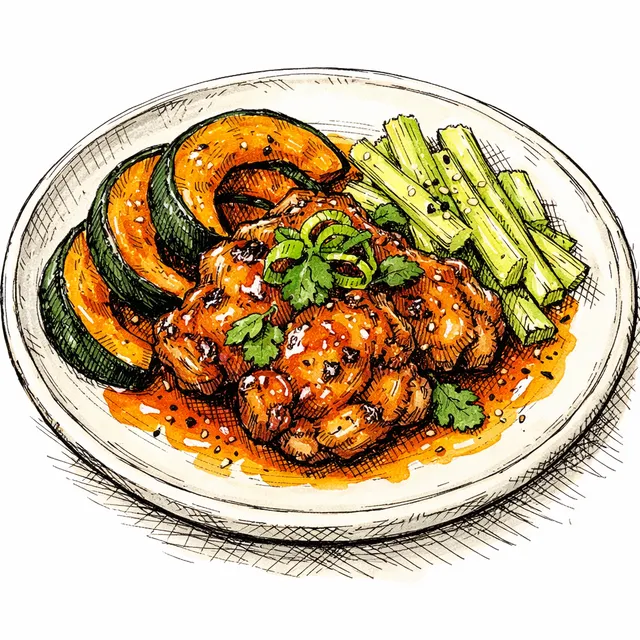
Koji-Buttermilk Chicken Thighs with Aji Amarillo–Mikan Glaze (My January Reset Dinner)
January cooking, for me, is a tug-of-war: I crave deep, roasty comfort, but I also want a bright finish that snaps my brain out of gray skies. This dish is where I let both win.
The idea came from two places I carry around: Tokyo’s obsession with precision (koji as a quiet superpower) and Lima’s love of aji amarillo—the kind of chile that doesn’t just burn, it glows. I started pairing it with mikan after a late-night fridge raid: half a jar of aji paste, a few sad winter citrus, and the need for something that tasted like “sunshine hitting cold skin.” It worked instantly.
Why this works: the overnight koji-buttermilk cure is enzymatic cheating. Koji breaks down proteins; buttermilk’s acidity helps the seasoning penetrate. Result: thighs that stay absurdly juicy even when you roast hard enough to shatter the skin.
Kabocha is my favorite sponge for chicken drippings, and the shio-koji pickled celery is the reset button—salty, tangy, crunchy.
Make it yours: swap mikan for orange or yuzu, add a spoon of miso to the glaze, or pickle fennel instead of celery. Break the rules—just keep the crackle and the snap.
Featured Recipe
Koji-Buttermilk Chicken Thighs with Aji Amarillo–Mikan Glaze, Roasted Kabocha, and Shio-Koji Pickled Celery
January is when I want two things at once: deep roasty comfort and a bright, electric finish. These chicken thighs get an overnight koji-buttermilk cure for absurd juiciness, then roast hard until the skin crackles; they’re lacquered with a Peruvian aji amarillo–mikan glaze that tastes like sunshine hitting winter. Kabocha soaks up the drippings, and a quick shio-koji celery pickle snaps the whole plate into focus.
Save a copy to your collection for editing
Ingredients
- 6 Bone-in, skin-on chicken thighs(About 2–2.5 lb / 900–1150 g)
- 1 cup Buttermilk(240 ml)
- 3 tbsp Shio koji(For the chicken cure)
- 3 cloves Garlic(Finely grated or minced)
- 1 tbsp Fresh ginger(Finely grated)
- 1 tsp Kosher salt(Optional; reduce/omit if your shio koji is very salty)
- 1 tbsp Neutral oil(Avocado/canola/grapeseed)
- 1 1/2 lb Kabocha squash(Seeded, cut into 1-inch wedges; leave skin on)
- 1 small Red onion(Cut into thick wedges)
- 1/2 tsp Black pepper
- 2 tbsp Aji amarillo paste(Peruvian chile paste; adjust to heat tolerance)
- 1/3 cup Mikan (or mandarin) juice(Fresh squeezed if possible)
- 1 tsp Mikan (or mandarin) zest
- 1 1/2 tbsp Soy sauce(Or tamari)
- 1 tbsp Rice vinegar
- 1 1/2 tbsp Honey
- 1 tbsp Unsalted butter(For gloss; optional but highly recommended)
- 3 stalks Celery(Sliced thin on a bias)
- 2 tbsp Shio koji(For the quick pickle)
- 2 tbsp Rice vinegar(For the quick pickle)
- 1 tbsp Mikan (or mandarin) juice(For the quick pickle)
- 1 tsp Toasted sesame oil(For the quick pickle)
- 2 Scallions(Thinly sliced, for finishing)
- 1 tbsp Toasted sesame seeds(For finishing)
- a light pinch or to taste salt(optional, also mentioned as kosher salt in ingredient list but here as generic salt)
- 3 cloves garlic(mentioned in steps but found as garlic in ingredient list without specified unit. Already present, so not missing.)
Instructions
- 1
Koji-buttermilk cure (the juicy part): In a bowl, whisk 1 cup Buttermilk, 3 tbsp Shio koji, 3 cloves Garlic, 1 tbsp Fresh ginger, and a light pinch or to taste salt. Add 6 Bone-in, skin-on chicken thighs and coat well. Cover and refrigerate at least 6 hours, ideally 12–24 hours.
10 min
Tip: Why I like 12–24 hours: koji enzymes have time to tenderize and boost umami without turning the surface mushy. Past ~36 hours you can start losing that clean ‘roast chicken’ texture.
- 2
Quick shio-koji celery pickle: In a container, mix 3 stalks Celery with 2 tbsp Shio koji, 2 tbsp Rice vinegar, 1 tbsp Mikan (or mandarin) juice, and 1 tsp Toasted sesame oil. Toss, cover, and refrigerate until serving.
5 min
Tip: This is my winter ‘salad’: salty-sweet, a little funky, and crunchy enough to cut through chicken fat.
- 3
Heat the oven and prep the pan: Set oven to 450°F / 230°C. Place a rimmed sheet pan in the oven to preheat (this helps the squash caramelize).
10 min
Tip: A hot pan is the home-cook cheat code for restaurant-level browning—especially with watery winter veg.
- 4
Roast the kabocha and onion: Toss 1 1/2 lb Kabocha squash wedges and 1 small Red onion with 1 tbsp Neutral oil, 1/2 tsp Black pepper, and a light pinch or to taste salt (go easy—drippings and glaze will season). Carefully remove the hot sheet pan, spread vegetables in an even layer, and roast 15 minutes.
15 min
Tip: Keep squash pieces similar in size; kabocha is dense and needs time to get creamy inside.
- 5
Add chicken and start crisping: Remove chicken from the marinade, letting excess drip off (don’t wipe it bone-dry). Nestle thighs skin-side up among the squash/onion. Roast 20 minutes.
20 min
Tip: Buttermilk solids will brown fast—good. If you see any overly dark spots early, rotate the pan and lower to 425°F / 220°C.
- 6
Make the glaze: In a small saucepan, combine 2 tbsp Aji amarillo paste, 1/3 cup Mikan (or mandarin) juice and 1 tsp Mikan (or mandarin) zest, 1 1/2 tbsp Soy sauce, 2 tbsp Rice vinegar, and 1 1/2 tbsp Honey. Simmer until syrupy enough to coat a spoon, 3–5 minutes. Off heat, whisk in 1 tbsp Unsalted butter for shine.
7 min
Tip: Aji amarillo + citrus reads like ‘tropical’ without being sweet. The vinegar keeps it from tasting like candy.
- 7
Lacquer and finish roasting: Brush chicken with glaze. Roast 8 minutes. Brush again and roast 5–8 minutes more, until the skin is deeply browned and an instant-read thermometer hits 175°F / 80°C in the thickest part (thighs love going higher than breast).
16 min
Tip: Two-stage glazing prevents burning: first layer sets, second layer perfumes and shines. If glaze threatens to scorch, move pan down a rack.
- 8
Rest and plate: Rest chicken 5 minutes. Serve thighs over roasted kabocha and onion. Add a pile of the shio-koji celery pickle on the side. Finish with 2 Scallions and 1 tbsp Toasted sesame seeds. Spoon any pan juices over everything.
7 min
Tip: Don’t waste the pan juices—koji + squash drippings = instant umami gravy.
Chef's Notes
Story/personal meaning: I learned to love aji amarillo in Lima—its sunny fruitiness reminded me of yuzu, but with a warmer, rounder heat. Years later in Tokyo, I started curing meats with koji and realized it’s basically flavor insurance for home cooks: tender, juicy, browned, and deeply savory. This dish is my January mood—gray skies outside, bright glaze inside. Why this works (my nerdy part): Shio koji brings enzymes (proteases) that gently break down proteins, plus glutamates for umami. Buttermilk adds mild acidity and milk sugars; the acidity helps seasoning penetrate, and the sugars accelerate browning. Roasting thighs to ~175°F / 80°C melts connective tissue into gelatin so they eat buttery, not dry. The glaze is balanced like a good ceviche marinade—fruit + heat + salt + acid—so every bite tastes ‘alive’ even though it’s a roast. Make it practical: If you can’t find aji amarillo paste, blend 1–2 tbsp gochujang + 1 tbsp mild yellow miso + a squeeze of citrus, then adjust with vinegar/honey. If you don’t have shio koji, use 1 1/2 tbsp kosher salt + 1 tbsp sugar in the buttermilk; you’ll lose some funk/umami but keep the juiciness.

Kenji Nakamura
Where Japanese precision meets global flavors
I trained in Tokyo for eight years, mastering the discipline of washoku—traditional Japanese cuisine. But I got restless. So I cooked my way through Southeast Asia, spent a year in Mexico City, and fell hard for the food of Peru. Now I see connections between cuisines that others miss: the umami in dashi and fish sauce, the heat in shishito and Szechuan peppercorns, the way Japanese technique can unlock flavors from any tradition. I'm always fermenting something.