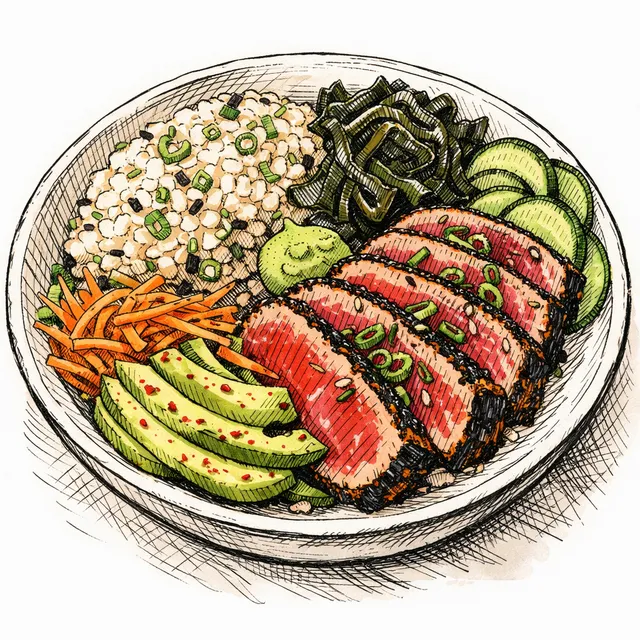
Kombu & Charred Habanero-Cured Seared Yellowfin Tuna Bowl
When I was cooking in Mérida, I became obsessed with how the locals used habanero—not just to set your mouth on fire, but to wake up every other flavor on the plate. Years later, sitting in my Tokyo kitchen staring at a sheet of kombu, it hit me. Why not combine that fiery Yucatan punch with the delicate, clean precision of Japanese tataki? The result is this yellowfin tuna bowl, dry-cured in glutamate-packed kombu and charred habanero, then hard-seared just enough to leave an icy-rare center. Balanced over garlic-dashi jasmine rice with a crisp sunomono crunch and a sweet mango-ponzu dressing, it is pure magic. Why this works: the kombu pulls out excess moisture while flooding the fish with natural umami, softening the habanero's aggressive heat into a clean, lingering warmth. Tip: Don't rush the cure. Give it at least 20 minutes for the magic to happen, but feel free to swap the mango for papaya if you want to lean even deeper into the tropics. Break the rules and make it your own!
Featured Recipe
Kombu & Charred Habanero-Cured Seared Yellowfin Tuna Bowl
Inspired by the fiery coastal flavors of the Yucatán collided with Tokyo tataki precision, this vibrant lunch bowl features yellowfin tuna dry-cured in glutamate-packed kombu and charred habanero, hard-seared to leave an icy-rare center. Balanced over garlic-dashi jasmine rice with a sunomono crunch and sweet mango-ponzu dressing, it's an explosion of clean heat, acid, and pure umami.
Save a copy to your collection for editing
Timeline
Ingredients
- 12 oz sushi-grade yellowfin tuna loin(cut into an even rectangular block for uniform searing)
- 1 tsp kombu powder(finely ground dried kelp)
- 1/4 tsp charred habanero powder(or finely ground dried habanero chili)
- 1 1/2 tsp kosher salt(divided: 1 tsp for tuna cure, 1/4 tsp for rice, 1/4 tsp for quick pickle)
- 1 tsp turbinado sugar(for the tuna cure)
- 1 cup jasmine rice(rinsed until water runs clear)
- 1 1/4 cups dashi broth(homemade or instant dashi)
- 2 cloves garlic(finely minced)
- 1 tsp toasted sesame oil(for blooming garlic)
- 1 Persian cucumber(sliced paper-thin into rounds)
- 3 red radishes(shaved paper-thin on a mandoline)
- 2 tbsp unseasoned rice vinegar(for pickling)
- 1 tsp mirin(for pickling)
- 3 tbsp fresh mango purée(ripe mango blended smooth)
- 2 tbsp soy sauce(use shoyu or tamari)
- 1 tbsp fresh lime juice
- 1 tbsp yuzu juice(or sub fresh lemon juice)
- 1 tsp grated fresh ginger(finely grated on a microplane)
- 1 tbsp neutral high-heat oil(such as avocado or grapeseed oil for searing)
- 1 ripe avocado(halved, pitted, and thinly fanned)
- 1 tsp toasted white sesame seeds(for garnish)
- 2 scallions(thinly sliced on a bias)
Instructions
- 1
Rinse 1 cup jasmine rice in cold water until clear, then drain. Heat a medium saucepan over medium heat with 1 tsp toasted sesame oil, and sauté 2 cloves garlic for 1 minute until fragrant and lightly golden. Add the drained rice, stirring to coat the grains for 1 minute. Pour in 1 1/4 cups dashi broth and 1/4 tsp kosher salt. Bring to a rolling boil, cover with a tight-fitting lid, turn heat to lowest setting, and cook undisturbed for 14 minutes.
16 min
Tip: Toasting the garlic in sesame oil before adding the dashi creates an aromatic foundation that anchors the citrus-heavy components later.
- 2
In a small bowl, whisk together 1 tsp kombu powder, 1/4 tsp charred habanero powder, 1 tsp kosher salt, and 1 tsp turbinado sugar. Pat the 12 oz sushi-grade yellowfin tuna loin completely dry with paper towels. Rub the spice mixture evenly across all sides of the tuna block. Place on a wire rack over a plate and transfer to the refrigerator to cure uncovered for 12 minutes.
14 min
Tip: Keep the curing window strictly around 10 to 12 minutes—any longer and the salt pulls out too much moisture, toughening the delicate flesh.
- 3
In a medium bowl, toss 1 Persian cucumber and 3 red radishes with 2 tbsp unseasoned rice vinegar, 1 tsp mirin, and 1/4 tsp kosher salt. Gently massage with clean fingertips to encourage quick osmosis, then set aside in the fridge to lightly pickle while you make the sauce.
5 min
Tip: Thin slices mean this sunomono achieves pickled perfection in under ten minutes without losing its snappy textural integrity.
- 4
In a small mixing bowl or glass jar, whisk together 3 tbsp fresh mango purée, 2 tbsp soy sauce, 1 tbsp fresh lime juice, 1 tbsp yuzu juice, and 1 tsp grated fresh ginger until emulsified and glossy. Set aside at room temperature.
4 min
Tip: The tropical sweetness of mango tempers the smoke of charred habanero and elevates the naturally floral acidity of yuzu.
- 5
Remove the cured tuna from the refrigerator. Quickly rinse off surface cure under a gentle trickle of ice-cold water, then pat thoroughly dry with paper towels. Place the tuna block in the freezer for 4 minutes to chill the exterior—this allows for an intense sear without cooking the core.
5 min
Tip: Moisture is the enemy of a crisp crust; take 30 extra seconds to ensure the tuna's surface is bone-dry before searing.
- 6
When the rice timer finishes, turn off the heat, lift the lid to lay a clean tea towel over the pot, replace the lid, and let it rest undisturbed for 5 minutes. Then fluff gently with a fork or rice paddle.
6 min
Tip: The tea towel traps condensation and prevents it from dripping back into the grains, yielding distinct, fluffy grains.
- 7
Set a heavy cast iron or carbon steel skillet over high heat until wisps of smoke appear. Add 1 tbsp neutral high-heat oil, swirling to coat. Sear 12 oz sushi-grade yellowfin tuna loin hard for 30 to 40 seconds per side, including the narrow edges, until an opaque 1mm crust forms while the center stays deeply ruby and raw. Immediately transfer to a cutting board.
3 min
Tip: Resist the urge to move the block while it touches the skillet; let the direct contact produce that caramelization instantly.
- 8
Using a very sharp knife pulled smoothly in a single stroke, slice the seared tuna against the grain into 1/4-inch thick slices. Divide the warm garlic-dashi rice between two wide shallow bowls. Fan the seared tuna on one side and 1 ripe avocado on the other. Mound the drained cucumber-radish pickle alongside, spoon the mango-ponzu generously over the tuna, and garnish with 1 tsp toasted white sesame seeds and 2 scallions.
5 min
Tip: Wiping your knife blade with a damp towel between cuts keeps the slices sharp, clean, and restaurant-gorgeous.
Chef's Notes
WHY THIS WORKS: Curing yellowfin tuna with a mix of coarse salt, sugar, and kombu powder prior to searing is pure food science magic. The salt-sugar gradient initiates osmosis, drawing out excess liquid from the surface cell layers while kombu infuses free glutamic acid straight into the fish. This quick cure both seasons the fish down to its core and tightens the exterior protein structure. When that dry, dense surface hits the screaming-hot skillet, the Maillard reaction triggers almost instantly without vaporizing steam. The 4-minute freezer rest creates an intentional temperature buffer—the exterior hits blistering heat while the interior remains cool, buttery, and translucent. Don't skip the brief ice-water rinse before searing; you want the seasoning absorbed into the flesh, not burning in the pan!

Kenji Nakamura
Where Japanese precision meets global flavors
I trained in Tokyo for eight years, mastering the discipline of washoku—traditional Japanese cuisine. But I got restless. So I cooked my way through Southeast Asia, spent a year in Mexico City, and fell hard for the food of Peru. Now I see connections between cuisines that others miss: the umami in dashi and fish sauce, the heat in shishito and Szechuan peppercorns, the way Japanese technique can unlock flavors from any tradition. I'm always fermenting something.