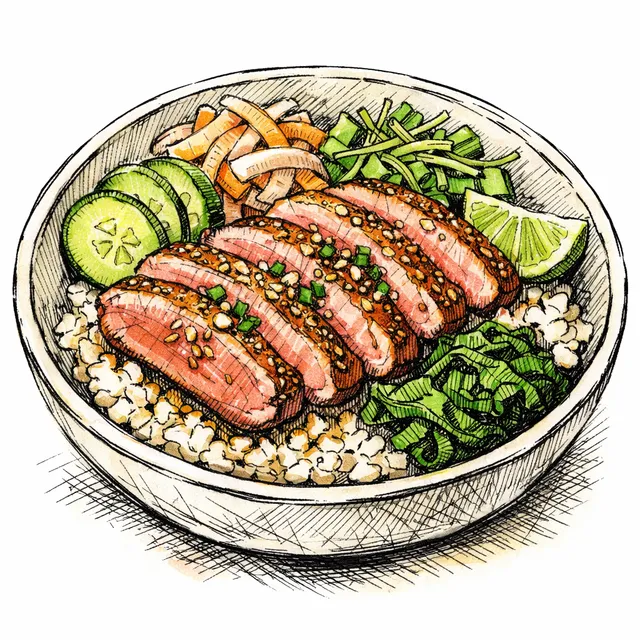
Lemongrass & Shio Koji-Cured Seared Duck Breast Bowl
When I was cooking in Southeast Asia, I became obsessed with the rhythm of street food vendors balancing acid, funk, and fat. Years later in my Tokyo kitchen, I started playing with shio koji, and a lightbulb went off. Why not use this live enzyme powerhouse to cure duck breast? That is how this bowl was born. I remember the first time I tested it—the enzymes in the koji broke down the proteins just enough to make the meat insanely tender, while the crushed coriander and lemongrass brought a tropical brightness that cut right through the rich duck fat. What makes this recipe so special to me is how it bridges two culinary worlds I love: the precision of Japanese fermentation and the bold, aromatic punch of Southeast Asian street markets. My big tip for making it your own? Do not rush the cold-pan sear. Starting the duck in a cold pan renders the fat slowly, giving you that shatteringly crisp skin while keeping the inside beautifully medium-rare. Toss in some quick-pickled Fuyu persimmons for crunch, and you have got magic in a bowl.
Featured Recipe
Lemongrass & Shio Koji-Cured Seared Duck Breast Bowl
Succulent duck breast cured in enzymatically active shio koji, crushed coriander, and fragrant lemongrass, seared cold-pan style to crackling perfection. Served over turmeric-coconut jasmine rice alongside quick-pickled crisp Fuyu persimmon and bok choy glazed in a duck-fat tamarind pan tare.
Save a copy to your collection for editing
Timeline
Ingredients
- 2 boneless duck breasts(approx. 7-8 oz each, skin scored in a tight diamond pattern)
- 2 tbsp shio koji(rice koji cure base)
- 1 stalk lemongrass(tender inner white core only, finely grated on a microplane)
- 1 tsp whole coriander seeds(toasted and coarsely crushed in a mortar)
- 1 tsp kosher salt(divided: 1/2 tsp for cure, 1/2 tsp for rice)
- 0.25 tsp ground white pepper
- 1 cup jasmine rice(rinsed until water runs clear)
- 0.75 cup unsweetened coconut milk
- 0.75 cup water
- 1 tbsp fresh ginger(peeled and finely grated)
- 0.25 tsp ground turmeric(for earthy warmth and golden color)
- 1 firm Fuyu persimmon(peeled, halved, and thinly shaved)
- 2 tbsp unseasoned rice vinegar
- 1 tsp raw honey
- 2 tbsp fresh mint leaves(torn right before serving)
- 4 heads baby bok choy(halved lengthwise and rinsed thoroughly)
- 2 tbsp sake(dry Japanese cooking sake)
- 1.5 tbsp tamari(or gluten-free dark soy sauce)
- 1 tbsp mirin
- 1 tsp tamarind concentrate(pure seedless tamarind paste)
- 1 tsp toasted white sesame seeds(for finishing)
- 2 stalks scallions(thinly sliced on a bias)
Instructions
- 1
Mix 2 tbsp shio koji, grated 1 stalk lemongrass, 1 tsp whole coriander seeds, 0.5 tsp kosher salt, and 0.25 tsp ground white pepper in a shallow bowl. Slather the paste all over 2 boneless duck breasts, pressing deeply into the scored skin crosshatches. Let sit at room temperature for 20 minutes to fast-cure.
20 min
Tip: Do not exceed 25 minutes; shio koji's active proteases work quickly and can break down the duck's texture if left too long.
- 2
In a heavy-bottomed saucepan, combine rinsed 1 cup jasmine rice, 0.75 cup unsweetened coconut milk, 0.75 cup water, 1 tbsp fresh ginger, 0.25 tsp ground turmeric, and remaining 0.5 tsp kosher salt. Bring to a boil over medium-high heat, cover tightly, reduce to lowest heat, and simmer for 15 minutes, then pull off the heat to steam covered for 5 minutes.
22 min
Tip: Turmeric blooms beautifully in the fat of coconut milk, coloring every grain a luminous gold.
- 3
Whisk 2 tbsp unseasoned rice vinegar with 1 tsp raw honey until dissolved in a small bowl. Toss in shaved 1 firm Fuyu persimmon and fold in 2 tbsp fresh mint leaves. Let gently macerate on the counter.
7 min
Tip: Fuyu persimmons are non-astringent and stay delightfully crisp, acting as a vibrant sweet-tart foil to the duck fat.
- 4
Whisk 2 tbsp sake, 1.5 tbsp tamari, 1 tbsp mirin, and 1 tsp tamarind concentrate together in a small ramekin until smooth. Have your halved 4 heads baby bok choy dry and ready by the stove.
5 min
Tip: Pre-mixing this quick pan tare prevents the sugars from scorching when hitting the hot duck skillet later.
- 5
Scrape the excess cure paste off 2 boneless duck breasts and pat dry with paper towels. Place breasts skin-side down in a cold, dry carbon steel or cast iron skillet over medium-low heat. Cook undisturbed for 9 minutes until the fat renders out and the skin turns deeply mahogany and crisp. Flip, cook the flesh side for 2 to 3 minutes until internal temperature hits 130°F (54°C) for medium-rare, then transfer to a cutting board to rest for 5 minutes.
12 min
Tip: The cold-pan start is non-negotiable for duck: it slowly renders the insulating subcutaneous fat pad so the skin gets shatteringly crisp without overcooking the meat.
- 6
Pour off all but 1 tablespoon of rendered duck fat from the skillet (save the rest in a jar for roasting potatoes later!). Turn heat to high, place halved 4 heads baby bok choy cut-side down, and sear for 2 minutes until blistered. Pour in the tamarind-sake mixture, toss the greens to coat as the sauce bubbles and glazes for 1 minute, then transfer bok choy to a side plate and reserve the pan sauce.
4 min
Tip: Rendered duck fat carries roasted aromatics from the sear, emulsifying instantly with the acidic tamarind and sake reduction.
- 7
Fluff the turmeric-coconut rice. Carve 2 boneless duck breasts across the grain into 1/4-inch slices. Divide the rice between two wide shallow lunch bowls, fan the sliced duck along one side, tuck in the glazed bok choy, and spoon the pickled persimmon alongside. Drizzle remaining tamarind-duck pan tare over the sliced meat, then garnish with 1 tsp toasted white sesame seeds and 2 stalks scallions.
5 min
Tip: Slice at a 45-degree angle to maximize the surface area of tender meat against the crackling skin.
Chef's Notes
Why this works: Duck breast has a dense, muscular red-meat structure encased in a thick, insulating cap of subcutaneous fat. Curing it with shio koji unleashes living Aspergillus oryzae enzymes (proteases and amylases). In just twenty minutes at room temperature, the proteases begin breaking tough collagen and muscle proteins into savory amino acids (free glutamates), while the amylases convert rice starches into simple sugars that dramatically enhance caramelization during searing. Starting the duck in an unheated, cold skillet allows the fat to liquefy and escape before the skin burns. Pairing this unctuous fat with the malic acid of crisp autumn Fuyu persimmon and the tangy tartaric punch of Southeast Asian tamarind keeps every bite of this lunch bowl electrified and balanced.

Kenji Nakamura
Where Japanese precision meets global flavors
I trained in Tokyo for eight years, mastering the discipline of washoku—traditional Japanese cuisine. But I got restless. So I cooked my way through Southeast Asia, spent a year in Mexico City, and fell hard for the food of Peru. Now I see connections between cuisines that others miss: the umami in dashi and fish sauce, the heat in shishito and Szechuan peppercorns, the way Japanese technique can unlock flavors from any tradition. I'm always fermenting something.