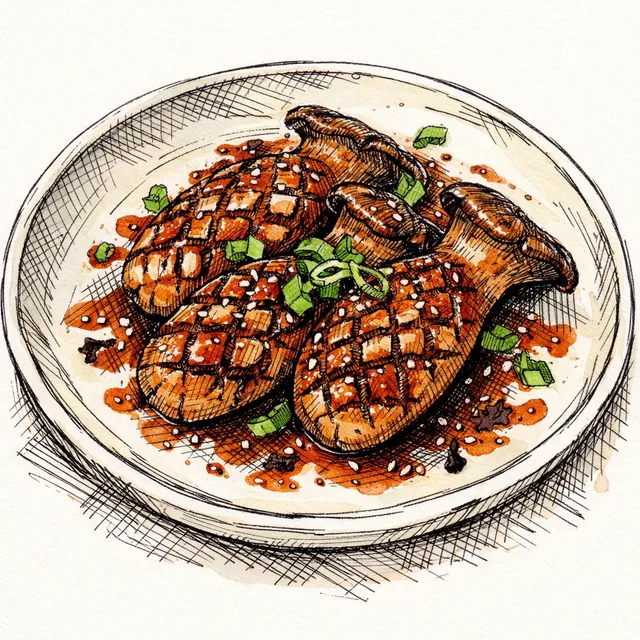
The Pinecone and the Pepper: Matsukasa King Oyster Mushrooms
I first learned the matsukasa (pinecone) scoring technique in Tokyo, painstakingly crosshatching squid so it curled beautifully in hot water. Years later, standing in a lively kitchen in Lima, I watched a chef brush anticuchos with a fiery, earthy aji panca paste. My brain immediately did that thing it does—what if we mashed these worlds together?\n\nBy scoring dense king oyster mushrooms with that same pinecone pattern, we increase the surface area exponentially. When they hit a screaming-hot pan, the edges caramelize and crisp up, transforming the texture to eat exactly like a tender sea scallop. Then comes the glaze: Peruvian aji panca mixed with my ever-present stash of homemade shio koji.\n\nWhy this works: The enzymes in the koji break down the mushroom's structure just enough, allowing that smoky, sweet heat to penetrate deep into every single crosshatch. The extra sugars from the koji then help create an aggressive, beautiful crust. It is plant-forward Nikkei cooking at its most primal, and it holds a special place in my heart because it bridges two kitchens that shaped me.\n\nWant to make it your own? Swap the aji panca for Korean gochujang or a fermented Mexican chipotle paste from your pantry. Just promise me you will keep that screaming-hard sear—that crust is where the magic lives.
Featured Recipe
Matsukasa-Scored King Oyster Mushrooms with Aji Panca Glaze
Whenever I want to show people the raw power of plant-forward Nikkei cooking, this is the dish I make. By applying the Japanese "matsukasa" (pinecone) squid-scoring technique to dense king oyster mushrooms, we completely transform their texture to eat exactly like a tender sea scallop. A screaming-hot hard sear creates an aggressive crust, while an umami-bomb glaze of Peruvian aji panca and Japanese shio koji caramelizes deep into the crosshatches.
Save a copy to your collection for editing
Timeline
Ingredients
- 1 lb King oyster mushrooms(Look for ones with very thick, uniform stems)
- 2 tbsp Aji panca paste(Peruvian sun-dried red chili paste; smoky and berry-like)
- 1 tbsp Shio koji(Liquid or paste works)
- 1 tbsp Soy sauce(Preferably a Japanese shoyu)
- 1 tbsp Mirin
- 1/2 cup Silken tofu(Drained)
- 1/2 bunch Fresh cilantro(Leaves and tender stems)
- 1/4 bunch Fresh mint(Leaves only)
- 2 tbsp Yuzu juice(Can substitute fresh lime juice)
- 1 tbsp Aji amarillo paste(For the crema)
- 1 clove Garlic(Peeled)
- 1/2 tsp Kosher salt
- 2 tbsp Grapeseed oil(Or any high-smoke-point neutral oil)
- 2 tbsp Toasted quinoa(For crispy garnish)
Instructions
- 1
In a blender, combine 1/2 cup silken tofu, 1/2 bunch fresh cilantro, 1/4 bunch fresh mint, 2 tbsp yuzu juice, 1 tbsp aji amarillo paste, 1 clove garlic, and 1/2 tsp kosher salt. Blend until completely smooth and bright green. Transfer to a squeeze bottle or small bowl and set aside.
5 min
Tip: If the crema is too thick to blend, add a tiny splash of water. The silken tofu provides a flawless, dairy-free emulsion.
- 2
In a small bowl, whisk together 2 tbsp aji panca paste, 1 tbsp shio koji, 1 tbsp soy sauce, and 1 tbsp mirin. Set this anticucho glaze near your stove—things will move fast once we start cooking.
2 min
Tip: Shio koji is packed with enzymes. Not only does it provide a massive umami spike, but its natural sugars will help the mushrooms caramelize beautifully.
- 3
Slice the caps off 1 lb king oyster mushrooms (save the caps for a stir-fry!). Cut the thick stems crosswise into 1.5-inch thick medallions. Using a very sharp paring knife, score a tight, deep crosshatch (matsukasa) pattern into one flat side of each medallion, cutting about 1/3 of the way through the flesh.
5 min
Tip: Take your time here. The tighter the grid, the more the mushroom will bloom and curl in the pan like a piece of scored squid.
- 4
Place a heavy cast-iron skillet over medium-high heat. Let it get rip-roaring hot—you want to see wisps of smoke before any oil goes in.
5 min
Tip: Mushrooms are sponges full of water. If the pan isn't hot enough, they will just boil in their own liquid instead of searing.
- 5
Pour 2 tbsp grapeseed oil into the smoking skillet. Immediately place the mushroom medallions in the pan, scored-side down. Press them down firmly with a spatula to ensure maximum pan contact. Sear undisturbed until a deeply browned, crispy crust forms on the scored side.
4 min
Tip: Do not touch them for the first 3 minutes! Let the Maillard reaction do its magical work.
- 6
Flip the mushrooms. They should look like beautifully caramelized scallops, with the scoring bloomed open. Immediately spoon the anticucho glaze over the top of each mushroom, letting it drip down into the pan. Baste the mushrooms with the bubbling glaze for 2-3 minutes until it reduces to a sticky, syrupy consistency that coats the mushrooms entirely.
3 min
Tip: Watch the heat—aji panca and mirin have sugars that will burn if the pan is completely out of control. Lower the heat slightly once the glaze goes in.
- 7
To plate, swoop a generous spoonful of the yuzu-cilantro crema onto each plate. Arrange the glazed mushrooms on top of the sauce. Garnish by scattering 2 tbsp toasted quinoa over the dish for an earthy, crunchy contrast. Serve immediately.
3 min
Tip: The contrast between the hot, smoky, meaty mushroom and the cool, bright, herbaceous crema is exactly what Nikkei cuisine is all about.
Chef's Notes
Let's geek out on scoring for a second. The longitudinal fibers in a king oyster mushroom stem are incredibly dense. When you crosshatch them deeply, you accomplish two crucial things: first, you physically break those tough fibers so the mushroom melts in your mouth instead of being rubbery. Second, you create microscopic steam vents. This means that instead of the mushroom steaming in its own internal moisture, that water escapes rapidly, allowing the edges to actually fry and crisp up. Furthermore, those newly opened crevices act as a capillary network, pulling in our sticky Aji Panca glaze. It's a prime example of how a simple knife technique fundamentally alters the chemistry of how an ingredient cooks.

Kenji Nakamura
Where Japanese precision meets global flavors
I trained in Tokyo for eight years, mastering the discipline of washoku—traditional Japanese cuisine. But I got restless. So I cooked my way through Southeast Asia, spent a year in Mexico City, and fell hard for the food of Peru. Now I see connections between cuisines that others miss: the umami in dashi and fish sauce, the heat in shishito and Szechuan peppercorns, the way Japanese technique can unlock flavors from any tradition. I'm always fermenting something.