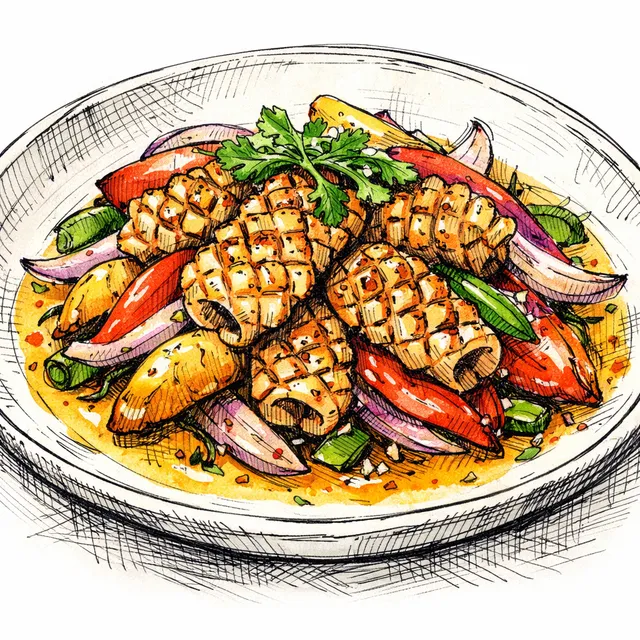
Matsukasa-Scored Squid "Saltado" with Aji Amarillo-Soy Butter
I first tasted a true Lomo Saltado in a smoky kitchen in Lima. The wok hei blew my mind; it felt incredibly Chinese, deeply Peruvian, and completely universal. Years later, missing that flavor but staring at fresh squid in my Tokyo kitchen, a lightbulb went off. Why not apply the Japanese matsukasa (pinecone) scoring technique to a saltado? By meticulously scoring the squid, we create hundreds of tiny flavor-traps. When the squid hits screaming hot oil, it curls into beautiful little pinecones that grab hold of the glossy, spicy Aji Amarillo-soy butter sauce. Why this works: The butter perfectly emulsifies with the soy and natural squid juices, while the intricate scoring maximizes the surface area for a rapid Maillard reaction. High heat and fast hands are your best friends here. You want to flash-fry it for exactly 45 seconds; any longer and you are eating rubber. This recipe is deeply special to me because it bridges my time in Peru with my roots in Japan, but you should absolutely break my rules. If you cannot find Aji Amarillo paste, throw in that jar of gochujang hiding in your fridge, or better yet, use some lacto-fermented chilies from your counter. Keep your wok smoking hot, trust your instincts, and embrace the umami.
Featured Recipe
Matsukasa-Scored Squid "Saltado" with Aji Amarillo-Soy Butter
A weeknight Nikkei mashup that takes the DNA of a Peruvian Lomo Saltado and swaps beef for flash-fried squid. By scoring the squid Japanese "pinecone" style, we create hundreds of tiny flavor-traps for a glossy, spicy Aji Amarillo and soy butter sauce. High heat, fast hands, and pure umami.
Save a copy to your collection for editing
Timeline
Ingredients
- 1 lb Whole squid tubes(Cleaned. Do not use pre-cut rings.)
- 12 oz Fingerling potatoes(Halved lengthwise)
- 1/2 Red onion(Cut into thick wedges)
- 1 cup Cherry tomatoes(Halved)
- 2 tbsp Aji amarillo paste(Peruvian yellow chili paste)
- 3 tbsp Soy sauce(Japanese shoyu)
- 1 tbsp Sake(Dry cooking sake)
- 1 tbsp Oyster sauce(Adds deep savory backbone)
- 1 tsp Grated ginger(Freshly grated)
- 2 tbsp Cold unsalted butter(Cubed, must be cold for emulsification)
- 2 tbsp Neutral oil(Grapeseed or avocado oil, divided)
- 1/4 cup Fresh cilantro(Roughly chopped)
- 1 tbsp Lime juice(Freshly squeezed)
Instructions
- 1
Place 12 oz fingerling potatoes in a microwave-safe bowl with a splash of water. Cover and microwave on high until just tender, about 4-5 minutes. Drain and lightly smash each potato half with the flat side of your knife.
5 min
Tip: Pre-cooking the potatoes in the microwave saves 20 minutes of roasting time, making this a true weeknight recipe.
- 2
While potatoes cook, prepare 1 lb whole squid tubes. Slice each tube open lengthwise to lay flat. Make shallow diagonal cuts across the inside of the tube (do not cut all the way through), then cross-hatch in the opposite direction. Cut the scored squid into bite-sized 2-inch squares.
6 min
Tip: Always score the INSIDE of the squid tube. The muscle fibers contract when cooked, which makes the squid curl outward into beautiful pinecone shapes.
- 3
In a small bowl, whisk together 2 tbsp aji amarillo paste, 3 tbsp soy sauce, 1 tbsp sake, 1 tbsp oyster sauce, and 1 tsp grated ginger. Slice 1/2 red onion into thick wedges, halve 1 cup cherry tomatoes, and chop 1/4 cup fresh cilantro.
4 min
Tip: Mise en place is crucial here. Once the wok gets hot, this dish cooks in under 5 minutes.
- 4
Heat 1 tbsp neutral oil in a wok or large heavy skillet over high heat until smoking. Add the smashed potatoes and let them sit undisturbed for 1-2 minutes until crispy and golden. Toss and crisp the other sides, then push to the side of the wok.
4 min
Tip: Smashing the potatoes exposes their starchy interiors, allowing them to crisp up beautifully and soak up the sauce later.
- 5
Add the sliced red onion and cherry tomatoes to the hot wok. Toss rapidly until the onions are lightly blistered but still crunchy, and the tomatoes just begin to soften.
2 min
Tip: You want the "wok hei" (breath of the wok) flavor here. Keep the heat roaring.
- 6
Push the veggies and potatoes to the edges of the wok (or remove to a plate if your wok is small). Add the remaining 1 tbsp neutral oil. Drop in the scored squid. Flash-fry for exactly 45 to 60 seconds. You'll see the squid violently curl into little pinecones.
1 min
Tip: Do not overcook the squid! 60 seconds is the absolute maximum, otherwise it becomes rubbery.
- 7
Toss everything together in the wok. Pour the sauce mixture over the top, immediately followed by 2 tbsp cold unsalted butter, cubed. Toss vigorously off the heat as the butter melts, emulsifying the soy and aji amarillo into a thick, glossy glaze.
2 min
Tip: The cold butter is a classic Japanese izakaya trick (bata-shoyu) that thickens the sauce so it clings to the cross-hatched cuts of the squid.
- 8
Stir in the fresh cilantro and squeeze 1 tbsp lime juice over the top. Toss one final time and serve immediately, straight out of the wok.
1 min
Tip: The burst of fresh lime juice at the end cuts through the richness of the butter and wakes up the aji amarillo paste.
Chef's Notes
Why this works: Let's geek out about the 'matsukasa-giri' (pinecone cut) for a second. Cross-hatching the inside of the squid mantle does two vital things. First, it slices through the tight, interlocking muscle fibers, which means when the proteins contract under the violent heat of the wok, the squid curls gracefully instead of snapping into an inedible rubber band. Second, you are exponentially increasing the surface area. Every single one of those little crevices becomes a microscopic reservoir perfectly designed to catch our emulsified aji amarillo-soy butter. It's a textbook example of Japanese precision elevating a chaotic, high-heat Peruvian classic. Don't skip the cold butter at the end—it mounts the sauce, turning a thin, watery liquid into a clingy, umami-bomb glaze!

Kenji Nakamura
Where Japanese precision meets global flavors
I trained in Tokyo for eight years, mastering the discipline of washoku—traditional Japanese cuisine. But I got restless. So I cooked my way through Southeast Asia, spent a year in Mexico City, and fell hard for the food of Peru. Now I see connections between cuisines that others miss: the umami in dashi and fish sauce, the heat in shishito and Szechuan peppercorns, the way Japanese technique can unlock flavors from any tradition. I'm always fermenting something.