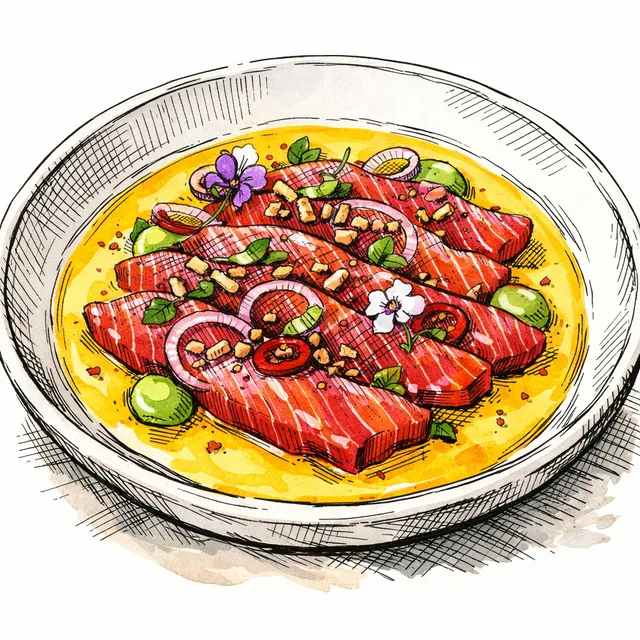
Mezcal & Hibiscus Cured Salmon Tiradito: Where Tokyo Meets Lima
I still remember sitting at a tiny cevicheria in Lima, watching the chef slice fish with the exact same reverence my mentors in Tokyo demanded. That was the moment I realized sashimi and ceviche share the same DNA, but tiradito is where they truly fall in love. This Mezcal and Hibiscus Cured Salmon Tiradito is my love letter to that epiphany. I take fatty sushi-grade salmon and give it a quick 45-minute cure in smoky mezcal, dried hibiscus, and shio koji. Why this works: The shio koji acts as a tenderizer and umami-amplifier, while the alcohol in the mezcal carries the fat-soluble flavor compounds of the hibiscus deep into the flesh without chemically cooking the protein like citrus would. The result is an incredibly fudgy piece of fish. We bathe it in a bright, fiery aji amarillo-yuzu emulsion that perfectly cuts the salmon's richness. What makes this special to me is how seamlessly these supposedly distant worlds bridge together. To make it your own, try swapping the mezcal for an earthy tequila or use a local citrus if yuzu is hard to find. Break the rules, trust your palate, and keep experimenting!
Featured Recipe
Mezcal & Hibiscus Cured Salmon Tiradito with Aji Amarillo-Yuzu Emulsion
Sashimi and ceviche share the same DNA, but tiradito is where they truly meet and fall in love. Here, I take fatty sushi-grade salmon and give it a 45-minute quick-cure in smoky mezcal, dried hibiscus, and shio koji. The result is a visually stunning, incredibly fudgy piece of fish swimming in a bright, fiery aji amarillo-yuzu emulsion.
Save a copy to your collection for editing
Timeline
Ingredients
- 12 oz sushi-grade salmon loin(skinless, pin bones removed, preferably belly or thick loin)
- 1/4 cup shio koji(liquid or paste)
- 2 tbsp mezcal(preferably espadin for that clean smoke)
- 1 tbsp dried hibiscus flowers(finely ground in a spice mill)
- 1 tbsp flaky sea salt(plus extra for finishing)
- 1/4 cup white quinoa(rinsed well)
- 2 tbsp neutral oil(grapeseed or avocado, for frying)
- 2 tbsp aji amarillo paste(Peruvian yellow chili paste)
- 2 tbsp yuzu juice(can substitute with equal parts lime and grapefruit if in a pinch)
- 1 tbsp white soy sauce(shiro shoyu; keeps the sauce color vibrant)
- 1 tbsp olive oil(high quality extra virgin)
- 1 whole serrano pepper(very thinly sliced into rings)
- 1 handful micro cilantro(or baby shiso leaves)
Instructions
- 1
In a small bowl, whisk together 1/4 cup shio koji, 2 tbsp mezcal, 1 tbsp dried hibiscus flowers, and 1 tbsp flaky sea salt to create a vibrant, thick curing paste.
5 min
Tip: Grinding the hibiscus finely ensures its fat-soluble pigments and tart flavor will penetrate the salmon quickly.
- 2
Place the 12 oz sushi-grade salmon loin on a small tray or in a glass dish. Coat the fish entirely with the hibiscus-mezcal cure, cover tightly with plastic wrap, and refrigerate for exactly 45 minutes.
45 min
Tip: Don't exceed 60 minutes or the fish will become too firm and the mezcal flavor will overpower the delicate salmon.
- 3
While the salmon cures, bring a small pot of water to a boil. Add the 1/4 cup white quinoa and simmer for 10 minutes until tender. Drain thoroughly in a fine-mesh sieve and pat dry with paper towels.
12 min
Tip: Drying the quinoa is crucial; any leftover moisture will cause dangerous splattering in the next frying step.
- 4
Heat 2 tbsp neutral oil in a small skillet over medium-high heat. Add the cooked, dried quinoa and shallow-fry, stirring constantly, until golden and crispy. Transfer to a paper towel-lined plate and season lightly with salt.
8 min
Tip: The popping sound will stop when the quinoa is crispy. Watch closely so it doesn't burn.
- 5
In a mixing bowl, combine 2 tbsp aji amarillo paste, 2 tbsp yuzu juice, and 1 tbsp white soy sauce. Whisk vigorously while slowly drizzling in 1 tbsp olive oil until the emulsion is smooth and glossy. Set aside in the fridge.
5 min
Tip: Using white soy sauce (shiro shoyu) adds intense umami without muddying that gorgeous bright yellow color of the aji amarillo.
- 6
Once the 45-minute mark hits, remove the salmon from the fridge. Gently rinse the cure off the fish under cold water, then pat completely dry with paper towels. Using your sharpest knife, slice the salmon against the grain into thin tiradito-style pieces.
5 min
Tip: Notice how the exterior has a beautiful ruby ring from the hibiscus, while the flesh feels dense and fudgy from the shio koji.
- 7
Fan the sliced salmon across a chilled plate. Spoon the aji amarillo-yuzu emulsion generously around and slightly over the fish. Garnish with the crispy quinoa, 1 whole serrano pepper slices, and 1 handful micro cilantro.
5 min
Tip: Serve immediately while the plate is cold but the fish is approaching room temperature for maximum flavor release.
Chef's Notes
Let's geek out for a second on why this specific cure works. Why alcohol and shio koji together? Alcohol, like the mezcal used here, acts as an incredible solvent. It pulls the non-water-soluble flavor compounds from the hibiscus and carries them deep into the lipid-rich flesh of the salmon. At the same time, the proteases in the shio koji are actively breaking down protein chains into amino acids (hello, glutamates and umami). The combination of the two, plus the salt drawing out excess moisture, creates a texture that is impossibly dense and fudgy in just 45 minutes. You're effectively chemically 'cooking' the exterior while intensely seasoning the interior.

Kenji Nakamura
Where Japanese precision meets global flavors
I trained in Tokyo for eight years, mastering the discipline of washoku—traditional Japanese cuisine. But I got restless. So I cooked my way through Southeast Asia, spent a year in Mexico City, and fell hard for the food of Peru. Now I see connections between cuisines that others miss: the umami in dashi and fish sauce, the heat in shishito and Szechuan peppercorns, the way Japanese technique can unlock flavors from any tradition. I'm always fermenting something.