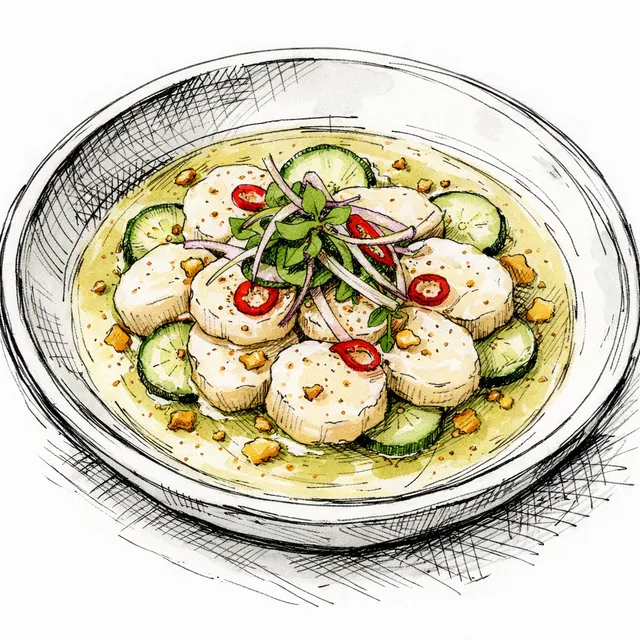
Miso Meets Mexico: The Science of Yuzu Scallop Aguachile
I was eating aguachile from a cart in Sinaloa, sweating through my t-shirt, when it hit me. The searing heat of the chilies and the sharp lime acid shared the exact same DNA as a delicate Japanese ponzu preparation—they just spoke at different volumes. That sweaty afternoon revelation birthed my White Miso & Yuzu Scallop Aguachile. It is a beautiful collision of Mexican street food and Japanese precision that I hold deeply close to my heart. We take sweet, raw sea scallops and 'cook' them for exactly four minutes in an electric, umami-rich broth of yuzu, serrano, and white miso, then finish them with smoky charred avocado. Why exactly four minutes? Here is where I have to geek out on the science. Scallop proteins denature rapidly in high acid. At three minutes, the center remains unpleasantly slippery; at seven minutes, the acid chemically overcooks the delicate flesh into a rubber eraser. Four minutes gives you a perfect, tender snap. The white miso acts as a magical buffer, mellowing the yuzu's aggressive bite while injecting a deep, fermented umami backbone. I keep jars of miso fermenting constantly for applications exactly like this. To make it your own, play with the heat! Swap the serrano for a fiery habanero, or even use a dash of Korean gochujang to bridge yet another culinary divide. Break the rules, trust your palate, and keep experimenting.
Featured Recipe
White Miso & Yuzu Scallop Aguachile
A collision of Mexican street food and Japanese precision. Sweet, raw sea scallops are "cooked" for exactly four minutes in an electric, umami-rich broth of yuzu, serrano, and white miso, then finished with smoky charred avocado.
Save a copy to your collection for editing
Timeline
Ingredients
- 1 lb dry-packed sea scallops(Sushi-grade. Must be dry-packed; wet-packed will water down the cure.)
- 1/4 cup yuzu juice(Bottled 100% yuzu juice is fine if fresh is unavailable)
- 1/4 cup fresh lime juice(Freshly squeezed)
- 1 tbsp white miso paste(Sweet white miso (shiro miso))
- 1 whole serrano chili(Stem removed. Remove seeds for a milder aguachile.)
- 1/2 cup fresh cilantro(Leaves and tender stems, loosely packed)
- 1 tsp toasted sesame oil
- 1 whole firm-ripe avocado(Halved and pitted)
- 1/2 whole Persian cucumber(Thinly sliced)
- 1/2 whole Granny Smith apple(Cut into brunoise (tiny dice))
- 1/2 tsp flaky sea salt(Like Maldon)
- 1/4 cup aguachile broth(Reserved from step 3)
Instructions
- 1
I always start with the broth. In a blender, combine 1/4 cup yuzu juice, 1/4 cup fresh lime juice, 1 tbsp white miso paste, 1 whole serrano chili, 1/2 cup fresh cilantro, and 1 tsp toasted sesame oil. Blend on high until screaming green and completely smooth. Set this aside. The miso is the secret here—it emulsifies the acidic juices and adds a hit of glutamic acid that bridges the gap between Tokyo and Sinaloa.
5 min
Tip: If your blender struggles with small volumes, add a splash of cold water, but try to avoid it to keep the acid sharp.
- 2
Take your 1 lb dry-packed sea scallops and slice them horizontally into 1/4-inch coins. Remove the tough crescent-shaped muscle on the side of the scallop if it's still attached.
3 min
Tip: Popping the scallops in the freezer for 10 minutes before slicing makes getting perfectly even coins much easier.
- 3
Here's where the science happens. Place the sliced scallops in a non-reactive glass or stainless bowl and pour over exactly half of your blended aguachile broth (reserve the rest). Set a timer for 4 minutes. Why 4 minutes? The citric acid denatures the scallop proteins, turning them opaque and snappy on the outside, while leaving the center buttery and raw. Go to 10 minutes and you're eating pencil erasers.
4 min
Tip: Toss the scallops gently halfway through the cure to ensure they cook evenly.
- 4
While the scallops cure, let's play with fire. Take your 1 whole firm-ripe avocado. Hit the cut side hard with a kitchen blowtorch until nicely charred and smoky. (If you don't have a torch, sear cut-side down in a ripping hot, dry cast iron skillet for 1 minute). Scoop out the flesh and dice it.
3 min
Tip: The charred avocado adds a mock-mezcal smokiness without muddying our pristine green broth.
- 5
Prep your textural garnishes quickly before the timer goes off. Very thinly slice your 1/2 whole Persian cucumber and brunoise (tiny dice) the 1/2 whole Granny Smith apple. The apple brings a malic acid tartness that plays beautifully with the citric acid of the yuzu.
2 min
- 6
Time to build. Use a slotted spoon to arrange the cured scallops on a chilled platter. Pour the reserved, un-diluted aguachile broth over the top. Scatter your charred avocado, cucumber slices, and green apple around the scallops. Finish with a generous pinch of 1/2 tsp flaky sea salt. Serve immediately.
2 min
Tip: Serve with tostadas, plantain chips, or crispy nori sheets.
Chef's Notes
My kitchen in the summer feels like a sauna, which is exactly why I developed this dish. When I need something cold, electric, and sharp, this is what I make. The key to this recipe is trusting the clock. The difference between a 4-minute cure and an 8-minute cure in high-acid environments is astronomical. Keep it brief, keep it cold, and don't skip the white miso—it's the invisible architect holding the whole flavor profile together.

Kenji Nakamura
Where Japanese precision meets global flavors
I trained in Tokyo for eight years, mastering the discipline of washoku—traditional Japanese cuisine. But I got restless. So I cooked my way through Southeast Asia, spent a year in Mexico City, and fell hard for the food of Peru. Now I see connections between cuisines that others miss: the umami in dashi and fish sauce, the heat in shishito and Szechuan peppercorns, the way Japanese technique can unlock flavors from any tradition. I'm always fermenting something.