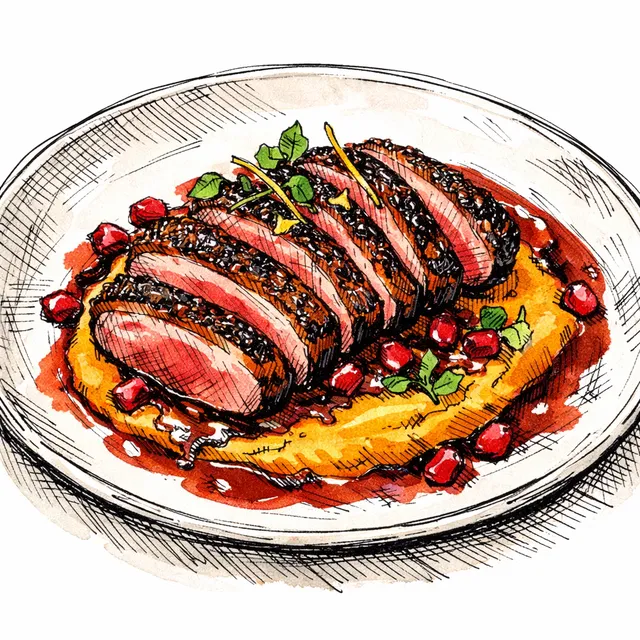
Morita and Kombu-Cured Seared Duck Breast
I first dreamt up this duck dish sitting in a bustling Oaxacan market while clutching a cup of spiced hot chocolate, thinking about the deep, smoky allure of chile morita. My mind immediately jumped to dashi, to kombu, to the umami backbone of my Tokyo training. Why not cure duck in both? The result is my Morita and Kombu-Cured Seared Duck Breast, served over a brown butter-kabocha silk and glossed with a pomegranate-yuzu jus. Curing the duck in pulverized morita, kombu, and sansho pepper draws out moisture while packing a dual punch of smoky heat and oceanic glutamate. When you render that skin down to paper-thin crispiness, magic happens. Here is my nerdy tip: do not rush the cure. Give it a solid four hours to let the kombu enzymes work their magic on the muscle fibers, breaking down proteins for maximum tenderness while building insane depth of flavor. Break the rules, play with the heat, and always keep something fermenting on your counter!
Featured Recipe
Morita & Kombu-Cured Seared Duck Breast with Brown Butter-Kabocha Silk & Pomegranate-Yuzu Jus
Plump duck breasts are cured in a pulverized blend of smoky chile morita, dried kombu, and tingly sansho before being gently rendered to paper-thin crispiness. Served over a velvety brown butter-kabocha squash purée and glossed with an umami-rich pomegranate pan jus, this dish bridges Tokyo's precision cooking with the vibrant depth of Oaxaca.
Save a copy to your collection for editing
Timeline
Ingredients
- 2 boneless duck breasts(roughly 7 to 8 oz each, skin-on)
- 5 g dried kombu(wiped clean and finely pulverized into powder in a spice grinder)
- 2 dried morita chiles(stemmed, seeded, and finely ground)
- 1 tsp sansho peppercorns(toasted and finely crushed (or Sichuan red peppercorns))
- 1 tbsp turbinado sugar
- 1.5 tbsp kosher salt(Diamond Crystal preferred)
- 1 lb kabocha squash(peeled, seeded, and cut into 1/2-inch cubes)
- 3 tbsp unsalted butter(split)
- 1.5 tbsp white miso(sweet shiro miso)
- 0.5 cup dashi broth(or low-sodium chicken broth)
- 2 stalks Tokyo negi(white and pale green parts only, cut into 1.5-inch batons (or large scallions))
- 4 oz chanterelle mushrooms(brushed clean, torn into bite-sized pieces)
- 1.5 tbsp pomegranate molasses
- 2 tbsp hon-mirin
- 1 tbsp fresh yuzu juice(or Meyer lemon juice)
- 1 shallot(minced finely)
- 1 whole shallot(minced)
Instructions
- 1
Grind the powdered 5 g dried kombu, 2 dried morita chiles, 1 tsp sansho peppercorns, 1 tbsp turbinado sugar, and 1.5 tbsp kosher salt together until well blended. Score the skin of the 2 boneless duck breasts in a tight 1/8-inch crosshatch pattern, cutting only through the fat layer without slicing into the flesh. Coat both sides of the duck generously with the cure, gently rubbing it into the crosshatch lines. Let cure uncovered on a wire rack set over a tray for 20 minutes at room temperature.
20 min
Tip: Scoring allows heat to penetrate and render out the thick fat layer evenly. Don't cut into the red meat, or precious juices will leak out.
- 2
While the duck cures, set a medium saucepan over medium heat with 0.5 cup dashi broth and the 1 lb kabocha squash cubes. Cover tightly and simmer until the squash is completely fork-tender and yielding, about 12 minutes.
12 min
Tip: Cutting the kabocha small ensures it cooks rapidly and steams evenly in the dashi without scorching.
- 3
In a small skillet over medium heat, melt 2 tbsp unsalted butter, swirling continuously until milk solids foam, brown, and release a hazelnut aroma, about 3 minutes. Remove from heat immediately. Transfer the cooked kabocha, remaining cooking liquid, browned butter, and 1.5 tbsp white miso into a blender. Purée on high until silky smooth. Return to the warm saucepan off the heat and keep covered.
5 min
Tip: The brown butter emulsion binds with the natural starch in the kabocha, eliminating the need for heavy cream while imparting rich roasted nut notes.
- 4
Rinse the surface cure off the 2 boneless duck breasts under a light trickle of cold water and pat thoroughly dry with paper towels. Place the duck breasts skin-side down in a cold, dry carbon-steel or cast-iron skillet. Set the heat to medium-low. Cook undisturbed as the fat slowly liquefies and bubbles, spooning off rendered fat every couple minutes to keep the skin shallowly submerged. Render until the skin is intensely crisp, deep mahogany, and paper-thin, about 11 minutes.
12 min
Tip: Starting in a completely cold skillet is the golden rule of duck cookery. It gives the dense subcutaneous fat time to melt out before the protein overcooks.
- 5
Flip the duck breasts flesh-side down and sear for 2 to 3 minutes, until an instant-read thermometer inserted into the thickest part registers 130°F (54°C) for medium-rare. Transfer the duck to a warm resting board skin-side up and let rest for 7 minutes.
7 min
Tip: Resting skin-side up maintains that glassy crunch while allowing muscle fibers to relax and reabsorb juices.
- 6
Pour out all but 1 tablespoon of rendered duck fat from the skillet. Return skillet to medium-high heat. Add 2 stalks Tokyo negi batons and 4 oz chanterelle mushrooms. Sear hard without moving for 2 minutes until charred at the edges, toss gently, cook for 1 more minute until tender, season with a pinch of salt, and transfer to a side plate.
3 min
Tip: Tokyo negi has high natural sugar content; searing it hard in rendered duck fat caramelizes the exterior while leaving the inner layers sweet and juicy.
- 7
In the same skillet over medium heat, add the 1 minced shallot and cook in the residual fat for 1 minute until fragrant. Deglaze the pan with 2 tbsp hon-mirin, scraping up all caramelized fond. Stir in 1.5 tbsp pomegranate molasses and simmer for 2 minutes until glossy and syrupy. Kill the heat, whisk in the remaining 1 tbsp unsalted butter and 1 tbsp fresh yuzu juice, plus any rested duck juices from the cutting board.
4 min
Tip: Mounting the sauce off the heat with cold butter emulsifies the glaze into a velvety pan jus with a mirror finish.
- 8
Slice each rested duck breast against the grain into 1/4-inch medallions. Spoon a swoosh of warm kabocha purée across each heated dinner plate. Fan the sliced duck over the purée, nestle the charred negi and chanterelles alongside, and drizzle the glossy pomegranate-yuzu jus across the duck and plate perimeter.
3 min
Tip: Slice with a single forward push of a sharp chef's knife rather than a sawing motion to keep the crispy skin bonded to the meat.
Chef's Notes
Why this works: Duck breast carries a tremendous amount of dense subcutaneous fat and mineral-rich, gamey iron. Quick-curing it in salt, kombu, and morita chile acts on two fronts: the salt and sugar draw out surface moisture via osmosis to supercharge skin crisping, while glutamic acid from the kombu bonds with nucleotides in the duck to multiply umami exponentially. The smoky, fruity morita chile cuts right through duck's rich gaminess, and sansho provides that signature citrus-tingling numbness that resets the palate between bites. Starting the duck in a dead-cold pan is the science of rendering: collagen softens gradually, giving liquid fat an escape route before the skin seizes up.

Kenji Nakamura
Where Japanese precision meets global flavors
I trained in Tokyo for eight years, mastering the discipline of washoku—traditional Japanese cuisine. But I got restless. So I cooked my way through Southeast Asia, spent a year in Mexico City, and fell hard for the food of Peru. Now I see connections between cuisines that others miss: the umami in dashi and fish sauce, the heat in shishito and Szechuan peppercorns, the way Japanese technique can unlock flavors from any tradition. I'm always fermenting something.