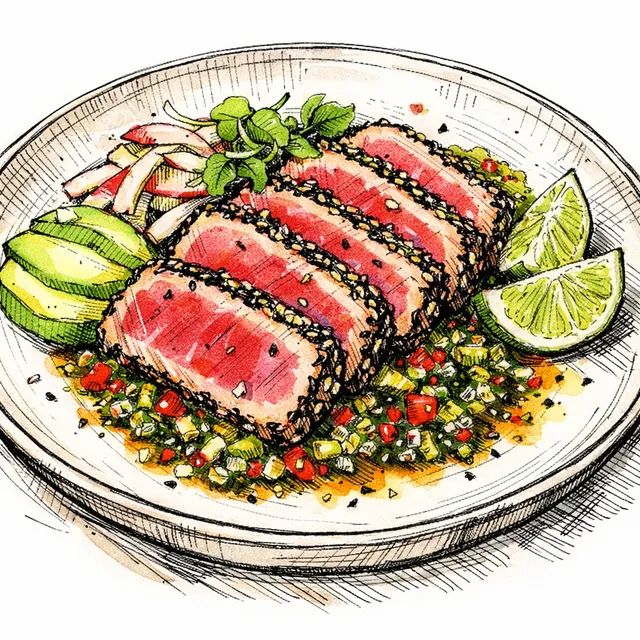
Nikkei Sesame-Seared Ahi Tuna with Yuzu-Rocoto Chimichurri
I still remember standing in a bustling cevicheria in Lima, watching the chef slice the catch-of-the-day with the exact same reverence my sushi master in Tokyo demanded. That shared DNA between Japanese tataki and Peruvian ceviche is where this Nikkei Sesame-Seared Ahi Tuna was born. This dish is my love letter to that cross-cultural connection. We are taking sushi-grade ahi and giving it a flash-sear—exactly 30 seconds per side—to create a toasted, nutty sesame crust while keeping the center cool and raw. But the real magic happens with the Yuzu-Rocoto Chimichurri. Rocoto peppers have this incredible, almost fruity heat that plays beautifully with the floral acidity of Japanese yuzu. Why this works: The toasted sesame crust provides the Maillard reaction umami that raw fish lacks, while the chimichurri's sharp acidity cuts right through the tuna's rich oils, balancing every bite. Make it your own: Don't stress if you can't find fresh rocoto peppers. I have swapped in a fermented habanero mash—I always have a jar bubbling away on my counter—mixed with a little bell pepper for sweetness, and it absolutely sings. Just remember to slice against the grain—treat the fish with precision, then let the global flavors go wild!
Featured Recipe
Nikkei Sesame-Seared Ahi Tuna with Yuzu-Rocoto Chimichurri
When Tokyo precision meets Lima's vibrant coastal heat, you get this dish. We're lightly searing sushi-grade ahi tuna, then applying meticulous knife work to let it carry a bright, ferociously flavorful yuzu and rocoto pepper chimichurri.
Save a copy to your collection for editing
Timeline
Ingredients
- 1.5 lbs sushi-grade ahi tuna saku block(Look for a uniform rectangular block (saku) for the best slicing geometry)
- 1 tbsp soy sauce(Used as a binder for the sesame crust)
- 1/4 cup mixed black and white sesame seeds(Toasted)
- 1 lb fingerling potatoes(A nod to the thousands of potato varieties in Peru)
- 3 tbsp neutral oil(Grapeseed or avocado oil, divided (2 tbsp for potatoes, 1 tbsp for searing))
- 1/2 cup fresh cilantro(Finely chopped, stems included for flavor)
- 1/4 cup fresh shiso leaves(Finely chopped. If you can't find shiso, use mint with a pinch of cumin)
- 2 scallions(Finely minced)
- 1 tbsp rocoto paste(Peruvian red chili paste; substitute with sambal oelek if absolutely necessary)
- 2 tbsp yuzu juice(100% pure yuzu juice)
- 1 tbsp rice vinegar(Unseasoned)
- 1 clove garlic(Grated on a microplane)
- 1/4 cup extra virgin olive oil(High quality, fruity)
- 1 tbsp toasted sesame oil(For aromatic depth)
- 1 tsp flaky sea salt(Maldon or similar, to finish)
Instructions
- 1
Preheat your oven to 425°F (220°C). Bring a medium pot of generously salted water to a boil for the potatoes.
10 min
Tip: Always salt your potato water until it tastes like the ocean. It's your only chance to season the inside of the potato.
- 2
Add 1 lb fingerling potatoes to the boiling water. Cook until just fork-tender, which should take about 15 minutes depending on their size.
15 min
Tip: Don't overboil them or they will disintegrate when smashed. You want them just yielding.
- 3
While the potatoes boil, let's talk acid balancing and build the chimichurri. In a bowl, combine 1/2 cup fresh cilantro, 1/4 cup fresh shiso leaves, 2 scallions, and 1 clove garlic. Stir in 1 tbsp rocoto paste, 2 tbsp yuzu juice, and 1 tbsp rice vinegar. The sharp, floral yuzu and mellow, sweet rice vinegar create a dual-acid structure. Whisk in 1/4 cup extra virgin olive oil and 1 tbsp toasted sesame oil. Let this sit so the acids lightly 'cook' the raw garlic and herbs.
10 min
Tip: Letting the chimichurri macerate is critical. The acid softens the harshness of the raw garlic and blooms the capsaicin in the rocoto.
- 4
Drain the cooked potatoes and place them on a heavy baking sheet. Using the bottom of a heavy glass, gently smash each potato until flattened but still intact. Drizzle with 2 tbsp neutral oil, season with salt, and roast in the oven until deeply golden and crispy.
20 min
Tip: Let the potatoes steam off for a minute after draining before smashing—the drier they are, the crispier they get.
- 5
While the potatoes roast, prep the tuna. Pat the 1.5 lbs sushi-grade ahi tuna saku block perfectly dry with paper towels. Lightly brush all sides with 1 tbsp soy sauce—this acts as an umami-rich glue. Pour the 1/4 cup mixed black and white sesame seeds onto a plate and press the tuna into the seeds to coat evenly on all sides.
5 min
Tip: Drying the fish first ensures the soy sauce coats evenly and doesn't just run off.
- 6
Heat the remaining 1 tbsp neutral oil in a carbon steel or cast-iron skillet over screaming high heat. Once the oil begins to smoke lightly, add the crusted tuna. Sear for exactly 30 seconds per side. Remove immediately to a cutting board.
3 min
Tip: Do not walk away. You want a millimeter of cooked white meat and a completely rare, ruby-red center.
- 7
Now for the precision slicing. Using your sharpest, longest knife (a Yanagiba is ideal, but a sharp chef's knife works), find the grain of the tuna. You must cut against it. Angle your blade at 45 degrees and, using one long, smooth pulling motion, slice the tuna exactly 1/4-inch thick. Do not saw back and forth.
2 min
Tip: Cutting exactly 1/4-inch thick on a bias maximizes the surface area of the fish. This is crucial because it gives our acidic chimichurri more area to cling to, perfectly balancing the bite.
- 8
To plate, lay down a bed of the crispy smashed potatoes. Fan out your precision-sliced tuna over the top. Spoon the macerated yuzu-rocoto chimichurri generously over the fish, ensuring the oils pool slightly on the plate. Finish with 1 tsp flaky sea salt.
2 min
Tip: Plate while the potatoes are hot and the tuna is cool. That temperature contrast is a beautiful thing.
Chef's Notes
When I was cooking in Lima, I fell in love with traditional chimichurri, but my Japanese brain couldn't help but tinker. Acid balancing is the invisible architecture of any dish. Here, we're using a 2:1 ratio of acid to fat. The yuzu brings an aggressive, floral punch while the rice vinegar offers a mellow, sweet baseline. This dual-acidity easily cuts through the richness of the olive oil, the nuttiness of the sesame, and the dense meatiness of the ahi tuna. Combine that with proper knife technique—cutting against the grain to ensure a tender chew—and you elevate a simple seared tuna into something profoundly balanced.

Kenji Nakamura
Where Japanese precision meets global flavors
I trained in Tokyo for eight years, mastering the discipline of washoku—traditional Japanese cuisine. But I got restless. So I cooked my way through Southeast Asia, spent a year in Mexico City, and fell hard for the food of Peru. Now I see connections between cuisines that others miss: the umami in dashi and fish sauce, the heat in shishito and Szechuan peppercorns, the way Japanese technique can unlock flavors from any tradition. I'm always fermenting something.