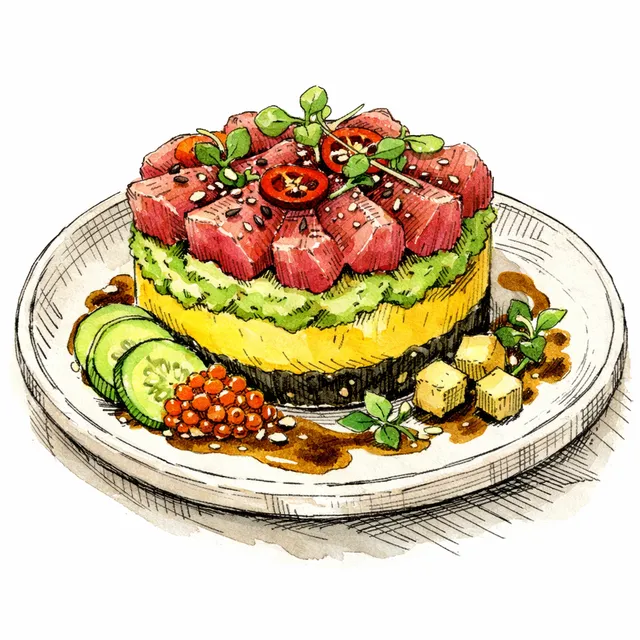
The Neon Purple Causa: Okinawan Sweet Potato & Maracuya-Cured Ahi
The first time I walked through Lima's Surquillo market, I was struck by the sheer volume of potato varieties. It reminded me of wandering through Tokyo's Tsukiji market, but with tubers instead of tuna. That memory sparked this Okinawan Causa Nikkei. I swapped the traditional yellow Peruvian potato for Okinawan purple sweet potatoes, bringing a deeper earthiness and a neon hue that absolutely pops. Why this works: The real geek-out moment is the maracuya (passionfruit) and yuzu cure for the ahi tuna. We do a precise 10-minute acid cure. Passionfruit is fiercely acidic. Letting the tuna sit for exactly 10 minutes denatures the exterior proteins, giving you a satisfying snap, while completely protecting that buttery raw center. If you leave it for 20 minutes, it turns to mush; 3 minutes, and you miss the textural contrast. This recipe is special to me because it is the exact point where Peruvian technique meets Japanese precision. Make it your own: Fold a little fermented gochujang into the potato base if you want some Korean heat—I always keep a jar bubbling on my counter. Break the rules, trust the timer, and taste the world on one plate.
Featured Recipe
Okinawan Causa Nikkei with Maracuya-Cured Ahi Tuna
Causa is Peru's brilliant cold potato appetizer, but I'm giving it a Tokyo spin with vibrant Okinawan sweet potatoes. The real magic here is the ahi tuna—it's 'cooked' entirely by the fierce acidity of passionfruit and yuzu. We use a precise 10-minute acid cure that denatures the exterior proteins for a satisfying snap, while protecting the buttery raw center. It's where Peruvian technique meets Japanese precision.
Save a copy to your collection for editing
Timeline
Ingredients
- 1 lb Okinawan purple sweet potatoes(Peeled and cut into 1-inch cubes. Can substitute Yukon Gold if unavailable.)
- 2 tbsp Aji Amarillo paste(The backbone of Peruvian heat and fruitiness)
- 3 tbsp Yuzu juice(Divided (1 tbsp for causa, 2 tbsp for cure). Fresh lime works in a pinch.)
- 1 tsp Toasted sesame oil
- 1 tsp Kosher salt(Plus more to taste)
- 12 oz Sashimi-grade Ahi Tuna(Cut into uniform 1/2-inch cubes)
- 1/4 cup Unsweetened passionfruit purée(Also known as maracuya)
- 1 tbsp Usukuchi (light soy sauce)(Lighter in color but saltier than dark soy; won't muddy the vibrant cure)
- 1 tbsp Shio Koji(Fermented rice malt. Crucial for accelerating the breakdown of proteins.)
- 1 tsp Fresh ginger(Finely grated to a paste)
- 1 medium Hass avocado(Peeled, pitted, and thinly sliced)
- 2 tbsp Crispy toasted quinoa(For crunch)
- 1/4 cup Fresh shiso leaves(Chiffonade (finely shredded))
Instructions
- 1
Set up a steamer basket over boiling water. Steam the peeled and cubed 1 lb Okinawan purple sweet potatoes until totally tender and yielding to a fork.
15 min
Tip: Okinawan potatoes are denser than standard sweet potatoes. Don't rush the steam; you want them completely soft to achieve a silky mash.
- 2
While the potatoes steam, whisk together the 1/4 cup Unsweetened passionfruit purée, 2 tbsp Yuzu juice, 1 tbsp Usukuchi, 1 tbsp Shio Koji, and 1 tsp Fresh ginger in a glass or ceramic bowl. Place in the fridge to chill.
5 min
Tip: Never use a metal bowl for acid-heavy marinades; it can impart a metallic taste to the delicate fish.
- 3
Using your sharpest knife, cut the 12 oz Sashimi-grade Ahi Tuna into uniform 1/2-inch cubes. Keep the tuna tightly covered in the refrigerator until exactly 10 minutes before serving.
5 min
Tip: Uniform cuts equal uniform acid-cooking. If your cubes are jagged, the thinner edges will turn rubbery.
- 4
Transfer the steamed 1 lb Okinawan purple sweet potatoes to a mixing bowl while piping hot. Mash thoroughly, then aggressively fold in the 2 tbsp Aji Amarillo paste, 1 tbsp Yuzu juice, 1 tsp Toasted sesame oil, and 1 tsp Kosher salt. Press plastic wrap directly onto the surface and place in the freezer to flash-chill.
10 min
Tip: Mashing while hot is non-negotiable—it prevents the starches from seizing and becoming gummy.
- 5
Prep your garnishes: thinly slice the 1 medium Hass avocado and chiffonade the 1/4 cup Fresh shiso leaves. Have your 2 tbsp Crispy toasted quinoa ready at your workstation.
5 min
Tip: Stack the shiso leaves, roll them tightly like a cigar, and slice across with a razor-sharp knife to avoid bruising the herbs.
- 6
The crucial step: Drop the 12 oz Sashimi-grade Ahi Tuna into the chilled passionfruit-yuzu cure. Toss gently to coat every surface. Set a timer for EXACTLY 10 minutes.
10 min
Tip: Passionfruit and yuzu have a pH around 2.7. The moment the fish hits this bath, the myosin proteins on the surface begin to unravel and re-link, creating an opaque, 'cooked' layer. Going past 10 minutes squeezes out moisture and turns the fish chalky.
- 7
Place a 3-inch ring mold in the center of a chilled plate. Pack a 1-inch layer of the chilled causa base into the bottom. Fan out a layer of 1 medium Hass avocado slices over the potato. Using a slotted spoon, lift the acid-cooked tuna from the cure and pack it gently on top of the avocado. Carefully lift the ring mold away.
5 min
Tip: If you don't have a ring mold, you can cut both ends off an empty, cleaned tuna can.
- 8
Spoon a teaspoon of the remaining cure over the tuna to dress it. Garnish the top generously with the 2 tbsp Crispy toasted quinoa and a shower of 1/4 cup Fresh shiso leaves. Serve immediately.
2 min
Tip: The contrast between the cold, dense potato, the creamy avocado, and the sharp, snappy acid-cooked tuna is everything.
Chef's Notes
Let's geek out for a second about acid-cooking. When we talk about 'cooking' fish without heat, we are talking about denaturing proteins. A high-acid bath (like passionfruit and yuzu) forces the tightly bundled protein networks to loosen up and form new bonds, turning the flesh firm and opaque. Why only 10 minutes? If you leave the tuna in too long, those new bonds tighten too much, wringing the water out of the fish and leaving you with rubber. But here's my secret weapon: Shio Koji. The enzymes in the fermented rice malt kickstart the breakdown of proteins into amino acids instantly. You get the snappy texture of a perfect acid-cure, amplified by a massive hit of savory umami in record time.

Kenji Nakamura
Where Japanese precision meets global flavors
I trained in Tokyo for eight years, mastering the discipline of washoku—traditional Japanese cuisine. But I got restless. So I cooked my way through Southeast Asia, spent a year in Mexico City, and fell hard for the food of Peru. Now I see connections between cuisines that others miss: the umami in dashi and fish sauce, the heat in shishito and Szechuan peppercorns, the way Japanese technique can unlock flavors from any tradition. I'm always fermenting something.