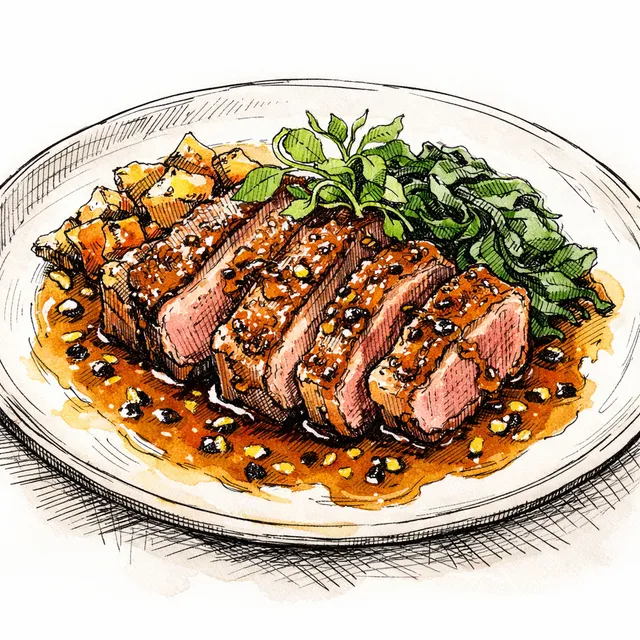
Pan-Seared Duck Breast with Maracuyá-Tamari Pan Reduction
When I was cooking in Lima, I became obsessed with maracuyá—Peruvian passion fruit. Its aggressive, tropical acidity is practically begging to cut through rich fats. That realization hit me while staring at a bubbling pan of duck fond in my tiny apartment kitchen, wondering what would happen if I swapped traditional orange sauce for something with a bit more punch. The result is this Pan-Seared Duck Breast with Maracuyá-Tamari Pan Reduction. Why does this work? Duck fat is heavy and luxurious; the organic acids in the passion fruit wake up your palate, while aged tamari and sake bridge the gap between French technique, Japanese umami, and Peruvian vibrance. Start your duck in a cold pan to render that fat out slowly until the skin shatters like glass. Then, deglaze with sake, ají amarillo paste, and our secret weapon: passion fruit pulp. Want to make it your own? Toss in a spoonful of homemade gochujang if you want a deeper, smoky heat. Get nerdy with your sear, break the classic French rules, and let's make something unforgettable.
Featured Recipe
Pan-Seared Duck Breast with Maracuyá-Tamari Pan Reduction
Crisp-skinned duck breast seared gently from a cold pan meets the punchy, high-voltage acidity of Peruvian maracuyá (passion fruit). Deglazing the pan's caramelized duck fond with sake, ají amarillo, and tamari creates a glossy, mouth-watering reduction that cuts right through rich duck fat.
Save a copy to your collection for editing
Timeline
Ingredients
- 2 boneless duck breasts(about 1 lb total, skin patted thoroughly dry)
- 1 1/2 tsp kosher salt(divided)
- 1/2 tsp freshly cracked black pepper(divided)
- 1 large shallot(finely minced (about 1/4 cup))
- 1 tbsp fresh ginger(peeled and finely grated on a microplane)
- 1 1/2 tbsp ají amarillo paste(Peruvian yellow chili paste)
- 1/3 cup dry junmai sake(for deglazing)
- 1/2 cup unsweetened passion fruit pulp(frozen pulp thawed, or fresh strained juice)
- 2 tbsp tamari(or dark Japanese soy sauce)
- 1 tbsp mirin(hon-mirin preferred)
- 1/3 cup low-sodium chicken or duck stock(unsalted or low-sodium)
- 2 tbsp cold unsalted butter(cubed into 4 pieces)
- 1 tsp fresh lime juice(freshly squeezed)
- 2 stalks scallions(green tops thinly sliced on a bias for garnish)
Instructions
- 1
Using a sharp knife, score the skin of 2 boneless duck breasts in a fine 1/8-inch diamond crosshatch pattern, cutting just through the fat layer without piercing the flesh. Season both sides evenly with 1 tsp kosher salt and 1/4 tsp freshly cracked black pepper.
5 min
Tip: Keeping the duck cold while scoring prevents dragging the blade against the fat, making clean, razor-thin lines much easier.
- 2
Place the scored breasts skin-side down into an unheated, dry 10-inch stainless steel or cast-iron skillet. Set the burner to medium-low. Allow the skin to slowly render out its fat over 9-10 minutes, periodically tilting the pan and spooning off excess fat into a heatproof bowl. When the skin is mahogany-brown and brittle-crisp, flip and cook the flesh side for 2-3 minutes, until an instant-read thermometer reads 130°F for medium-rare.
12 min
Tip: Starting in a cold pan gives the subcutaneous fat time to melt out before the delicate breast meat overcooks.
- 3
While the duck is gently rendering, mince 1 large shallot, grate 1 tbsp fresh ginger, and measure out 1 1/2 tbsp ají amarillo paste, 1/3 cup dry junmai sake, 1/2 cup unsweetened passion fruit pulp, 2 tbsp tamari, 1 tbsp mirin, and 1/3 cup low-sodium chicken or duck stock so everything is ready by the stove.
6 min
Tip: Mise en place is essential for pan sauces; reduction moves quickly once the pan is hot and deglazed.
- 4
Transfer the seared duck breasts to a cutting board fitted with a wire rack, resting them skin-side up for 7-8 minutes so the muscle fibers relax and retain their juices.
8 min
Tip: Resting skin-side up on a rack keeps the crust from turning soggy in pooling juices.
- 5
Pour off all rendered duck fat from the skillet, leaving just 1 tablespoon in the pan with all the browned fond. Place the pan over medium heat, add the minced shallot and grated ginger, and sweat for 1 minute. Stir in the ají amarillo paste and cook for 1 minute until fragrant and rust-colored.
2 min
Tip: Save the excess rendered duck fat in a jar in your fridge—it's pure liquid gold for roasting potatoes.
- 6
Pour in 1/3 cup dry junmai sake, scraping up all the sticky, caramelized bits from the bottom of the pan with a wooden spoon. Add 1/2 cup unsweetened passion fruit pulp, 2 tbsp tamari, 1 tbsp mirin, and 1/3 cup low-sodium chicken or duck stock. Bring to a vigorous boil over medium-high heat and reduce by half until the bubbles become thick and glossy, about 4-5 minutes.
5 min
Tip: The high sugar and acid content in maracuyá accelerates reduction, so watch closely to prevent scorching.
- 7
Remove the skillet from heat. Swirl in 2 tbsp cold unsalted butter one cube at a time, whisking continuously until melted and emulsified into a glossy, velvety nappe consistency. Stir in 1 tsp fresh lime juice, remaining 1/2 tsp kosher salt, and remaining 1/4 tsp freshly cracked black pepper.
2 min
Tip: Pulling the pan completely off the heat before mounting with butter prevents the emulsion from breaking and turning greasy.
- 8
Slice the rested duck breasts against the grain into 1/4-inch thick medallions. Spoon the maracuyá-tamari pan reduction onto warm plates, arrange the duck slices over the sauce, and scatter 2 stalks scallions over top.
3 min
Tip: Spoon the reduction under the duck rather than pouring it over the skin to preserve every bit of that shatter-crisp crunch.
Chef's Notes
Why this works: Duck breast has a thick layer of subcutaneous fat that can easily turn rubbery if seared too aggressively. By starting the breast in a cold, unheated pan, we allow the heat to gradually liquefy and render out the fat, crispening the skin like pork crackling without overcooking the lean meat underneath. The pan sauce leverages classic Nikkei balance: passion fruit delivers intense citric and malic acids that break through duck grease, while tamari and the fond supply heavy glutamates, and ají amarillo adds fruity, sunny warmth.

Kenji Nakamura
Where Japanese precision meets global flavors
I trained in Tokyo for eight years, mastering the discipline of washoku—traditional Japanese cuisine. But I got restless. So I cooked my way through Southeast Asia, spent a year in Mexico City, and fell hard for the food of Peru. Now I see connections between cuisines that others miss: the umami in dashi and fish sauce, the heat in shishito and Szechuan peppercorns, the way Japanese technique can unlock flavors from any tradition. I'm always fermenting something.