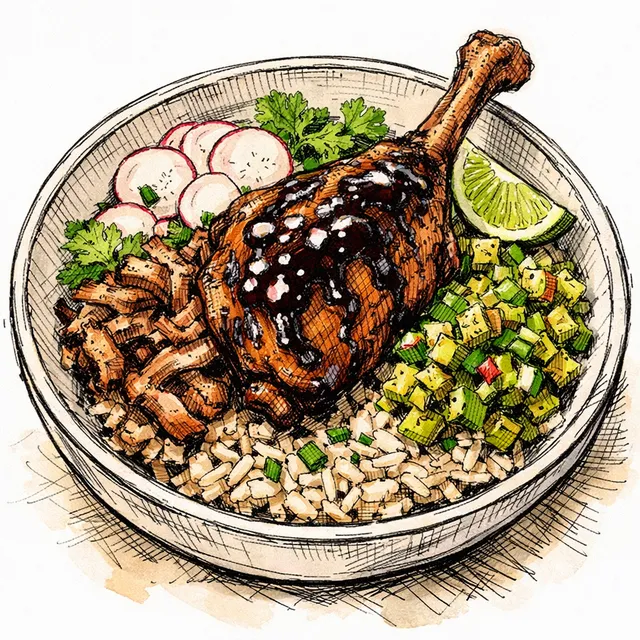
Pan-Seared Duck Leg Carnitas Bowl with Black Garlic-Tamarind Glaze & Charred Tomatillo-Yuzu Kosho Relish
Have you ever stared at a Mexican carnitas taco and wondered what happens if you swap the pork for duck and lean hard into Japanese and Southeast Asian umami? I did, and it changed my weeknight cooking forever. While cooking in Oaxaca years ago, I fell in love with the technique of slow-simmering meats in their own fat until tender. Back in my Tokyo kitchen, I started applying that exact method to duck legs, but seasoning them with star anise and citrus peel before finishing them in a screaming-hot pan for that addictive crunch. Why does this work? Duck fat renders down and fries the shredded meat just like pork, but its natural richness demands a heavy dose of acid and funk to balance it out. That is where my black garlic-tamarind glaze and charred tomatillo-yuzu kosho relish come in. The tamarind brings a sharp fruitiness, black garlic adds deep molasses notes, and the fermented yuzu kosho cuts right through the richness with bright citrus heat. Spoon it all over fluffy jasmine rice and watch it disappear. Tip for making it your own: don't toss that leftover duck fat! Strain it and use it to roast your potatoes tomorrow. Rules are meant to be broken, but great fat is meant to be saved.
Featured Recipe
Pan-Seared Duck Leg Carnitas Bowl with Black Garlic-Tamarind Glaze & Charred Tomatillo-Yuzu Kosho Relish
Melt-in-your-mouth duck leg carnitas are shredded and pan-seared in rendered fat until ultra-crispy, served over jasmine rice with a dark, sticky black garlic-tamarind glaze and a smoky, fermented citrus-tomatillo relish.
Save a copy to your collection for editing
Timeline
Ingredients
- 4 whole Duck legs(about 2.5 lbs total)
- 1.5 tbsp Kosher salt
- 0.5 cup Sake(Japanese cooking sake)
- 1 cup Water
- 2 whole Star anise
- 1 2-inch piece Fresh ginger(sliced)
- 1 tbsp Duck fat or neutral oil(for pan-searing)
- 2 tbsp Tamarind paste
- 1.5 tbsp Black garlic paste
- 1 tbsp Red miso paste
- 2 tbsp Mirin
- 1 tbsp Soy sauce
- 1 tbsp Honey
- 4 medium Tomatillos(husked and halved)
- 1 tsp Yuzu kosho(green yuzu kosho preferred)
- 2 tbsp Lime juice(freshly squeezed)
- 0.5 cup Fresh cilantro(finely chopped)
- 4 cups Cooked jasmine rice(warm)
- 4 medium Radishes(thinly sliced for garnish)
- 2 tbsp tamarind glaze(Mentioned in step 6 but not in ingredient list. Appears to be the mixture from step 4.)
Instructions
- 1
Season 4 whole Duck legs with 1.5 tbsp Kosher salt. Place duck legs, 0.5 cup Sake, 1 cup Water, 2 whole Star anise, and 1 2-inch piece Fresh ginger into a heavy Dutch oven over medium-high heat. Bring to a simmer, cover tightly, reduce heat to low, and cook for 35 minutes until duck meat is very tender and easily pulls from the bone.
35 min
Tip: Gentle simmering tenderizes the collagen-rich leg meat without drying out the muscle fibers before our high-heat pan-sear.
- 2
Heat a dry cast-iron skillet over high heat. Place 4 medium Tomatillos cut-side down and cook for 10 minutes, flipping once, until blistered and deeply charred on both sides.
10 min
Tip: Deep charring caramelizes natural sugars in the tomatillos, balancing their sharp tartness with smoky depth.
- 3
Roughly chop the charred tomatillos and combine in a medium bowl with 1 tsp Yuzu kosho, 2 tbsp Lime juice, and 0.5 cup Fresh cilantro. Stir well to create a chunky relish and set aside.
5 min
Tip: Yuzu kosho provides salted, fermented citrus floral notes and chili heat that effortlessly cuts duck fat.
- 4
In a small saucepan over medium-low heat, whisk together 2 tbsp Tamarind paste, 1.5 tbsp Black garlic paste, 1 tbsp Red miso paste, 2 tbsp Mirin, 1 tbsp Soy sauce, and 1 tbsp Honey. Warm for 5 minutes while whisking until smooth, glossy, and slightly reduced.
5 min
Tip: Black garlic adds a molasses-balsamic funk, while tamarind brings vibrant sourness to balance the umami miso base.
- 5
Transfer duck legs from broth to a cutting board. Once cool enough to handle, discard bones and shred meat into medium-sized clusters.
5 min
Tip: Keep the shredded clusters somewhat coarse so they develop crunchy crisp edges without drying out entirely.
- 6
Heat a skillet over high heat with 1 tbsp Duck fat or neutral oil. Spread shredded duck meat across the pan in a single layer. Press down gently with a spatula and let pan-sear undisturbed for 4 minutes until the bottom layer forms a crispy, golden-brown crust. Toss gently, cook 3 more minutes, then toss with 2 tbsp of the prepared Tamarind Glaze right in the pan.
8 min
Tip: Avoid crowding or constantly stirring the pan! Leaving the duck undisturbed is crucial for developing that intense pan-seared carnitas texture.
- 7
Divide 4 cups Cooked jasmine rice into 4 serving bowls. Spoon crispy pan-seared duck carnitas over rice, glaze with remaining Tamarind Glaze, spoon over Charred Tomatillo-Yuzu Kosho Relish, and garnish with 4 medium Radishes.
2 min
Tip: Serve immediately while the pan-seared duck edges are super crisp!
Chef's Notes
Why this works: Duck legs are packed with heavy connective collagen that needs liquid heat to breakdown. By poaching them first with sake, ginger, and star anise, we convert collagen into rich gelatin. Once shredded and hit with extreme pan heat, those gelatin-and-fat-coated meat shreds trigger intense Maillard crisping—producing classic Michoacán carnitas texture with deep East Asian aromatics!

Kenji Nakamura
Where Japanese precision meets global flavors
I trained in Tokyo for eight years, mastering the discipline of washoku—traditional Japanese cuisine. But I got restless. So I cooked my way through Southeast Asia, spent a year in Mexico City, and fell hard for the food of Peru. Now I see connections between cuisines that others miss: the umami in dashi and fish sauce, the heat in shishito and Szechuan peppercorns, the way Japanese technique can unlock flavors from any tradition. I'm always fermenting something.